Contents6 sections
Braze (Nasdaq: BRZE) sells a customer engagement platform: software that lets consumer brands send push notifications, in-app messages, emails, SMS and WhatsApp messages based on what each customer is doing right now. Most of its revenue comes from annual subscriptions. On October 20, 2026, Salesforce agreed to buy Braze for $47.50 per share in cash, and the stock jumped more than 50% in a day. From that point, the main driver of BRZE stock shifted from quarterly SaaS metrics to whether the deal closes on its stated terms. This guide uses official company releases, as of October 2026, to explain the business, the numbers investors watch and the risks while the acquisition is pending.
What Braze does and who uses it
Braze was founded in New York in 2011 and is led by co-founder and CEO Bill Magnuson. Its customers are mostly business-to-consumer companies that talk to large audiences through apps and websites. Salesforce's announcement names Canva, Dairy Queen, Equinox, Instacart, Urban Outfitters and Venmo among roughly 2,770 customers. Braze says it has 15 offices across the Americas, EMEA and Asia-Pacific.
The product ingests event streams, such as an app open, a search or an abandoned cart, keeps each customer profile updated in real time and decides which message to send, on which channel and when. Marketers design journeys in a tool called Canvas. BrazeAI features, including Operator, Agent Console and Decisioning Studio, help tune content, offers, channels and timing. Salesforce described the system as a cloud-native, event-streaming architecture optimized for high-volume, real-time consumer engagement. In practice, that puts Braze up against marketing clouds and email-first tools in the broader marketing automation market.
How Braze makes money
In the fiscal second quarter of 2027, which ended July 31, 2026, Braze reported revenue of $227.2 million. Subscription revenue was $207.7 million, about 91% of the total, and professional services and other revenue was $19.6 million. Contract values usually rise as customers send more messages, add channels or adopt AI features, so expansion inside existing accounts matters as much as new logos. Note that Braze's fiscal year ends January 31, so fiscal 2027 mostly overlaps calendar 2026.
Braze SaaS metrics to read in each earnings report
Subscription software companies are often valued on the size and durability of recurring revenue rather than current profit. The table below collects the metrics Braze reports every quarter, using its September 8, 2026 release.
Revenue
- Quarter ended July 31, 2026
- $227.2M
- Year earlier
- $180.1M
- What it tells you
- Up 26.2%, driven by new customers, upsells and renewals
Subscription revenue
- Quarter ended July 31, 2026
- $207.7M
- Year earlier
- $171.8M
- What it tells you
- The recurring core of the business
Dollar-based net retention (all, trailing 12 months)
- Quarter ended July 31, 2026
- 110%
- Year earlier
- 108%
- What it tells you
- Existing customers expanded on balance
Customers with ARR of $500K+
- Quarter ended July 31, 2026
- 361
- Year earlier
- 282
- What it tells you
- Large-customer net retention was 112%
Total customers
- Quarter ended July 31, 2026
- 2,789
- Year earlier
- 2,422
- What it tells you
- Pace of new logo wins
Remaining performance obligations
- Quarter ended July 31, 2026
- $1,092.5M
- Year earlier
- n/a
- What it tells you
- $691.1M expected within 12 months
Non-GAAP gross margin
- Quarter ended July 31, 2026
- 68.6%
- Year earlier
- 69.3%
- What it tells you
- Watch delivery costs as volume grows
GAAP operating loss
- Quarter ended July 31, 2026
- $18.1M
- Year earlier
- $38.8M
- What it tells you
- Includes $35.7M of stock-based compensation
Free cash flow
- Quarter ended July 31, 2026
- $21.7M
- Year earlier
- $3.5M
- What it tells you
- Can swing with payment timing
Dollar-based net retention compares the annual recurring revenue (ARR) from a cohort of customers 12 months ago with what the same cohort pays today. Above 100% means expansion outweighed churn and downgrades; new customers are excluded. Braze calculates it as a weighted average of month-end values over the trailing 12 months, so the figure moves slowly and lags turning points. For fiscal 2027, the company guided to revenue of $910 million to $913 million and non-GAAP operating income of $75.5 million to $76.5 million.
Braze will likely keep reporting quarterly results while the deal is pending. You can track the next report date on the theddari earnings calendar and confirm it on the Braze investor relations site.

The Salesforce Braze acquisition: terms and stock reaction
According to Salesforce's announcement, the definitive agreement values Braze at about $5.66 billion in enterprise value, with Braze Class A holders receiving $47.50 per share in cash. Closing is expected in Salesforce's fiscal 2028, which runs from February 2027 to January 2028, and requires Braze shareholder approval and regulatory approvals. Salesforce plans to use Braze's real-time engagement and AI decisioning to strengthen Marketing Cloud's cross-channel personalization alongside Data 360, Customer 360 and Agentforce.
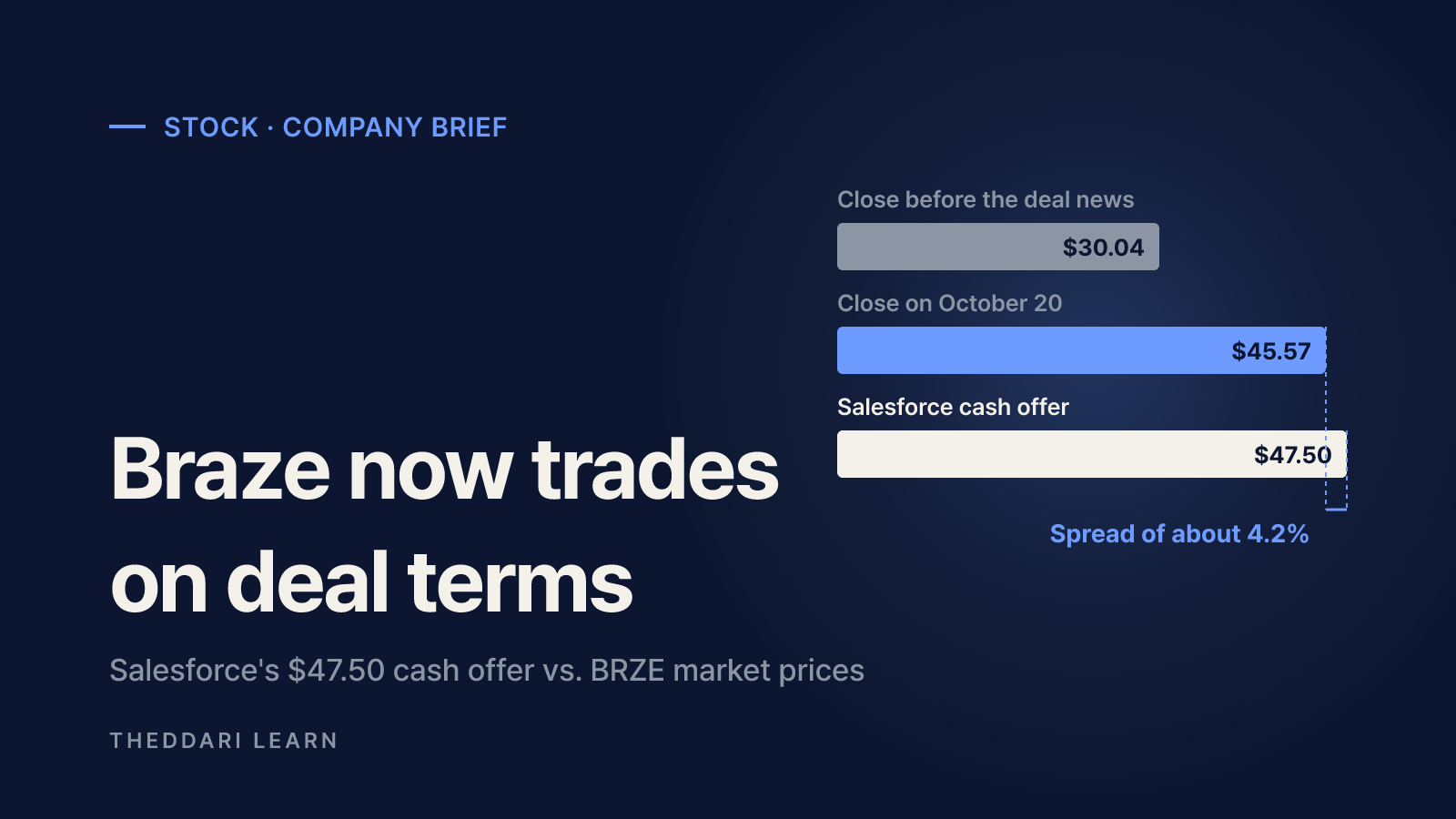
StockStory reported that the price is a 58.1% premium to the prior close of $30.04 and that Braze's 8-K describes a $300 million termination fee payable by Salesforce and a $191.39 million fee payable by Braze in specified circumstances. The Motley Fool noted BRZE closed at $45.57 on October 20, up 51.70%, on volume of 64.6 million shares, while fellow customer engagement software maker Klaviyo (KVYO) rose 11.82%.
Reading the merger arbitrage spread
The $1.93 gap between the $45.57 close and the $47.50 offer equals about 4.2% (1.93 divided by 45.57). That spread compensates holders for waiting until closing and for the risk that the deal breaks. Because closing could fall well into 2027 or later, the annualized figure is lower than the headline gap, and fees and taxes shrink it further. A widening spread can signal growing concern about regulators or the shareholder vote; a price above the offer can signal hopes of a higher bid. Neither is a forecast.
Risks to watch before the deal closes
Salesforce's release lists the usual merger risks: regulatory or shareholder approval may not come, the agreement may be terminated, the pending deal may disrupt Braze's staff and customer relationships, litigation may arise and competing offers may emerge. Salesforce already runs Marketing Cloud, so competition authorities may look at concentration in marketing software. If the deal fails, BRZE would trade again as a standalone company, and the pre-announcement price near $30 is a useful reference for the downside.
Standalone risks remain relevant too. Customer marketing budgets are sensitive to the economy, and generative AI tools are making message writing and audience segmentation easier, which intensifies competition across marketing automation. Braze is adding BrazeAI features in response, but its non-GAAP gross margin slipped from 69.3% to 68.6% over the year, so cost discipline is worth tracking.
- 1
Read the primary documents
Look for the proxy statement (Schedule 14A) Braze files with the SEC for the meeting date, termination conditions and regulatory scope. Do not rely on headlines alone.
- 2
Track the spread and the timeline
Calculate the gap between the market price and $47.50 and note the expected closing window. The longer the wait, the less that same gap is worth per year.
- 3
Write down the break price
Record the $30.04 pre-announcement close next to the current price so you understand the size of a possible drop if the deal fails. This is a reference point, not a prediction.
- 4
Check tax and settlement rules
Cash merger proceeds are generally treated like a sale for tax purposes. Rules differ by country and account type, so confirm how your jurisdiction and broker handle it.
Deal news and market chatter move quickly. The theddari stock Telegram tracker collects channel posts in one place, but always confirm anything you read there against company filings.
In short, Braze is a customer engagement SaaS company with roughly 91% subscription revenue and 110% net retention. Since October 2026, however, BRZE stock depends mainly on whether the $47.50 cash deal with Salesforce closes and when. Keep the operating metrics and the deal terms in separate notes, and size the downside of a failed deal before drawing conclusions.