Contents7 sections
APR Corp stock moves less on how fast sales grow and more on whether that growth turns into profit at the pace investors already expect. APR Corp (KRX: 278470) is the South Korean company behind Medicube skincare and the AGE-R line of home beauty devices. As of October 2026, it earns more than 80% of its revenue outside Korea, with the US and Europe making up roughly 70%. That mix makes operating margin, the won exchange rate and European logistics costs just as important as the top-line growth figure. This guide uses filings and Korean broker research available through October 22, 2026.
Interest spiked on October 16, when APR topped Google search trends in Korea. That day the shares closed at KRW 325,500, up about 9.2% from KRW 298,000 the day before, based on exchange closing data compiled by Korea Stock Data. Around the same time the company said it would launch two PN skin-booster products in Chile the following month. There is no clear evidence that a single headline caused the search surge; it came after a steep two-month decline.
What APR Corp sells: Medicube skincare plus beauty devices
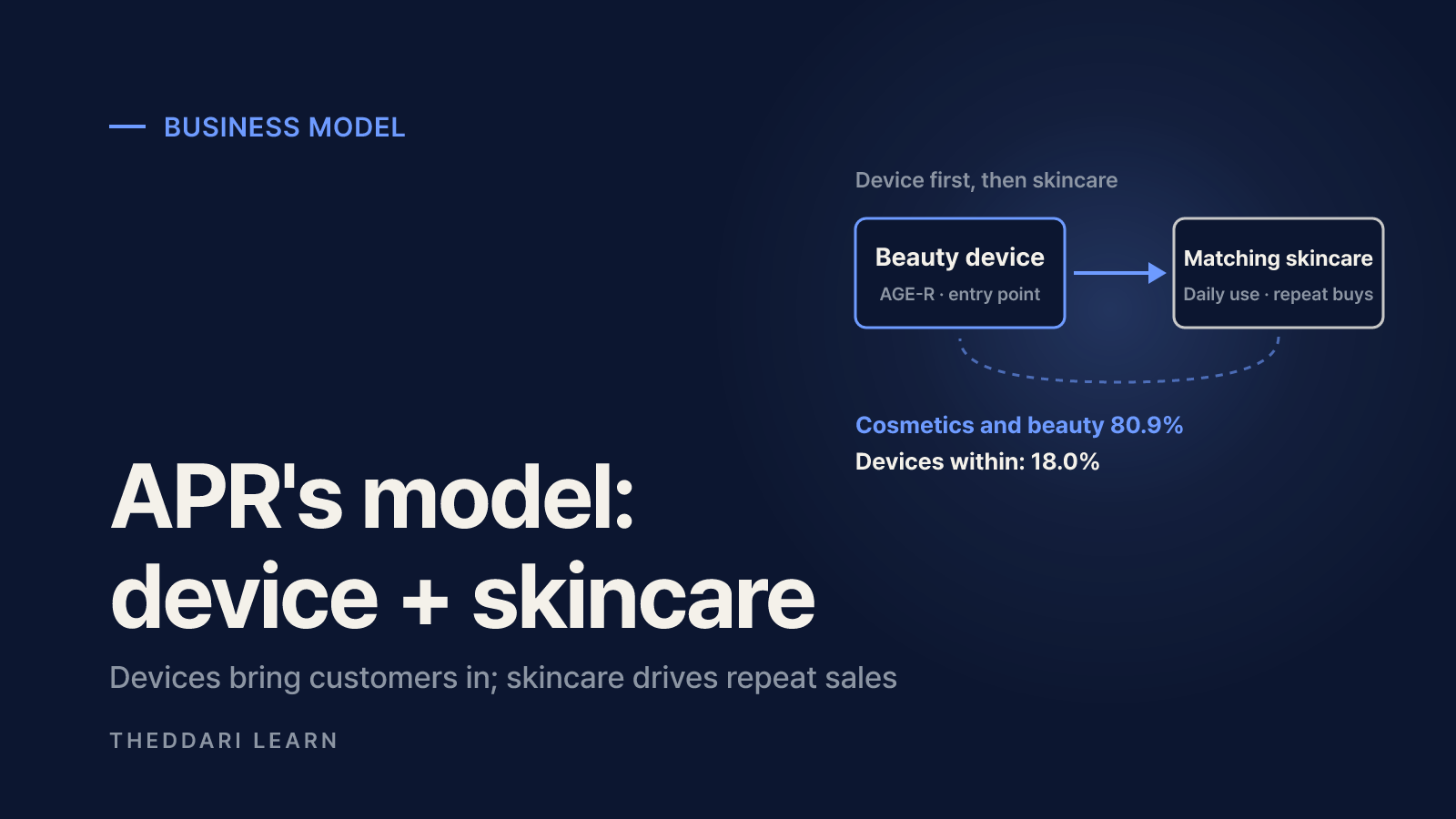
On a consolidated basis, cosmetics and beauty accounted for 80.9% of APR's first-half 2026 revenue, and beauty devices made up 18.0% within that segment, according to company figures reported by Mediapen. On paper it looks like a skincare company. The way APR describes it, the devices work as an entry point: someone buys an AGE-R device priced in the hundreds of thousands of won that lasts for years, then keeps buying the matching serums and creams.
- Beauty devices (AGE-R): Higher ticket, long replacement cycle. They pull customers into the brand.
- Companion skincare: Used daily, so it drives repeat orders and most of the revenue.
- New professional lines: PN skin boosters have been exported in small volumes since Q2, and a focused-ultrasound device received Korean approval in August, with domestic sales targeted for late 2026 or early 2027. These are not yet material to earnings.
APR does not publish device-to-skincare repurchase rates each quarter, so investors can only infer the flywheel from changes in the segment mix over time.
APR earnings metrics that matter most
For the first half of 2026, APR reported consolidated revenue of KRW 1.3609 trillion (+129.2%), operating profit of KRW 342.8 billion (+146.4%) and net income of KRW 258.8 billion (+122.6%), based on its DART half-year report. That puts the first-half operating margin near 25.2%. Q2 alone was a record: revenue of KRW 767.5 billion and operating profit of KRW 190.6 billion, a margin of about 24.8%.
Revenue growth (YoY and QoQ)
- Why it matters
- Investors react most to quarter-on-quarter slowdowns
- Reference point (Oct 2026)
- Q2 +134.2% YoY; IBK forecasts Q3 at +107.6% YoY
Operating margin
- Why it matters
- Shows whether ad spend and shipping costs are covered
- Reference point (Oct 2026)
- About 25.2% in H1; company target 24% to 26%
Sales by region
- Why it matters
- Dependence on the US and Europe
- Reference point (Oct 2026)
- US and Europe about 70%; Europe H1 KRW 228.9 billion (+363%)
Online vs offline
- Why it matters
- Amazon promotions vs store channels
- Reference point (Oct 2026)
- SK Securities estimates US online -10%, offline +32% QoQ in Q3
Segment mix
- Why it matters
- Whether devices keep pulling skincare sales
- Reference point (Oct 2026)
- Cosmetics and beauty 80.9%, devices 18.0% (H1)
The gap between sales growth and profit growth
IBK Securities forecasts Q3 2026 revenue of KRW 801.4 billion (+107.6%) and operating profit of KRW 170.5 billion (+77.3%), according to a Newspim research brief. Sales roughly doubling while profit grows more slowly means margins are compressing. The market reads that gap as a signal about the quality of growth.
Progress against company guidance
APR raised its 2026 revenue target from about KRW 2 trillion to KRW 3 trillion and set an operating margin goal of 24% to 26%. In August it also lifted its Europe sales target to KRW 500 billion, as reported by Global Economic. Tracking cumulative results against these targets tells you how the company is doing by its own yardstick, not just against analyst forecasts.

Why strong overseas sales did not stop the selloff
APR shares closed at a high of KRW 464,500 on August 31, 2026, then fell to KRW 283,000 by October 13, a drop of about 39.1%. The single worst day was October 13, when the stock lost about 19.6% from KRW 352,000. Yet analysts were still forecasting triple-digit sales growth. Korean coverage, including CBC News, pointed to three pressures:
- A stronger won. With about 70% of sales in the US and Europe, a rising won shrinks the value of overseas revenue once converted. Local media reported the dollar closed at KRW 1,324.2 on October 22, a new low for the year.
- An accounting change. Korea's adoption of K-IFRS 1118, the local version of IFRS 18, could put more currency effects into operating line items, so the same business result may show a different operating profit.
- European shipping costs. Inland delivery in Europe costs about 40% more than in the Americas, analysts said, so fast growth in European online sales raises freight and marketplace fees.
There were offsetting signals. During Amazon's Prime Big Deal Days on October 6-7, Medicube's US sales rose about 85% from the prior-year event, 13 Medicube products ranked in Amazon's US beauty top 100, and an average of more than 16 products per European country made the top 100, up from about 7 during Prime Day. APR already sells through Target and Walmart in the US, is moving into Costco and CVS, and entered Sephora in Europe in March. First-half Europe sales were KRW 228.9 billion, up about 363%, with offline sales in Europe up more than ninefold. With online freight weighing on margins, watch whether the channel mix shifts toward stores as a possible sign of margin recovery.
Currency is outside management's control. If APR's earnings materials give a constant-currency growth rate, use it to separate real demand from translation effects.
How to read APR's next earnings release
- 1
Note the date and the consensus
The statutory deadline for the Q3 2026 report is November 16, 2026, and preliminary numbers can arrive earlier. Write down the consensus operating profit beforehand so you can judge the result against expectations.
- 2
Read the preliminary filing
The DART preliminary earnings filing shows revenue, operating profit and net income with year-over-year and quarter-over-quarter changes. After the Q2 preliminary filing on August 5, 2026, the stock closed 5.7% higher the next trading day, but that is history, not a forecast.
- 3
Split the numbers by region and channel
Investor relations materials break out the US, Europe, Asia and Korea, plus online and offline. High European growth only helps if shipping costs are not rising faster.
- 4
Find the source of margin changes
Compare cost of sales (currency effects) and the share of advertising and freight in operating expenses with the prior quarter. Temporary costs and structural costs lead to very different readings.
- 5
Scan the filing list
Check non-earnings disclosures too. A notice of intent to designate APR as an unfaithful-disclosure company was filed on DART on October 20, 2026. Read the original filing for the reason and any penalty.
During earnings season, Korean broker notes and disclosure headlines arrive fast. Following the stock-focused Telegram channel feed is a quick way to see which issues keep coming up.
APR stock risks and limits to keep in mind
- Valuation: At the October 21, 2026 close of KRW 319,000, market value was about KRW 11.94 trillion and the trailing P/E, computed from DART figures, was about 27.6. A lot of growth is priced in, so small misses can move the stock sharply.
- Platform and regional concentration: Heavy reliance on the US, Europe and Amazon promotions makes quarterly results lumpy.
- Currency and accounting: A stronger won and new reporting rules can change reported numbers regardless of how the business performs.
- New-business execution: Skin boosters and medical devices need country-by-country approvals and trust from doctors. APR expects Korea's Class 4 medical device approval to take about 18 months.
- Targets are assumptions: The CEO's long-term goal of a KRW 100 trillion market value and broker price targets are models, not outcomes. The six-month average broker target was KRW 524,286 as of October 22, 2026, while the stock traded far below it.
The short version: do not stop at the revenue growth figure. Read it alongside operating profit growth, the US and Europe share and the currency backdrop, the online-to-offline shift in Europe, and progress toward APR's own KRW 3 trillion revenue and 24% to 26% margin goals. When those signals line up, the earnings story is much easier to interpret.