Contents8 sections
The Akedo token (AKE) is the BNB Smart Chain token behind AKEDO, an AI platform that lets users build simple games from text prompts. It reached No. 1 on CoinGecko's trending list on November 14, 2026, after CoinGecko showed the price jumping about 92.7% in a day to roughly $0.0117. Zoom out and the picture changes: AKE was still down about 65.1% over 30 days and roughly 92% below its all-time high of about $0.1467, set on September 20, 2026. Trending tells you people are looking, not that the token is sound. This guide walks through what to verify before buying.
Market figures below come from CoinGecko data captured around 13:30 UTC on November 14, 2026. Token design comes from the official AKEDO whitepaper, and company, fundraising and listing details come from a Blockworks Token Transparency filing dated August 18, 2026. Prices move by the minute, so focus on the method rather than the exact numbers.
What the Akedo token is for
According to the AKEDO whitepaper, AKEDO is a multi-agent framework built on large language models. Separate AI agents handle map building, rule design, game balancing and storytelling, so a creator can describe a game in plain language and get something playable. The project began in July 2024 with Akedog, a Telegram mini-game, and later added a content-creation engine and a token launchpad.
The whitepaper lists three core uses for AKE:
- Paying for creation: about $0.10 per prompt and $10 per published game, settled in AKE.
- Staking: protocol fees are split three ways, with 33% to stakers, 33% burned and 33% kept as platform revenue.
- Liquidity pairing: new game tokens launched on AKEDO are paired with AKE in their liquidity pools.
These are design rules, not evidence of demand. Because fees are priced in dollars, a higher AKE price means fewer tokens are needed for the same action. And the whitepaper says nothing about how many prompts and publications actually happen. Before you think about the burn percentage, look for real burn transactions on BscScan.
What CoinGecko trending really signals
CoinGecko's trending list ranks coins by recent search and page-view activity from its users. A crash can put a coin there as easily as a rally. AKE gained about 92.7% in 24 hours and about 96.5% over seven days, yet it was roughly flat over 14 days and down about 65.1% over 30 days. In other words, a month-long slide followed by a fast bounce. Volatility, not a new fundamental milestone, is what drew the attention.
Price
- CoinGecko (Nov 14, 2026)
- ~$0.0117
- What it tells you
- About 92% below the ~$0.1467 September high
24h change
- CoinGecko (Nov 14, 2026)
- ~+92.7%
- What it tells you
- Price nearly doubled in a day
30d change
- CoinGecko (Nov 14, 2026)
- ~-65.1%
- What it tells you
- The bounce has not undone the monthly drop
Market cap
- CoinGecko (Nov 14, 2026)
- ~$266.7M
- What it tells you
- Based on reported circulating supply
Fully diluted value
- CoinGecko (Nov 14, 2026)
- ~$1.17B
- What it tells you
- All 100B tokens valued at today's price
24h volume
- CoinGecko (Nov 14, 2026)
- ~$406.8M
- What it tells you
- Larger than market cap, signaling heavy short-term turnover
When daily volume exceeds market cap, the same tokens are changing hands several times a day. That kind of churn often comes with leveraged positioning and can reverse quickly. You can follow how crypto Telegram channels are reacting on the Theddari crypto Telegram trends page, but always trace claims back to official AKEDO accounts.
Akedo token supply: why only 22.8% circulates
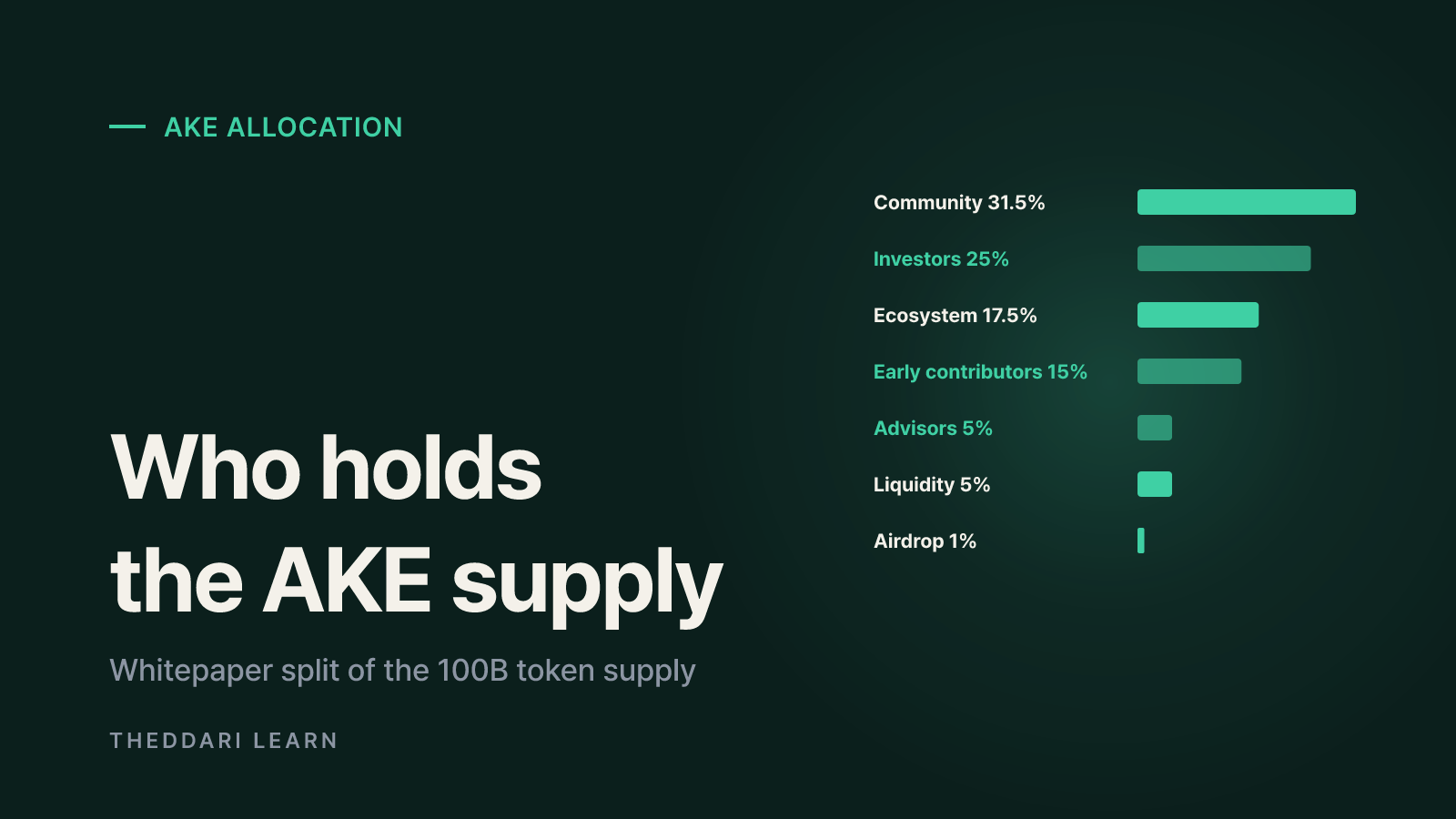
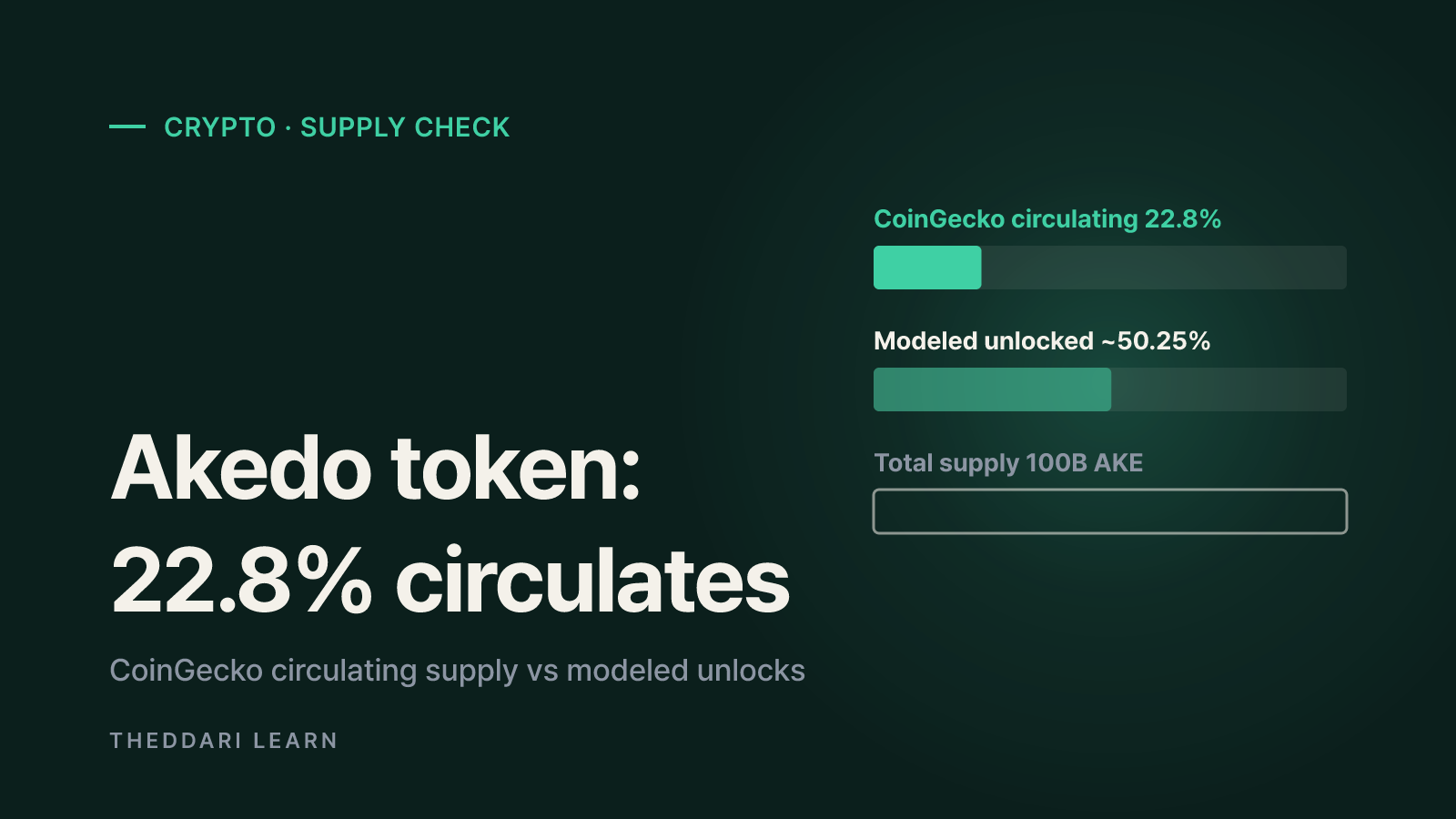
Total supply is fixed at 100 billion AKE. CoinGecko counts 22,796,250,000 as circulating, or 22.8%. The market-cap-to-FDV ratio is 0.23, which puts fully diluted value at roughly 4.4 times the market cap. If unlocked tokens reach the market faster than demand grows, that overhang can weigh on price.
Community (node, creator, player rewards)
- Share
- 31.5%
- Release terms (whitepaper)
- 2.08% at launch, rest linear over 48 months
Investors
- Share
- 25%
- Release terms (whitepaper)
- 3-month cliff, then 24 months linear
Ecosystem & growth
- Share
- 17.5%
- Release terms (whitepaper)
- 15.8% at launch; 1.7% with 20% at launch, rest over 6 months
Early contributors
- Share
- 15%
- Release terms (whitepaper)
- 6-month cliff, then 42 months linear
Advisors
- Share
- 5%
- Release terms (whitepaper)
- 6-month cliff, then 42 months linear
Liquidity provision
- Share
- 5%
- Release terms (whitepaper)
- Fully at launch
Community airdrop
- Share
- 1%
- Release terms (whitepaper)
- At launch
There is a mismatch worth noticing. CoinGecko's 22.8% equals the amount released at launch in August 2025. Tokenradar, applying the whitepaper's vesting rules, estimates that about 50.25% of supply had unlocked by November 14, 2026. Unlocked does not mean sold, but it does suggest the headline market cap may understate the tokens that could be sold.
Tokenradar's model estimates about 24.38% of total supply could unlock over the next 12 months, including roughly 1 billion investor tokens (1.00% of supply) in December 2026 alone. These are modeled estimates, so confirm with official announcements and wallet movements.
Exchanges and liquidity: check depth, not just volume
The Blockworks filing lists AKE on KuCoin, Binance Alpha, Kraken, MEXC, LBank, BingX, BitMart, Toobit, XT.COM, Gate and Ourbit, plus PancakeSwap V3 and Uniswap V3 on BSC. A long list of venues is not the same as deep liquidity.
Tokenradar's snapshot of order-book depth within 2% of the price on November 14, 2026 showed about $37,000 on PancakeSwap, about $39,000 to $47,000 on Kraken, about $12,000 to $15,000 on Gate and around $4,000 on KuCoin. Hundreds of millions in daily volume sit on top of only tens of thousands of dollars of resting orders near the price. Even a mid-sized order can move the market noticeably.
Perpetual futures also trade on Binance and OKX, with open interest of roughly $43 million. Liquidations in those markets can spill over into spot prices. You can see whether funding rates are lopsided with the Theddari funding-rate arbitrage tool and compare prices across venues with the cross-exchange arbitrage tool. Both describe current conditions; neither predicts where the price goes next.
Team, company and audit disclosures
Blockworks marked the AKEDO filing as partial, with 6 gaps, as of August 18, 2026. Here is what is known and what is missing:
- Operator: AKEDO Limited runs the service under its terms, but its country of incorporation and corporate structure are not disclosed. There is no foundation or DAO.
- Team: Blake Henderson is named as founder and is described as having worked on major mobile games, but Blockworks found no independent verification. Other team members are not named.
- Governance: token-holder voting is mentioned, but no on-chain voting contract or proposal threshold exists, so the operator effectively decides.
- Fundraising: a KuCoin Spotlight sale in August 2025 sold 800 million AKE at $0.0004 each for $320,000, and a $5 million seed round led by Karatage followed in January 2026.
- Airdrop: 1% of supply was distributed on August 21, 2025, but no per-address allocation data has been published.
I did not find a smart contract audit report in the whitepaper's tokenomics page or the filing summary reviewed for this guide. If an audit matters to you, look for the full report on the auditor's own site and confirm it covers the same contract address.
A five-step check before buying AKE
- 1
Match the contract
Confirm the BEP-20 address 0x2c3a8ee94ddd97244a93bc48298f97d2c412f7db is identical on CoinGecko, the official site and BscScan to avoid look-alike tokens.
- 2
Read the unlock calendar
Compare reported circulating supply (22.8%) with modeled unlocks (about 50.25%) and note how many tokens are due next month.
- 3
Measure depth
Check the plus-or-minus 2% order-book depth on the venue you plan to use and compare it with your order size.
- 4
Look for real usage
Search BscScan for transfers to burn addresses and for staking contract balances that show fees are actually being generated.
- 5
Cap your downside
Assume a 60%-plus monthly drop is possible, size positions accordingly and avoid leverage.
Bottom line: AKEDO has a clear product pitch and published tokenomics, but only 22.8% of supply is counted as circulating, a large share could unlock within a year, order books are thin and the operating company is lightly disclosed. Topping CoinGecko trending does not reduce any of those risks, so work through the checks yourself before deciding.