Contents7 sections
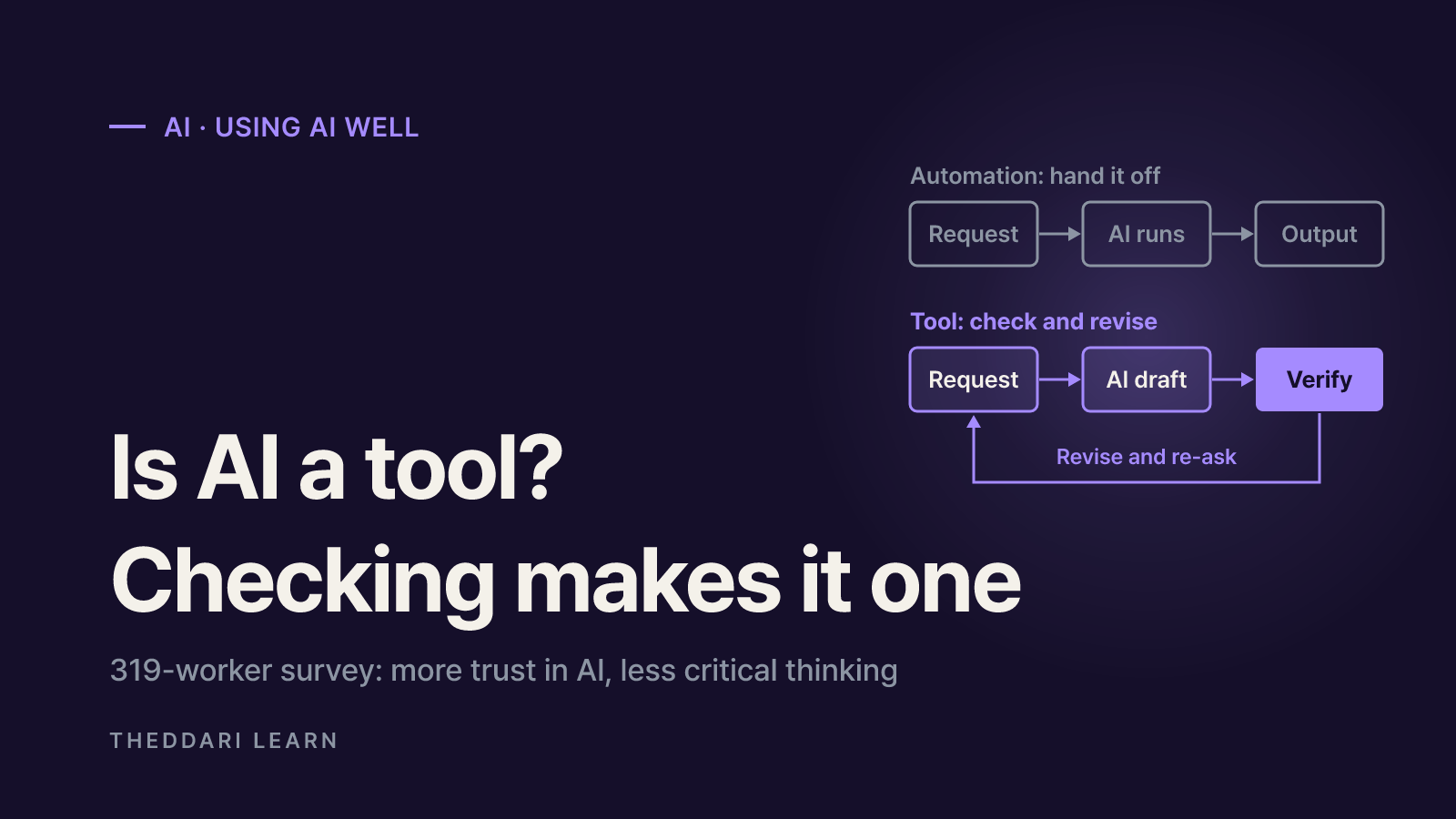
Is AI a tool? Rich Hickey, the creator of the Clojure programming language, says no: in his view large language models are automation that you hand work to, not instruments you wield. A widely shared rebuttal says yes, and adds that using AI well takes real skill. Both essays, along with a third piece predicting that thinking will become a hobby, drew heavy discussion on Hacker News in October 2026. This guide, written as of October 13, 2026 from the original essays and peer-reviewed research, lays out each argument, where the evidence on AI reliance actually points, and a practical way to check how you are using these systems.
Is AI a tool? What the debate is really about
On the surface this is an argument about a word. Underneath, it is about what people learn, or stop learning, while working with AI. The phrase "it's just a tool" is often used to mean "it's what you make of it." Hickey argues that framing hides properties of automation that you ignore at your peril. His critics argue the tool framing is exactly what keeps human skill and responsibility in view.
Rich Hickey: LLMs are automation, not tools
In his LinkedIn essay, Hickey settles on a definition: a tool is something you wield. Holding it gives you control and feedback; you supply intention and continuously direct the course of events. Good tools, he writes, are predictable, reliable, deterministic and of bounded function, and LLMs lack those properties. You do not direct an LLM's action; you make a request and it acts on its own. That, in his words, is automation.
His central analogy is the fast-food drive-thru: not a tool for cooking, but automation for avoiding cooking. Applied to research, he argues that if a model reads and summarizes papers for you, the model did the reading, not you. What you miss is learning how good writers write, how arguments are formed, which authors to trust, and how to think. He also warns that tuning prompts to a model's quirks is fragile knowledge that one software update can make obsolete.
The rebuttal: AI is a tool, and using it well takes skill
Huahai's response on yyhh.org accepts that outsourcing work can cost learning opportunities but rejects the conclusion. Picking up a saw does not guarantee a straight cut, and holding a chisel does not make you a sculptor. A tool's usefulness depends on the operator's ability to direct it, interpret feedback, recognize mistakes and correct them. Predictability and reliability, he argues, are criteria for judging tools, not requirements for being one.
He also challenges the tool-versus-automation split. A compiler does substantial work without the programmer directing each operation, and a spreadsheet recalculates without anyone doing the arithmetic, yet both are tools. A developer who asks an LLM to explain unfamiliar code, pushes back, inspects the source, tests a proposed change and rejects or refines it is running a feedback loop with a purpose. He concedes Hickey's point about reading is valid for one specific use: accepting a summary in place of the paper. His preferred distinction is between wielding an instrument with skill and delegating without adequate understanding or oversight.
A wider frame: thinking as a hobby
Diomidis Spinellis took a longer view in Thinking will become a hobby. He points to three forces, better performance, lower cost and round-the-clock availability, and predicts that AI will take over the bulk of cognitive work. Thought, he suggests, may become a leisure pursuit the way hunting and calligraphy did. His advice is to keep pace with AI while building a purposeful life beyond work. This is a forecast and personal view, not a research finding.
Rich Hickey
- Core claim
- LLMs are automation, not tools
- Main examples
- Drive-thru, summarized papers
- What it can miss
- Not every use replaces learning
Huahai (yyhh.org)
- Core claim
- LLMs are tools; skill matters
- Main examples
- Saw and chisel, compiler, spreadsheet
- What it can miss
- Assumes a skilled, attentive user
Diomidis Spinellis
- Core claim
- Cognitive work will shrink
- Main examples
- Performance, cost, availability
- What it can miss
- Long-range prediction, not evidence
What research says about AI reliance and critical thinking
The most relevant evidence comes from a CHI 2025 paper by researchers at Microsoft Research and Carnegie Mellon University. They surveyed 319 knowledge workers who use generative AI at work and collected 936 real examples. Higher confidence in AI doing a task was associated with less critical thinking. Higher confidence in one's own ability was associated with more critical thinking, though participants perceived that as more effort.
The Microsoft Research summary adds texture. For high-stakes tasks that required accuracy, participants said they spent more effort on critical thinking with AI than without it. For routine, low-stakes tasks under time pressure, they spent less. Critical thinking shifted toward verifying information, integrating responses and stewarding the task. The barriers were lack of awareness, limited motivation from time pressure, and difficulty refining prompts in unfamiliar domains.
The study is a self-reported survey that shows associations, not causation. It reflects the tools and participants at its 2025 publication and does not prove that AI use reduces thinking ability.
Read this way, the data gives each side something. Trusting the model and skipping checks looks like Hickey's automation, where the work is handed off. Keeping your own judgment and interrogating the output looks like the rebuttal's feedback loop. The same system can be used either way, and the user's habits decide which.
Using AI well: five skills that matter in practice
Combine the essays and the research and "AI skill" turns out to be a bundle of judgments rather than a single technique. None of these depend on a particular product or model.
- Choose what to delegate. Separate the skills you want to build from tasks where you only need the output, and keep doing the former yourself.
- Example: read the primary source in a new field yourself, and let AI reformat notes or draft boilerplate.
- State goals and standards. Define purpose, audience and quality bar before asking. Participants in the Microsoft study counted clear goal-setting as part of critical thinking.
- Verify. Check output against sources, tests and original material. Fluent text is not evidence of accuracy.
- Integrate. Adapt the result to your context and fill gaps rather than pasting it in unchanged.
- Own the result. If you cannot explain a part of the work when it turns out to be wrong, it is not finished.
Much of the skill lives outside the AI. Domain knowledge is what lets you spot errors and know what to ask, which is why participants found prompting harder in unfamiliar areas. Paradoxically, one of the surest ways to get better at using AI is to keep strengthening the fundamentals of your own field.
A quick self-check for over-reliance
- 1
Write your own answer first
Before asking, jot down your hypothesis or outline in a line or two. You now have something to compare against instead of accepting the first response.
- 2
Match verification to stakes
Money, health, legal and security questions deserve source checks and testing every time. Time pressure is exactly when people report cutting corners.
- 3
Supplement reading, do not replace it
Read important material yourself, then use AI to argue with your interpretation or surface what you missed.
- 4
Work without AI on a schedule
Periodically handle a core task unaided. It is the simplest way to see whether your own skills are holding up.
Debates like this one move quickly across developer forums and Telegram channels, and new rebuttals keep appearing. Theddari's AI Telegram trends and blog trend dashboard show which AI topics are being discussed most, which can be a starting point for finding the original essays. Popularity is not proof, so check the underlying arguments yourself.

What to take away from the tool debate
Hickey's strict definition exposes the risk hidden in "it's just a tool," and the rebuttal shows that the same definition struggles with compilers and spreadsheets. Both are opinion essays, and there is no official standard that settles the word. The common ground is clearer: handing work off wholesale can cost you learning, while keeping judgment and verification in your hands lets AI support your skill instead of substituting for it. A good next step is to pick one task you gave to AI this week and ask whether you could verify and explain every part of the result yourself.