Contents8 sections
- What the SpaceX compute deal includes
- How big are AI compute costs now? The numbers in context
- Why AI labs rent compute instead of only building it
- The 90-day clause: why terms matter more than the headline
- A checklist for investors
- Bottom line: look at structure, not just size
- Frequently asked questions
- Sources and references
AI compute costs have reached the point where a single lab can pay more than $1 billion a month to rent one supplier's GPUs. As of October 2026, the Wall Street Journal reports that Anthropic co-founder Tom Brown brokered a $1.25 billion-a-month compute deal with SpaceX, and a confidential Anthropic IPO prospectus reviewed by Reuters lists at least $518 billion of infrastructure commitments over the next decade.
This guide walks through what was actually disclosed, how big the numbers are relative to Anthropic's own spending, how the contracts differ, and what investors should verify. All figures are in US dollars. Because Anthropic's prospectus has not been published, details are based on reporting and may change once the public filing is out.
What the SpaceX compute deal includes
According to a summary of the WSJ profile, Brown, a Republican who runs Anthropic's compute deals, helped end a June standoff with Washington over model safety and won over Elon Musk. The contract terms themselves first appeared in SpaceX's offering materials. Based on AI Industry Today's breakdown, the key terms are:
- Capacity: cloud services agreements signed in May 2026 for access to roughly 325,000 Nvidia GPUs across the Colossus and Colossus II data centers in Memphis, Tennessee.
- Price and term: $1.25 billion a month through May 2029, with lower charges during the ramp-up in May and June 2026.
- Exit: after an initial three-month period, either company can terminate with 90 days' notice.
- Upside: Anthropic's prospectus says its xAI agreements could lead to up to $84.5 billion of spending on Nvidia-based capacity through 2029, mostly cancelable on 90 days' notice.
Multiply $1.25 billion by about 36 months and you get roughly $45 billion. The $84.5 billion ceiling is about 1.9 times larger, and nothing public yet explains the gap. It may include additional capacity or options, so treat the two figures as separate disclosures rather than an upgrade of one contract.
How big are AI compute costs now? The numbers in context
The cleanest yardstick is Anthropic's own history. Reuters reported that Anthropic's 2025 revenue grew about 12-fold to nearly $4.6 billion, while compute and infrastructure spending tripled from 2024 to $7.33 billion. That was more than half of $12.65 billion in total operating expenses, and the operating loss topped $8 billion. The roughly $42 billion net loss included about $34 billion of accounting charges tied to financing that could convert into shares, not cash spent on operations.
2025 compute and infrastructure spend
- Amount (USD)
- $7.33B
- Basis
- Prospectus, per Reuters
2025 average per month
- Amount (USD)
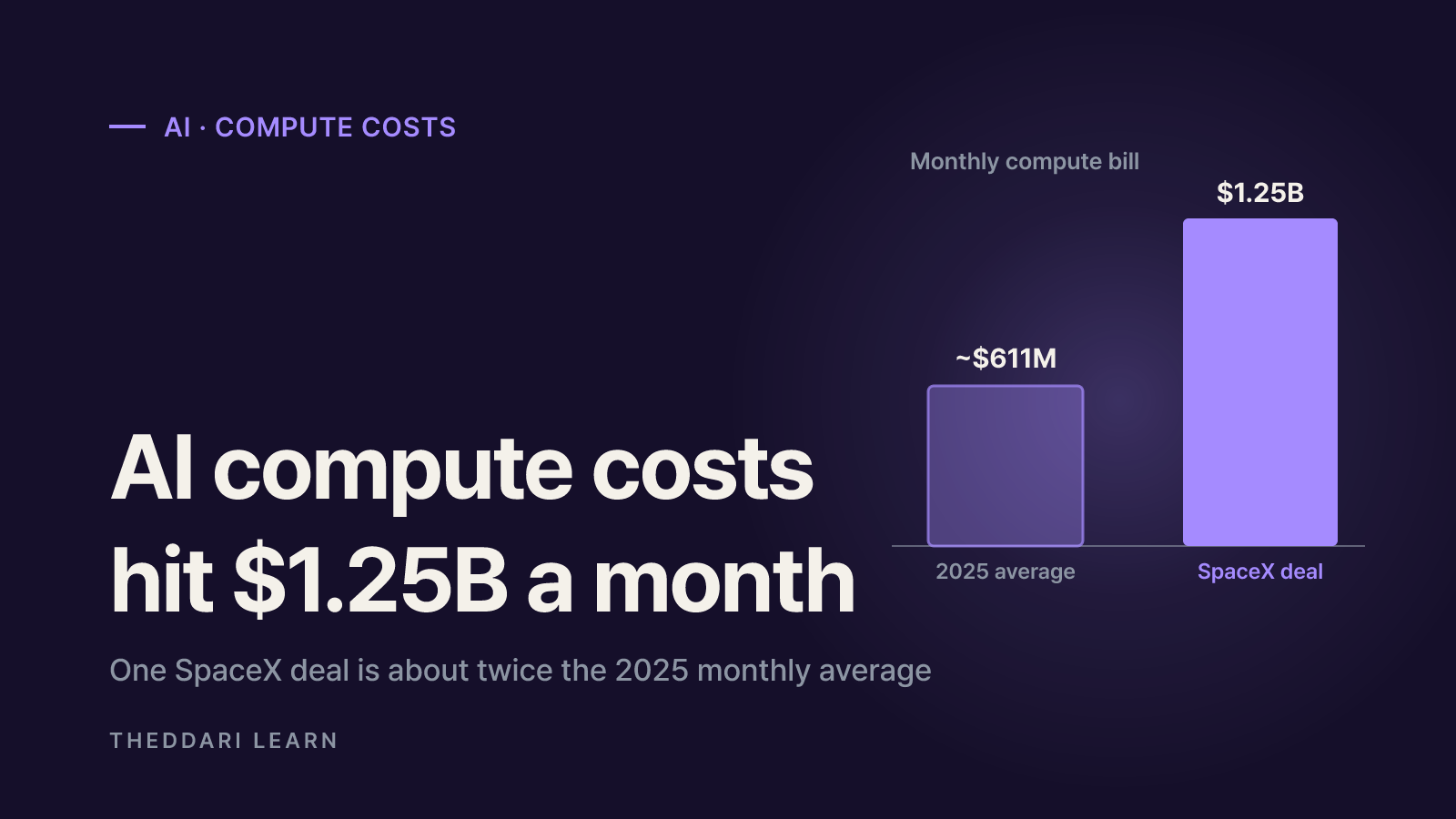
- ~$611M
- Basis
- $7.33B / 12
SpaceX contract, per month
- Amount (USD)
- $1.25B
- Basis
- SpaceX offering materials
SpaceX contract, annualized
- Amount (USD)
- $15B
- Basis
- $1.25B x 12
May 2026 to May 2029, simple total
- Amount (USD)
- ~$45B
- Basis
- $1.25B x 36 months
xAI agreements, maximum
- Amount (USD)
- $84.5B
- Basis
- Prospectus; mostly cancelable
10-year infrastructure commitments
- Amount (USD)
- $518B+
- Basis
- Six partners combined
The derived rows are straightforward arithmetic on disclosed numbers. The SpaceX contract alone runs at about twice Anthropic's 2025 average monthly compute bill, and its annualized $15 billion is roughly double the whole 2025 compute line. Anthropic has not disclosed 2026 revenue, so it is too early to say what share of this year's sales the contract consumes.
Where the $518 billion goes
InvestmentNews, summarizing the prospectus, lists six partners. About 80% of the total must be paid whether or not Anthropic uses the capacity.
- Amount (USD)
- At least $111.1B
- Term and conditions
- Apr 2026 to Jul 2033; pay the shortfall if spend falls short
Amazon
- Amount (USD)
- $110B
- Term and conditions
- May 2026 to Apr 2036; similar shortfall terms
Microsoft
- Amount (USD)
- $31.4B
- Term and conditions
- Nov 2026 to May 2033; cancelable only on uncured material breach
Broadcom-related equipment leases
- Amount (USD)
- ~$161.2B
- Term and conditions
- Non-cancelable by either side except on default
xAI (SpaceX)
- Amount (USD)
- Up to $84.5B
- Term and conditions
- Through 2029; mostly cancelable on 90 days' notice
AMD
- Amount (USD)
- Over $20B expected capacity
- Term and conditions
- AMD also agreed to buy up to $5B of Anthropic stock
Why AI labs rent compute instead of only building it
Anthropic told prospective investors that future demand for advanced AI will be limited principally by the availability of compute. When supply is the bottleneck, speed of access matters more than unit price, so labs stack several deal types at once. The same filing says Anthropic is moving from a cloud-only model toward dedicated data centers and directly leased chips.
Cloud minimum-spend commitment
- Example
- Google, Amazon
- Upside
- Large, long-dated capacity
- Trade-off
- Pay the difference if usage falls short
Equipment lease
- Example
- Broadcom-related
- Upside
- Custom chips and hardware
- Trade-off
- Long fixed cost; no exit short of default
Dedicated cluster rental
- Example
- SpaceX Colossus
- Upside
- Fast access to GPUs already running
- Trade-off
- Can be cut on 90 days' notice
Equity plus capacity
- Example
- AMD
- Upside
- Capital and chips together
- Trade-off
- Supplier and investor interests intertwine
The supplier map is also a competitor map. The prospectus notes that Amazon, Google and Microsoft each act as investor, customer, cloud provider, distributor and competitor, and SpaceX's xAI builds models that compete with Claude. Buying compute from a rival is now normal in frontier AI.
The 90-day clause: why terms matter more than the headline
Ninety days of a $1.25 billion monthly fee is about $3.75 billion. If the termination right is used, actual payments could land far below the $45 billion or $84.5 billion headlines. For Anthropic, the same clause means capacity it has built into product limits could vanish within a quarter. The prospectus lists this as a risk: if third-party compute is curtailed, repriced or terminated, results could be hurt.
An up-to figure like $84.5 billion is neither a fixed liability for Anthropic nor contracted backlog for SpaceX. Until minimum payments, optional capacity and who holds the exit right are public, read it as a ceiling.
Demand-side risk matters too. Per the prospectus, two customers produced nearly a quarter of 2025 revenue, and many large clients are not on long-term contracts. Costs locked in for a decade against revenue that can move quickly is the core asymmetry in AI infrastructure spending.
A checklist for investors
- 1
Read the public prospectus when it lands
Anthropic confidentially submitted a draft registration statement to the SEC. Once public, check the minimum payments, option capacity, which party can terminate, and how the $84.5 billion was calculated.
- 2
Compare how suppliers describe the deal
Watch whether Nvidia, cloud providers and SpaceX count these agreements as backlog or flag them as cancelable. The Theddari earnings calendar shows upcoming report dates.
- 3
Track compute as a share of revenue
In 2025, compute and infrastructure ($7.33B) exceeded revenue (about $4.6B). Whether that ratio falls in later disclosures is the key test of the cost structure.
- 4
Monitor political and regulatory risk
The WSJ ties the deal to Washington relationships, and Reuters reports a temporary Pentagon blacklisting of Anthropic was blocked by a judge in August. Follow the news flow on the AI Telegram trends page.

Bottom line: look at structure, not just size
The $1.25 billion monthly fee is a vivid marker of how large AI compute costs have become. Yet inside the same company, the Google, Amazon, Microsoft and Broadcom commitments are effectively locked, while the SpaceX capacity can be ended on a quarter's notice. When you assess AI infrastructure spending, weigh the share of fixed commitments, the exit terms and the trend of compute versus revenue alongside the headline. As of October 2026, Anthropic's official numbers will only be settled by its public filing, so treat reported figures as conditional ranges until then.