Chip Export Controls: Why TSMC, Samsung Paused China Chips
A US chip rule effective Nov. 19, 2026 led TSMC and Samsung to pause some China shipments pending licenses. What the rule says and what to watch.
Contents6 sections
Key takeaways
- The Bureau of Industry and Security (BIS) announced an interim final rule on November 16, 2026; it took effect on November 19, 2026, the day it was published in the Federal Register.
- The shipment pause comes from Financial Times and Reuters reporting based on unnamed sources, not company filings. It covers some chips held back while licenses are pending, not a blanket China ban.
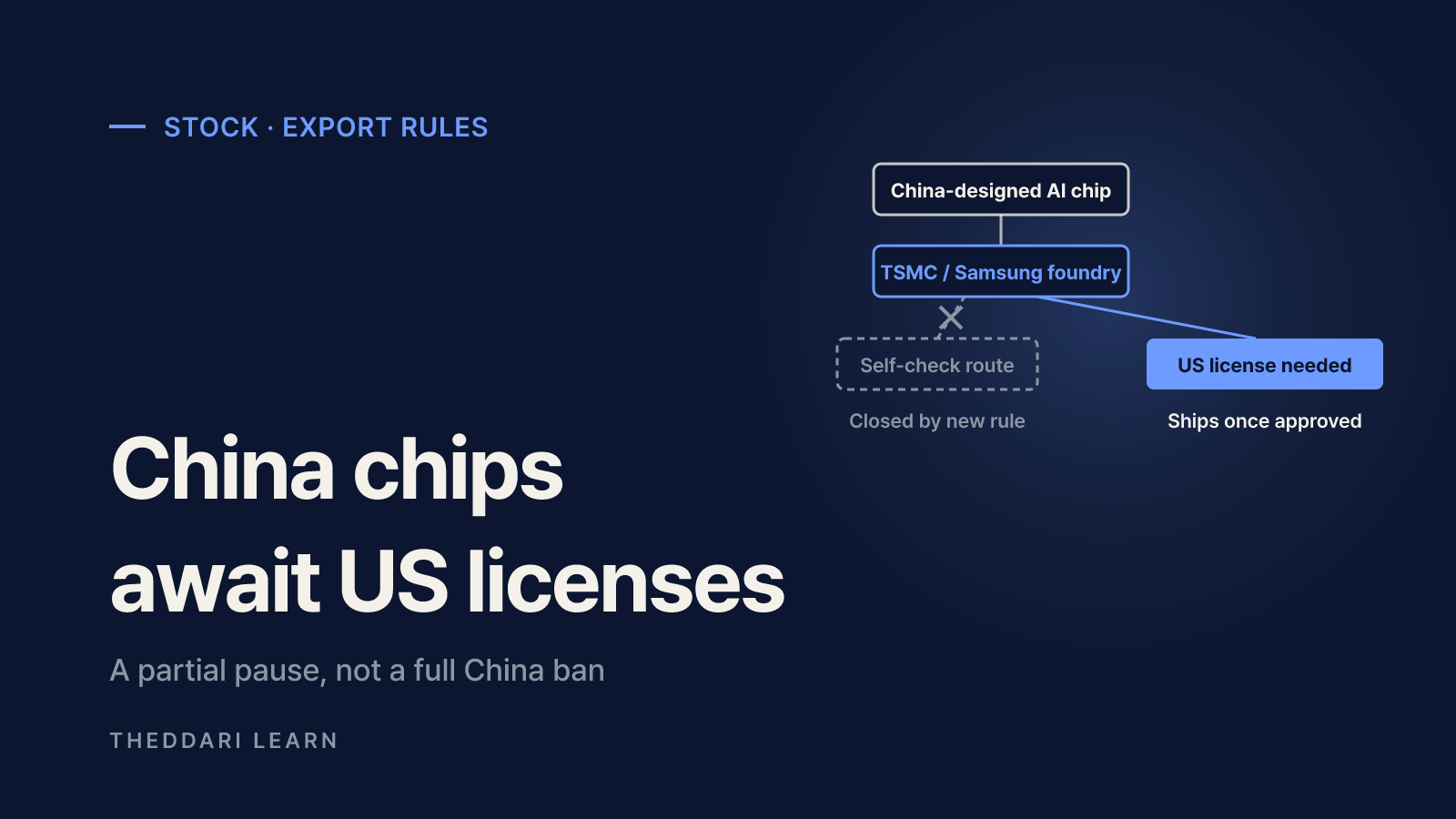
- The key change: foundries and packagers can no longer self-certify that advanced logic chips from China-based designers fall outside the controls.
- Smartphone chips were reportedly caught too. Industry sources expect licenses for them, so the real variable is how long approvals take.
- TSMC's China-based customers were about 5% of revenue in Q3 2026, down from about 8% a year earlier, according to Stock Analysis citing TSMC's quarterly report.
Short answer: yes, but only partly. New US chip export controls that took effect on November 19, 2026 led TSMC and Samsung Electronics to pause some deliveries to Chinese customers while they apply for US export licenses. That is not a blanket ban on selling to China, and the details come from Financial Times and Reuters reporting based on unnamed sources rather than company filings. This guide separates the official rule text from the reporting, as of November 20, 2026, and lists what TSM ADR and Samsung shareholders can actually track.
The Commerce Department's Bureau of Industry and Security (BIS) announced the interim final rule on November 16. It became effective on November 19, the same day it was published in the Federal Register as document 2026-23529. Public comments are due by January 19, 2027, so parts of it could still change.
What the new chip export controls change
The rule is titled "Addressing Remote Access to Advanced Semiconductors," which makes it sound like a cloud rule. It is, but it also reaches contract chipmakers. The Federal Register summary lists four pieces:
- Overseas data center controls. A license is needed to send advanced chips to any data center that will give companies headquartered in China, Macau or other Country Group D:5 destinations access to more than 12 million aggregate TPP (total processing performance). Latham & Watkins puts that at roughly 760 Nvidia H100s.
- Five new license countries. Advanced chips bound for Indonesia, Malaysia, Singapore, Thailand and Brazil now need a license, except shipments to US-headquartered companies that meet monthly reporting rules.
- Tighter foundry and OSAT presumptions. Chips from designers in China and other listed destinations are presumed to be controlled 3A090.a chips, and the ways to rebut that presumption shrink.
- AI Diffusion Rule rescinded. The Biden-era rule, which BIS stopped enforcing in May 2025, is formally removed.
Why foundries are directly affected
Under the January 2025 foundry due diligence rule, a foundry or an approved packager could clear an advanced logic chip by attesting that it fell below certain thresholds, generally about 30 billion transistors. Latham explains that the new rule removes that path when the designer sits in, or is ultimately owned from, China and other listed destinations. Only an attestation from an approved or authorized IC designer now works. Reuters, as summarized by TrendForce, reports that the approved list includes Nvidia, AMD, Apple, MediaTek and Realtek, and no mainland Chinese companies. In practice, advanced chips from Chinese designers now need a license before TSMC or Samsung can ship them.
Advanced logic chips from China-based designers
- Before Nov. 19, 2026
- Foundry or approved OSAT attestation could clear them
- After Nov. 19, 2026
- Only approved or authorized designer attestation; otherwise a license
Remote access via foreign data centers
- Before Nov. 19, 2026
- No direct rule
- After Nov. 19, 2026
- License if serving over 12M aggregate TPP to D:5-headquartered firms
Indonesia, Malaysia, Singapore, Thailand, Brazil
- Before Nov. 19, 2026
- No country license requirement
- After Nov. 19, 2026
- License required (US-headquartered exception with reporting)
China license review
- Before Nov. 19, 2026
- —
- After Nov. 19, 2026
- Case-by-case for chips under 21,000 TPP and 6,500 GB/s DRAM bandwidth
TSMC China shipments: what is confirmed vs. reported
Most of the confusion comes from mixing the rule (an official document) with reporting about how companies are responding (sourced, unconfirmed). Here is how the main claims stack up.
Rule took effect Nov. 19, 2026
- Evidence level
- Official text
- Where to verify
- Federal Register, 91 FR 74970
TSMC and Samsung paused some China shipments pending licenses
- Evidence level
- Multiple outlets citing FT sources
- Where to verify
- FT via Stock Analysis, Asia Business Daily
Samsung's Chinese customers include Baidu's Kunlunxin and ByteDance
- Evidence level
- Media report
- Where to verify
- FT reporting
Consumer smartphone chips also paused
- Evidence level
- Media report
- Where to verify
- FT via TrendForce
TSMC halted affected 16nm-and-below orders without licenses
- Evidence level
- Media report on internal guidance
- Where to verify
- Reuters via TrendForce
Total stop to all China sales
- Evidence level
- No support found
- Where to verify
- Nothing in the rule or reports
According to the FT, as relayed by The Asia Business Daily, both companies told Chinese clients in recent days that some chip shipments would be suspended while license applications move through the Commerce Department. Consumer electronics customers got similar notices because the exemption for chips designed for non-AI uses, such as smartphones, is gone.
TrendForce's summary of Reuters reporting adds that TSMC told affected Chinese designers to halt orders on 16nm and more advanced processes unless they obtain licenses, generally limiting them to 28nm and 40nm chips without HBM or advanced packaging. TSMC is also said to be screening customers' operating locations, parent companies, major shareholders, packagers and shipping routes, including orders placed through subsidiaries in Taiwan, the US, Europe, Japan and Southeast Asia.
Headlines that say TSMC or Samsung "banned" China are overstating the rule. A useful story names the product (advanced logic chips), the customer (non-approved designers based in China or other listed destinations) and the condition (waiting for a license).
Shipments already in transit on November 19 can be completed under the old terms until December 21, 2026, per Stock Analysis. That means any revenue effect is more likely to show up in the following quarter than in the current one.
What semiconductor stock investors should watch
A new rule does not automatically mean a large revenue loss. Split the question into exposure, license timing and guidance.
- 1
Measure China exposure
Stock Analysis, citing TSMC's quarterly report, says China-based customers were about 5% of TSMC revenue in Q3 2026, down from about 8% a year earlier. Only part of that is advanced-node work caught by the rule. For Samsung, regional sales in its Korean quarterly filings mix memory, devices and foundry, so a China share there overstates foundry exposure.
- 2
Track license approvals
The FT says smartphone chip licenses are likely but slow. Watch for company statements that licenses were granted, and for Xiaomi, Oppo or Vivo flagging launch or production delays.
- 3
Read the next guidance
Check whether management quantifies the China impact or says other demand can absorb freed capacity. Put the report dates on your list with the earnings calendar.
- 4
Follow rule changes
The comment period runs to January 19, 2027, and authorized IC designers must apply for approved status after December 31, 2026 to keep that standing. Revisions could widen or narrow the impact.
Avoid reading too much into a single price print. Stock Analysis noted TSMC's US-listed shares were up 0.7% in premarket trading at 5:36 a.m. ET on November 19, which reflects the whole market, not just this rule. Macro releases like inflation data can move chip stocks in the same week, so check the economic calendar before blaming a move on export news. If you follow chatter about the story, the stock Telegram trends page shows what is spreading, but check each claim against the table above.
How to verify the next export control headline
- Official text first. Match the Federal Register document number, effective date and comment deadline to what the article describes.
- Company confirmation. Look for a filing or an on-record statement from TSMC or Samsung. "People familiar with the matter" is not company confirmation.
- Scope. Confirm the product type, the customer group and the license condition are all stated.
- Dates. Note deadlines such as the December 21 transit window, the 90-day license window for existing data center arrangements, and the authorized designer deadline.
- Numbers. Recheck revenue shares in company earnings materials, since regional definitions differ between companies.
The bottom line: this is less a China export ban than a new license gate for advanced chips designed by Chinese companies and built by foreign foundries. For shareholders, the open questions are how quickly and how broadly licenses come through, and how TSMC and Samsung reflect that in their next guidance.
Frequently asked questions
Did TSMC and Samsung stop all shipments to China?
Which chips does the new BIS foundry rule cover?
Are smartphone chips for Xiaomi, Oppo and Vivo affected?
What happens to chips already in transit?
Is Samsung's memory business hit by this rule?
Sources and references
- 1Federal Register: Addressing Remote Access to Advanced Semiconductors (91 FR 74970)(opens in a new tab)www.federalregister.gov
- 2Latham & Watkins: US Commerce Department Adopts Rule Restricting Remote Access to Advanced AI Chips(opens in a new tab)www.lw.com
- 3Stock Analysis: TSMC and Samsung suspend some chip shipments to Chinese customers(opens in a new tab)stockanalysis.com
- 4TrendForce: TSMC, Samsung Reportedly Pause China Consumer Chip Shipments Under New U.S. Rules(opens in a new tab)www.trendforce.com
- 5The Asia Business Daily: Samsung Electronics, TSMC Halt Chip Shipments to Chinese Customers(opens in a new tab)www.asiae.co.kr
Related articles
 Stocks
Anthropic IPO Lockup Expiration Dates and ANT Price Impact
There is no single Anthropic lockup expiration date. Insider shares unlock in 23 steps, some on fixed dates and the largest ones tied to earnings. Here is the calendar, where to verify it, and how to think about price impact.
 Stocks
Korea Dividend Policy: What the President's Push Changes
A viral clip says President Lee Jae-myung 'drew the sword' on dividends. As of November 2026 no law forces Korean companies to pay more, but a new dividend tax break and disclosure rules are already in place.
 Stocks
Anthropic Ticker ANT: How to Verify a New IPO Symbol
Anthropic, PBC Class A common stock began trading on the Nasdaq Global Select Market under ANT on November 19, 2026. The ANTHROPIC-USD quote on Yahoo Finance is a token, not the stock. Here is how to confirm a new listing's symbol before you place an order.