Contents8 sections
- Rollups 101: why layer 2 networks exist
- ZK rollup vs optimistic rollup: the mechanics that matter
- What is Starknet, and what does the STRK token do?
- Starknet vs Arbitrum at a glance
- Practical checks before you bridge, stake or trade
- Risks and open questions for both networks
- Frequently asked questions
- Sources and references
Starknet is an Ethereum layer 2 that bundles transactions off-chain and proves they were executed correctly with a STARK validity proof, which Ethereum checks before the new state is accepted. That makes it a zero-knowledge (ZK) rollup, and STRK is its native token. Arbitrum is also an Ethereum layer 2, but it takes the opposite approach: it is an optimistic rollup that assumes results are valid and gives anyone a window to challenge them. This guide, written as of October 2026 from Ethereum Foundation and Arbitrum documentation, compares how the two settle, how long withdrawals take, what building on each looks like, what their tokens do and where the risks sit. It does not recommend buying or selling either token.
Rollups 101: why layer 2 networks exist
Ethereum mainnet has limited capacity, so layer 2 networks move execution and state storage off-chain and post a compressed record back to Ethereum. A rollup publishes enough data, either as calldata or in blobs, for anyone to rebuild its state independently. That public data is what lets users prove ownership and exit even if the operator goes offline, and it separates rollups from sidechains that secure themselves. One nuance from the Ethereum Foundation's ZK rollup page: blob data is not permanent archival storage, and the protocol only requires it to be served for roughly 18 days.
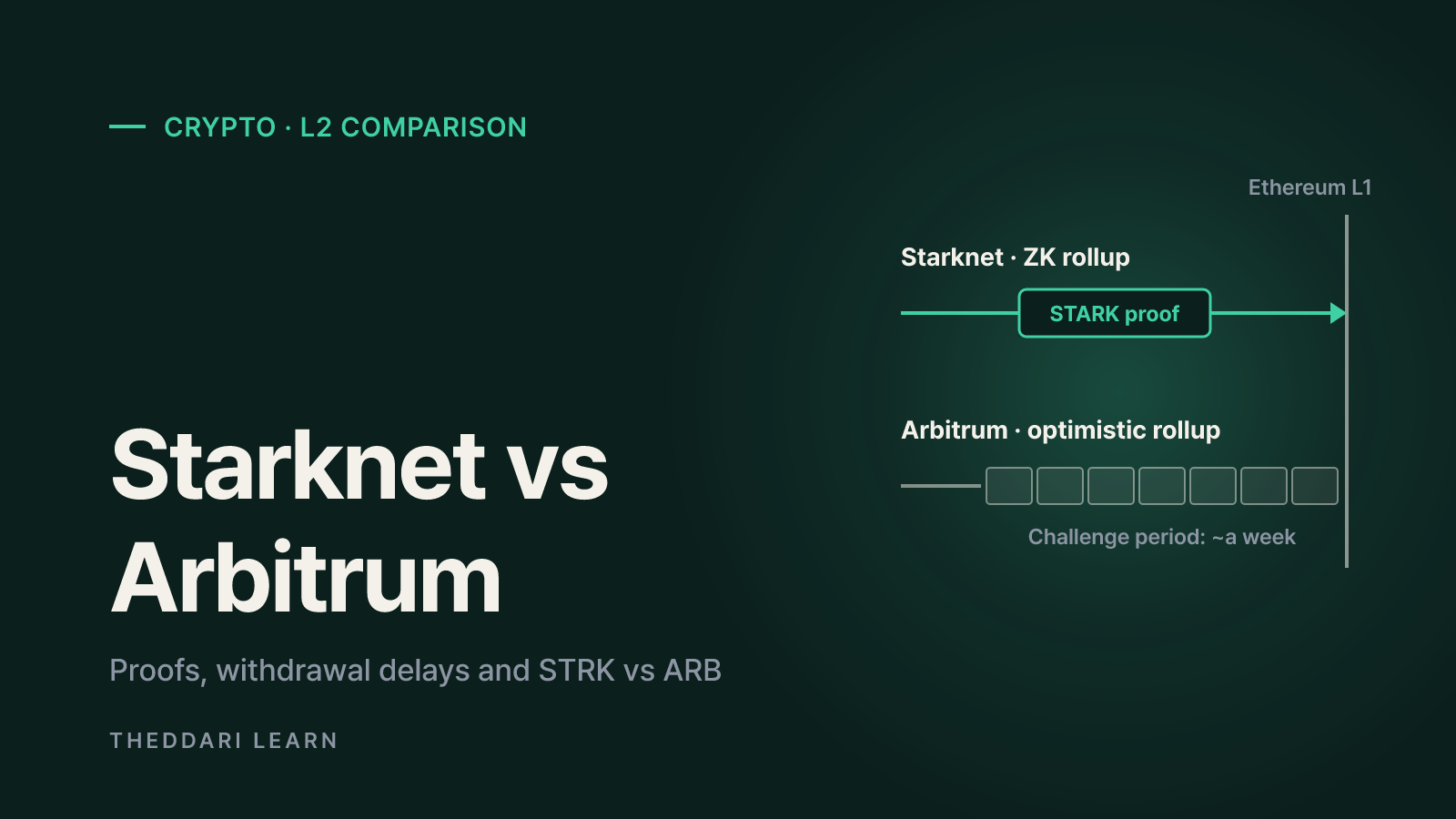
The real dividing line between rollup designs is how Ethereum becomes convinced that a batch is correct. ZK rollups submit a proof up front. Optimistic rollups skip the proof and rely on a dispute game if someone disagrees. Starknet sits in the first camp and Arbitrum in the second, and almost every practical difference between them, from withdrawal timing to developer experience, follows from that choice.
ZK rollup vs optimistic rollup: the mechanics that matter
Validity proofs: final once the proof checks out
In a ZK rollup, the operator executes a batch, computes a new state root and sends it to a verifier contract on Ethereum together with a validity proof. If the proof fails, the state change is rejected. Because the proof does the work, the Ethereum Foundation notes that exits can execute as soon as the proof is verified, with no challenge delay. There are two main proof families. SNARKs produce small proofs but often need a trusted setup ceremony. STARKs are transparent, meaning they use publicly verifiable randomness instead of a trusted setup, and they scale well for large computations. The trade-off is larger proofs that cost more to verify on Ethereum.
The same documentation lists real downsides. Proving general-purpose EVM computation is hard, so ZK rollups are often not readily EVM compatible. Proof generation can require specialized hardware, which may concentrate control among a few operators, and centralized sequencers can influence transaction ordering. Generating and verifying proofs also costs money, and some of that can show up in user fees.
Fraud proofs: final once nobody wins a challenge
An optimistic rollup posts results without a validity proof. During a challenge period, any watcher can dispute a result with a fraud proof; if nobody does, the batch is treated as final. The Ethereum Foundation's optimistic rollup page describes this period as roughly seven days, which is why native withdrawals to Ethereum are slow. Liquidity providers can front you the funds for a fee. The upside is compatibility: optimistic rollups are designed to run EVM code, so existing contracts and tooling port over with little rework. Security rests on the assumption that at least one honest node is watching and willing to challenge.
What is Starknet, and what does the STRK token do?
Starknet was developed by StarkWare and uses STARK proofs, which is where the name comes from. Its most distinctive design decision is that it does not try to mimic the EVM. Instead it is built around Cairo, a language and execution environment designed to be efficient to prove. For developers, that usually means rewriting Solidity contracts in Cairo. For users, it means checking that a wallet, exchange or bridge explicitly supports Starknet rather than assuming an Ethereum address workflow will carry over.
Starknet presents STRK as the token used to pay network fees, to stake for network security and to vote in governance, and it states that token economics can change through community governance decisions. Because those parameters move, this guide does not quote supply, inflation, unlock or staking minimums. Read the official Starknet STRK page directly and note its last-updated date before relying on any number.
Starknet vs Arbitrum at a glance
Rollup type
- Starknet
- ZK rollup with STARK validity proofs
- Arbitrum One
- Optimistic rollup with fraud-proof disputes
When state is final
- Starknet
- When Ethereum's verifier accepts the proof
- Arbitrum One
- After the 6.4-day challenge window, or after winning a dispute
Withdrawal to Ethereum
- Starknet
- After proof verification; proof cadence adds some wait
- Arbitrum One
- Challenge window wait; fast exits cost a fee
Developer stack
- Starknet
- Cairo; not EVM-native
- Arbitrum One
- EVM-compatible; Solidity tooling
Token role
- Starknet
- STRK: fees, staking, governance (per Starknet; may change)
- Arbitrum One
- ARB: ArbitrumDAO governance voting
Supply notes
- Starknet
- Check the official STRK page
- Arbitrum One
- 10 billion initial; up to 2% new issuance per year
Arbitrum One handles disputes with BoLD, short for Bounded Liquidity Delay. According to Arbitrum's BoLD overview, BoLD is live on Arbitrum One, Arbitrum Nova and Arbitrum Sepolia, and it replaced an allowlisted validator set with permissionless validation, so anyone can post or challenge state claims. The challenge window is 6.4 days and the DAO can change it. Disputes are designed to finish within a fixed period: two challenge periods, plus a two-day grace period for the Security Council to intervene if necessary, plus a small delta for computation. A single honest party is still enough to defend the correct state.
On tokens, the ArbitrumDAO governance docs describe ARB as an ERC-20 governance token. Holders vote, directly or through delegates, on proposals such as chain upgrades for Arbitrum One and Nova and use of the DAO treasury, with voting power weighted by token count. ARB launched with an initial supply of 10 billion, and the DAO can mint up to 2% of supply per year through a constitutional proposal, with the first mint eligible from March 15, 2024. That page is labeled a public preview, so its wording may change.
Practical checks before you bridge, stake or trade
- Read the token documentation first: role, total supply, issuance rules and unlock schedules, plus the date the page was updated. A spike in attention is not evidence of an upgrade or unlock; look for an official announcement.
- Match the network. The same ticker can exist on Ethereum mainnet, Starknet and Arbitrum. Confirm which network your exchange and wallet support before sending, because assets sent on the wrong network can be difficult or impossible to recover.
- Plan the exit route. Decide between the canonical bridge and a paid fast-exit service, and remember that third-party services add their own smart contract risk.
- Separate price data from signals. Exchange price gaps and social chatter describe conditions; they do not predict direction.
If you trade on Korean exchanges or follow them, theddari's Kimchi premium tracker shows how STRK and ARB prices on Korean venues compare with global ones. Gaps often reflect deposit and withdrawal limits, exchange rates and liquidity, so a gap alone is not an opportunity. The crypto Telegram trends page shows which topics crypto channels are discussing, which can help you spot a narrative early, but mentions are not verification. Cross-check anything important against the project's own announcements.

Risks and open questions for both networks
- Sequencer control: both rollups rely on an operator to order transactions. Check whether you can force a transaction through Ethereum if you are censored or the sequencer stalls.
- Upgrade authority: Arbitrum's BoLD design explicitly includes a Security Council grace period. Who can change contracts, and how quickly, is part of the trust model on any L2.
- Bridge and contract risk: canonical bridges and third-party services can both suffer bugs or operational failures that lock or lose funds.
- Supply changes: ARB allows up to 2% annual issuance, and Starknet says STRK's token economics can change through governance. New issuance and unlocks can increase circulating supply.
- Attention is not a catalyst: rising on a trending list means more people are looking, not that something fundamental changed.
In short, Starknet and Arbitrum are both Ethereum rollups that settle in opposite ways. Starknet front-loads cryptographic proof and accepts a separate Cairo stack; Arbitrum accepts a challenge window in exchange for EVM compatibility and familiar tooling. Neither design settles the question of token value. Whatever you use, start with current official documentation, the exit route you would actually take and the token's supply schedule.
This AI-written guide is general information based on public documentation as of October 2026 and is not investment advice. It does not recommend any token or transaction. Crypto assets carry significant price, technical and regulatory risk, so verify current terms in official sources and consider your own circumstances.