Contents10 sections
- How a stablecoin keeps its peg, and where it can fail
- Stablecoin risks at a glance
- What causes a stablecoin depeg?
- Stablecoin liquidity risk: redeeming is not the same as selling
- Stablecoin AML risks and why they reach ordinary users
- Stablecoin risks and benefits: the balanced view
- What the GENIUS Act changes, and what it does not
- A checklist before you hold a stablecoin
- Frequently asked questions
- Sources and references
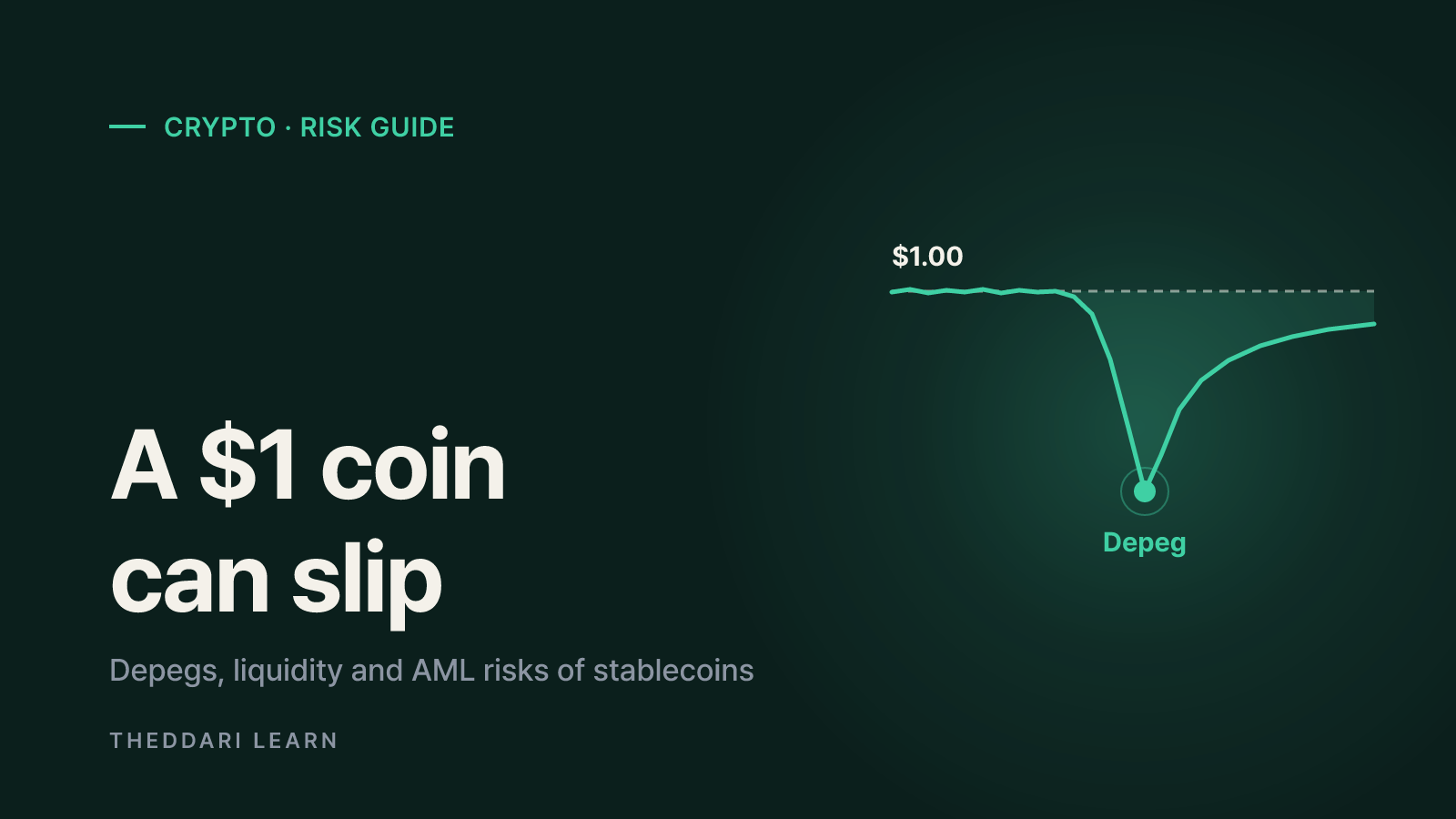
The core stablecoin risks fall into four groups: depegging, when the market price drifts away from the reference value such as one US dollar; redemption and liquidity risk, when you cannot convert tokens back to dollars at par when you need to; financial integrity risk, when tokens are used for money laundering or sanctions evasion and controls such as freezes reach ordinary holders; and operational risk from the banks, blockchains and bridges a token depends on. This guide is current as of October 2026 and is based on the Bank for International Settlements (BIS) 2026 Annual Economic Report, the text of the US GENIUS Act and Circle's own statement on the March 2023 USDC depeg. It does not assess any token's current reserves or price; it explains what to check before you hold or pay with one.
How a stablecoin keeps its peg, and where it can fail
Most large stablecoins are fiat-backed. The issuer takes in dollars, holds reserves such as cash, bank deposits and short-term Treasury bills, and promises to redeem tokens for dollars. Other designs use crypto collateral or rely on algorithms and market incentives instead of external reserves. In every design, the peg depends on confidence that one token can be exchanged for one dollar and on a redemption channel that actually works. When the price dips below $1, arbitrageurs with redemption access buy cheap tokens and redeem them at par; when it rises above $1, they mint and sell.
That arbitrage loop is not open to everyone. In Chapter III of its 2026 Annual Economic Report, the BIS notes that stablecoin secondary-market prices have deviated from par to date, even if mostly moderately, and that redemption frictions are common, so current designs resemble exchange-traded fund shares more than a means of payment. Because stablecoin transfers settle neither directly nor indirectly on central bank balance sheets, the report says they cannot ensure exchange at par across issuers and blockchains under all conditions. Trading near $1 on a calm day is not evidence of how a token behaves under stress.
Stablecoin risks at a glance
Depeg
- What goes wrong
- Market price moves away from the reference value
- What to check
- Past deviations and current order book depth
Reserve and bank risk
- What goes wrong
- Part of the reserves is stuck at a troubled bank or in riskier assets
- What to check
- Reserve composition, custodians and disclosure frequency
Redemption and liquidity
- What goes wrong
- Retail holders may only be able to sell, not redeem
- What to check
- Who can redeem, fees and processing times
AML and sanctions
- What goes wrong
- Tainted tokens can be frozen or deposits held
- What to check
- Source of funds and counterparties
Chain and bridge
- What goes wrong
- Tokens spread across chains add operational failure points
- What to check
- Whether the issuer natively supports that chain
Regulatory
- What goes wrong
- Rules differ by jurisdiction and issuer status
- What to check
- Issuer licence and where it is supervised
These risks interact. A bank problem shakes confidence in reserves and triggers a depeg; a depeg pushes many holders to sell or redeem at once, which strains liquidity; and an integrity problem can leave an innocent holder with frozen tokens. A single headline figure such as the size of the reserves does not tell you how all of these channels behave together.
What causes a stablecoin depeg?
Reserve assets and bank concentration
Where the reserves sit matters as much as how large they are. When Silicon Valley Bank failed in March 2023, Circle disclosed that $3.3 billion of USDC reserves, about 8% of the total, was held at SVB, and USDC traded below its peg. After the US Treasury Secretary and prudential regulators announced that SVB depositors would be made whole, Circle said the deposit would be fully available when banks reopened, and its statement was titled to say the depeg had closed. Circle also reported that at the time 77% of reserves ($32.4 billion) were short-dated Treasury bills and 23% ($9.7 billion) was cash.
Two lessons follow. Even a mostly conservative reserve can lose market confidence when a slice is concentrated at one institution, because the market prices the worst case first. And the recovery depended on a government decision outside the issuer's control. Holders should not assume the same backstop will appear in the next episode.
Banking hours versus 24/7 blockchains
Blockchains never close, but banks and Treasury markets do. The USDC stress unfolded over a weekend, and Circle framed its update around US banks opening on Monday. While the banking system is closed, large redemptions cannot be settled in dollars, so fear shows up only in the token's market price. Most retail holders are not direct customers of the issuer, which means their only practical exit in a crisis may be an exchange order book.
Design, chain and bridge risk
Algorithmic and under-collateralized designs have weak tools to restore the peg once confidence breaks, because there are no external reserves to absorb redemptions. Fiat-backed tokens add another layer when the same brand exists on many chains or as bridged versions created by third parties. A natively issued token and a bridge-wrapped token may not share the same redemption rights. The BIS report warns that fragmentation across multiple blockchains introduces new operational risks and hinders interoperability.
Stablecoin liquidity risk: redeeming is not the same as selling
Think about liquidity at two levels. At the issuer level, the BIS explains that stablecoins follow a cash-in-advance model: new tokens require full upfront payment, so the issuer cannot expand its balance sheet elastically the way a bank can, and its capacity is constrained by the liquidity and depth of its reserve-asset markets. A wave of redemptions forces the issuer to sell reserve assets for cash, and if those markets are stressed, both speed and value can suffer.
At the holder level, an exchange sale fills only against the bids that are actually on the book. Reported volume can look large, yet bids thin out quickly when worry spreads, and a large sell order can push your average execution price well below $1. Prices for the same token can also differ across exchanges, especially when one venue pauses withdrawals. If you compare venues, include deposit and withdrawal status, fees and transfer times before treating a gap as real. Theddari's cross-exchange price comparison and Korean premium pages can help you see how quoted prices differ between markets, but they do not show whether you could redeem at par.

Stablecoin AML risks and why they reach ordinary users
The BIS 2026 report identifies financial integrity as the most critical concern with current stablecoins. On public permissionless blockchains, identities are hidden behind addresses, and mixers and cross-chain bridges can obscure flows and weaken oversight. Public ledgers and new analytics tools help, the BIS says, but anti-money laundering and countering the financing of terrorism (AML/CFT) challenges remain substantial.
Regulation is responding by making issuers able to stop tokens. Under the GENIUS Act, a permitted issuer is treated as a financial institution under the Bank Secrecy Act. It must run an AML program, report suspicious transactions, verify customers, maintain a sanctions compliance program and have the technical capability to block, freeze and reject impermissible transactions. It may issue tokens only if it can comply with lawful orders to seize, freeze or burn them. At the same time, the Act's issuance and sale restrictions do not apply to direct transfers between individuals acting for themselves or to transactions through self-custody wallets.
For holders, that cuts both ways. Freezing tools help trace and stop criminal proceeds, but anyone who receives tainted tokens may also see them frozen or find an exchange deposit held for review. Avoid accepting tokens whose history you cannot explain, be wary of peer-to-peer deals with strangers, and treat any offer to move stablecoins for a fee or to lend your wallet or exchange account as a red flag. Read your exchange's policies on deposits from external wallets before you need them.
Stablecoin risks and benefits: the balanced view
The BIS acknowledges that stablecoins show some of tokenisation's potential: round-the-clock transfers, programmable payments and atomic settlement, where an asset and a payment move together. There is real demand for dollar access in places where it is hard to get. The same report, however, warns that widespread adoption in current forms could open channels for regulatory evasion and raise dollarisation risks in emerging and developing economies. In other words, the features that drive adoption are also what make the risks system-wide as usage grows.
What the GENIUS Act changes, and what it does not
The GENIUS Act, signed on 18 July 2025 as Public Law 119-27, sets the US framework for payment stablecoins. Permitted issuers must hold identifiable reserves on at least a 1:1 basis in cash, deposits, Treasury bills with 93 days or less to maturity, certain overnight repurchase agreements, government money market funds and similar assets. They must publish a redemption policy and all fees in plain language, with at least seven days' notice for fee changes, and post a monthly report of tokens outstanding and reserve composition, including average tenor and custody location. A registered public accounting firm must examine those reports, and the CEO and CFO must certify them. Reserves generally may not be rehypothecated, and holders' claims rank ahead of other creditors with respect to the reserves.
Those rules address reserve quality and transparency for permitted US issuers. They do not cover foreign or non-permitted issuers in the same way; the Act gives digital asset service providers until three years after enactment before they are barred from offering non-permitted payment stablecoins to people in the United States. Implementation details depend on regulators' rules, so confirm what already applies to a specific issuer from its own disclosures. No reserve rule fixes thin exchange order books, chain or bridge failures, or illicit-finance risk in peer-to-peer transfers. If you live outside the US, check your own jurisdiction's rules and your exchange's notices.
A checklist before you hold a stablecoin
- 1
Identify the issuer and its regulator
Note the issuer, where it is licensed and who supervises it. Confirm that the contract address and chain you use are ones the issuer officially supports rather than a third-party bridged version.
- 2
Read the reserve report and redemption terms
Check reserve composition, custodians, reporting frequency and the scope of any independent examination. Write down whether you can redeem directly or must sell on an exchange, plus the fees and timing.
- 3
Check where you would actually sell
Look at bids, depth and withdrawal status on the venue you use. Compare prices across venues only after accounting for fees and transfer times.
- 4
Screen counterparties and sources
For peer-to-peer or over-the-counter trades, ask where the tokens came from. If the history cannot be explained, walk away.
- 5
Decide where you will watch for news
Depegs move with issuer statements and bank or regulatory headlines. Decide in advance which official channels you will check if something looks wrong.
News about issuers and regulators often spreads first through Telegram channels. Theddari's crypto Telegram trends page shows which topics are being discussed most, which can help you notice an emerging story sooner. Channel posts can be unverified, so always confirm against the issuer's official announcements.
This AI-written guide reflects public sources as of October 2026 and is general information, not investment advice. It does not recommend holding or trading any stablecoin. Reserve practices, redemption terms and regulations change, so check the issuer's official disclosures and your regulator's guidance and consider your own circumstances.