OpenAI Funding Round Falls Short: How to Read AI Raises
OpenAI reportedly secured about $11B of a $30B target in October 2026. Learn what targets, commitments, closings, tranches and valuations really tell you.
Contents7 sections
- What the OpenAI funding round reports actually say
- Funding round vocabulary: target, commitment, close, tranche
- Comparing March's $122 billion round: how commitments were built
- What the shortfall signals, and what it does not
- Checklist for the next AI funding headline
- Frequently asked questions
- Sources and references
Key takeaways
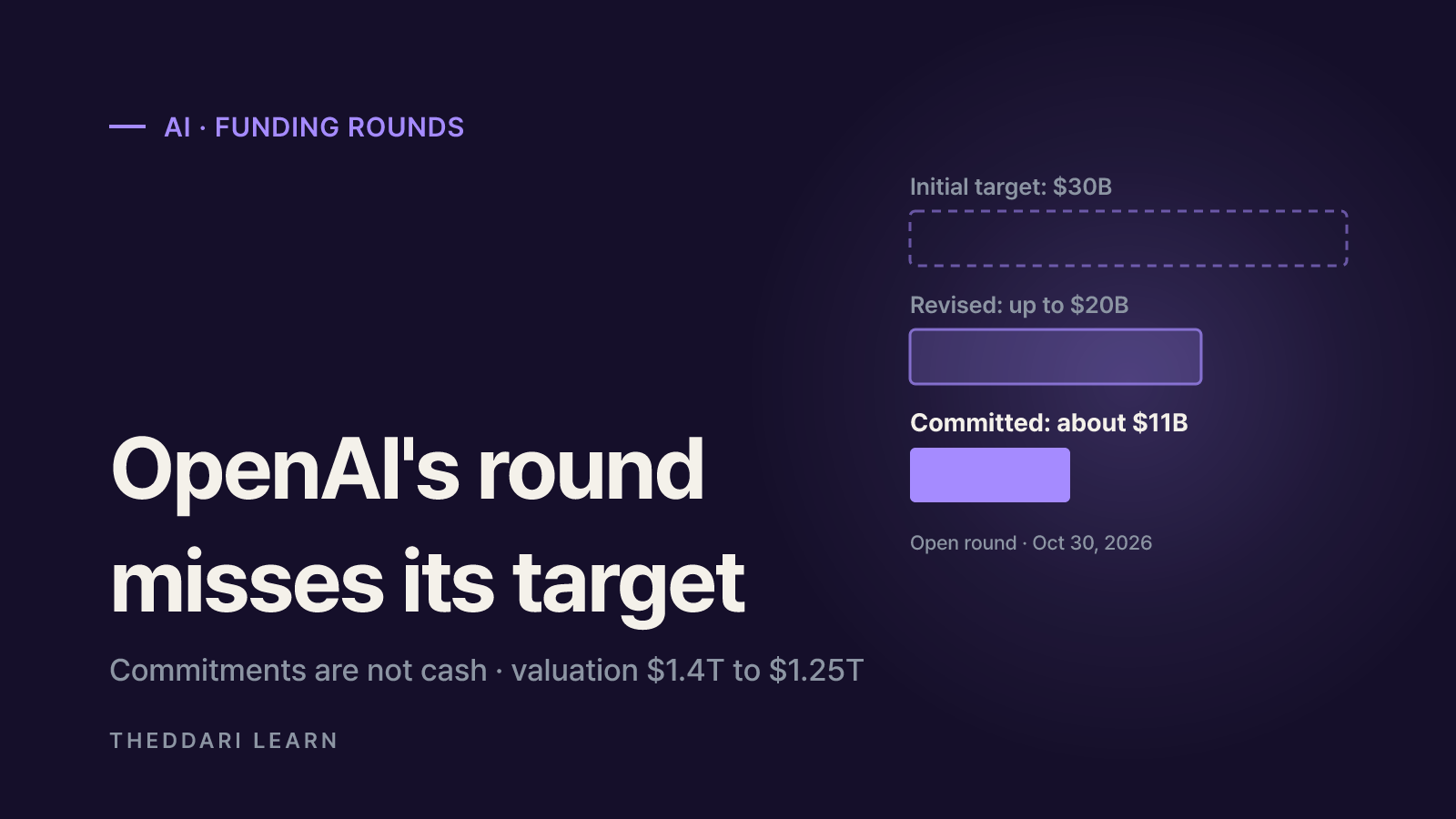
- Per a WSJ report on Oct 30, 2026, OpenAI has about $11 billion committed toward a $30 billion target, at a $1.25 trillion valuation instead of the hoped-for $1.4 trillion.
- The $11 billion is commitments, not cash in the bank. The round is still open, and the target has reportedly been cut to as much as $20 billion.
- In March 2026 OpenAI closed $122 billion committed at an $852 billion post-money value; Amazon's $50 billion was $15 billion up front plus $35 billion on conditions.
- The useful signal is the combination of valuation reset, investor mix, payment conditions and IPO timing, not the headline shortfall alone.
- OpenAI is private, so most investors feel this through listed suppliers and partners. Check each company's exposure and earnings dates first.
The short answer: the latest OpenAI funding round falling short tells you that big investors balked at the price and terms of an extra raise, not that OpenAI has run out of money. According to a Wall Street Journal report published October 30, 2026 (US Eastern time), OpenAI had secured roughly $11 billion in commitments toward the $30 billion it initially targeted, at a $1.25 trillion valuation rather than the $1.4 trillion it had hoped for (Dow Jones/WSJ text). The round is still open, and the target has reportedly been lowered to as much as $20 billion.
This guide uses reporting and official OpenAI announcements available as of November 2, 2026. Rather than rehashing OpenAI's valuation or losses, it focuses on how to read the mechanics of a funding round: targets, commitments, closings, tranches, and pre-money versus post-money valuation. The figures come from anonymous sources; TechCrunch said it had asked OpenAI for comment, and no official numbers had been published at the time of writing.
What the OpenAI funding round reports actually say
Separating the claims by source makes it easier to tell what is confirmed and what is second-hand. Every number in this table comes from press reports, not from OpenAI.
Initial target
- Reported detail
- $30 billion, hoping for a $1.4 trillion valuation
- Source
- WSJ, TechCrunch
Commitments so far
- Reported detail
- About $11 billion (roughly 37% of target)
- Source
- WSJ, anonymous sources
Valuation
- Reported detail
- $1.25 trillion
- Source
- WSJ
Revised target
- Reported detail
- Up to $20 billion; first close expected to be lower
- Source
- TechCrunch citing the FT; WSJ
Lead investors
- Reported detail
- A group of UAE investors
- Source
- TechCrunch citing the FT
Next pool
- Reported detail
- Family offices and high-net-worth individuals
- Source
- WSJ
The Journal tied the weak response to a sharp tech selloff after disappointing results from Google, Amazon and Intel, and to growing investor caution about funding the AI build-out. It also cited its earlier reporting that rival Anthropic more than doubled revenue to $11.6 billion from the first to the second quarter, while OpenAI's sales grew about 18% to $6.7 billion and its operating losses deepened. TechCrunch traced the sequence: a late-September report of $30 billion at $1.4 trillion, an October 22 report of $30 billion at $1.25 trillion, then the cut to $20 billion. In other words, the price came down first and the size followed.
Quick math: $11B / $30B is about 36.7%, and $11B / $20B is 55%. Even against the reduced goal, OpenAI is only a little past halfway, so the next few weeks of family-office and wealthy-investor demand are the thing to watch.
Funding round vocabulary: target, commitment, close, tranche
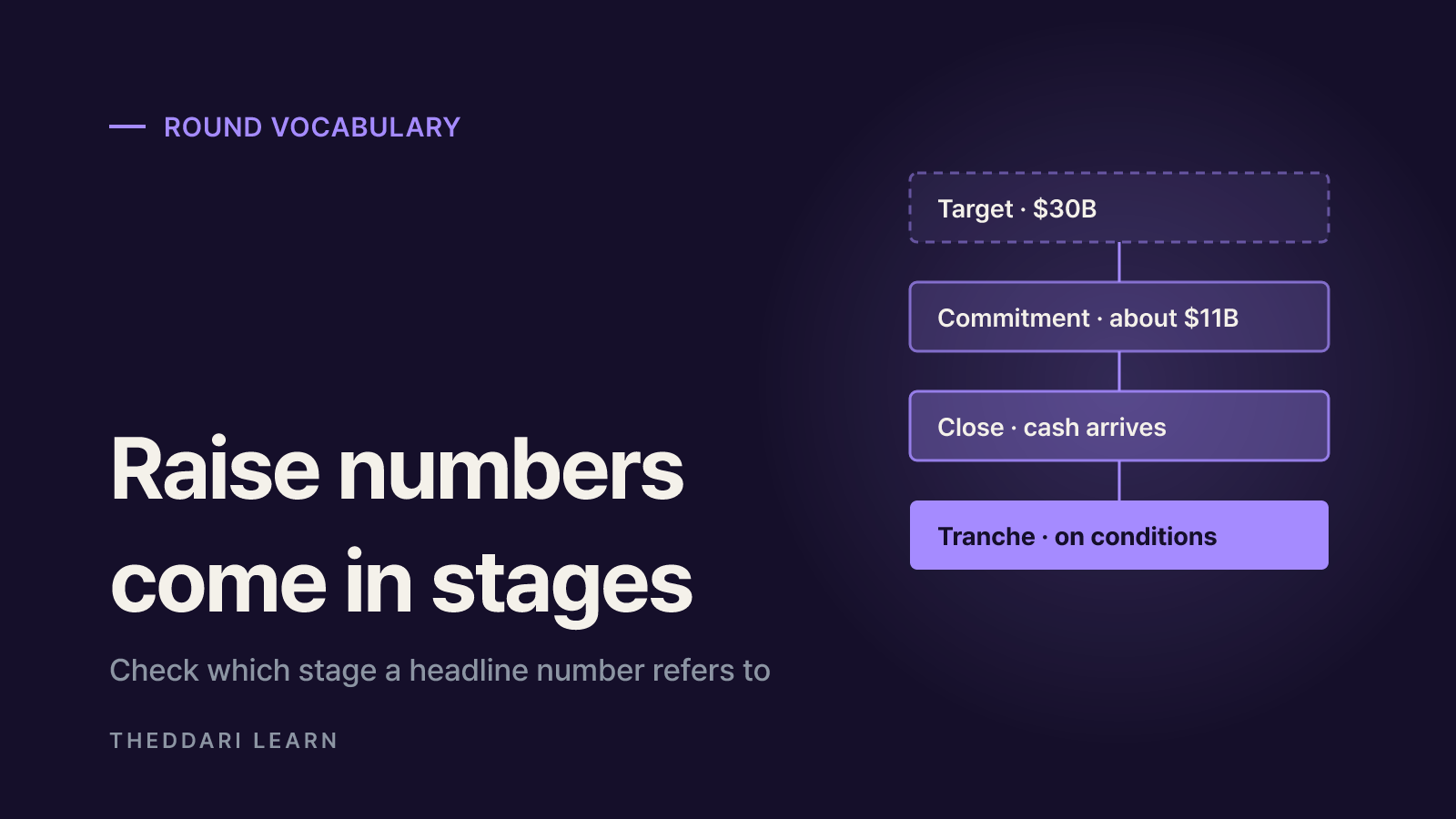
Headlines about AI startup fundraising often use 'raised' for four different numbers. Keeping them apart is the fastest way to spot an overstated story.
- 1
Target
The size the company and its advisers float to the market. It is partly a negotiating anchor and can move up or down. The $30 billion figure is a target.
- 2
Commitment
An investor's agreement to put money in on set terms. The roughly $11 billion is at this stage; it does not mean the cash has arrived.
- 3
Close
The point at which documents are signed and money transfers. Large rounds often have a first and second close. The FT reportedly expects the first close to land below $20 billion.
- 4
Tranche
A commitment paid in installments. If later payments depend on milestones such as revenue, infrastructure or governance changes, some money may never arrive if conditions are not met.
Pre-money versus post-money valuation
Pre-money valuation is what the company is worth before new cash comes in; post-money adds the new investment. OpenAI's March round is a clean example. In February it announced $110 billion at a $730 billion pre-money valuation, and when the round closed with $122 billion committed, it reported an $852 billion post-money valuation ($730B + $122B = $852B). Reports on the new round do not say which basis the $1.25 trillion uses, so treat comparisons with March as approximate.
How much of the company do new investors get?
If you assume $1.25 trillion is post-money, $11 billion buys about 0.88% of the company and $20 billion about 1.6%. Dilution for existing holders is small. What markets care about is the strength of demand at that price, because the last private price tends to become the reference point for an IPO.
Comparing March's $122 billion round: how commitments were built
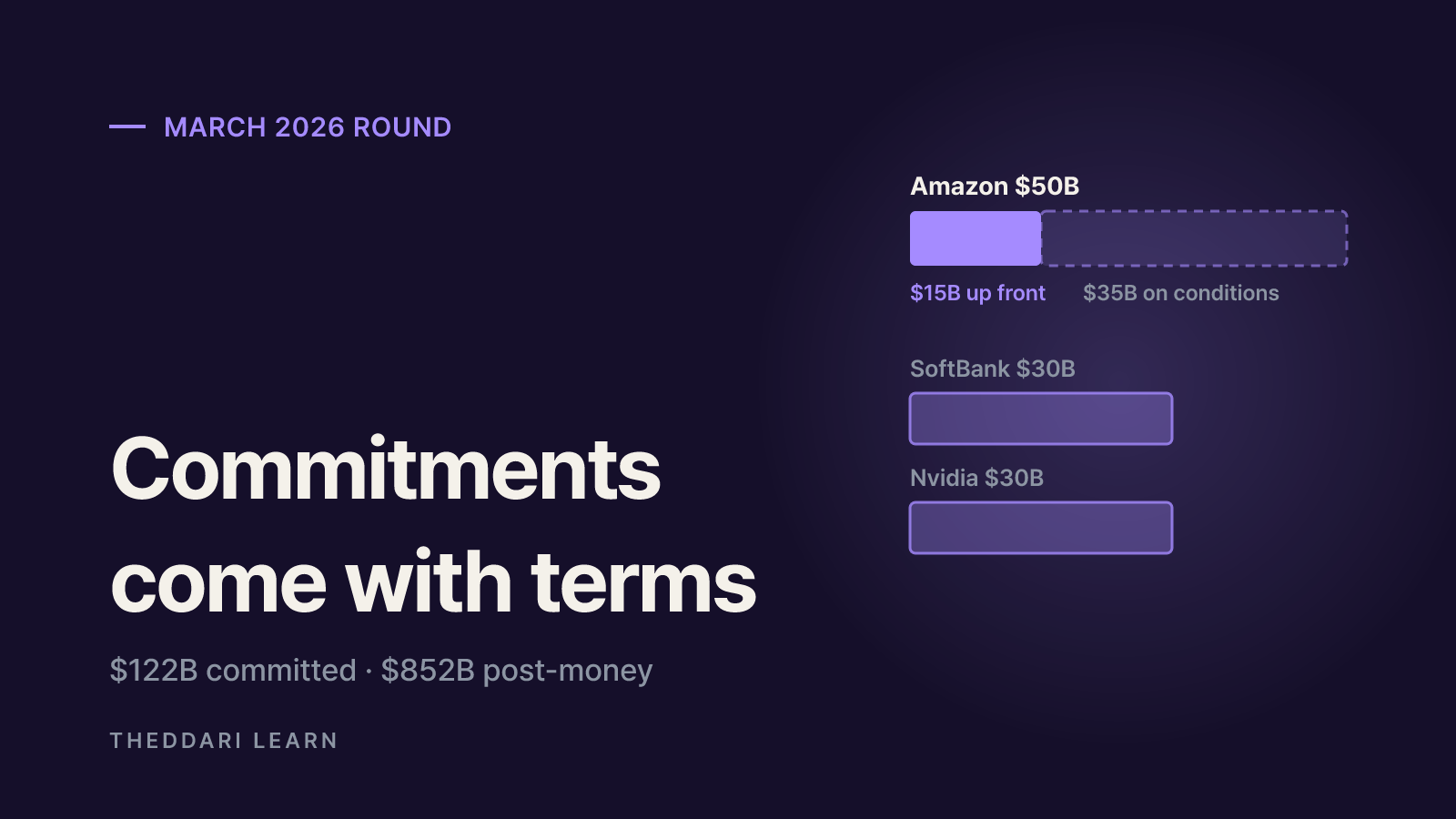
On February 27, 2026, OpenAI announced $110 billion from SoftBank ($30 billion), Nvidia ($30 billion) and Amazon ($50 billion). By March 31 financial investors had joined and the round closed at $122 billion committed. OpenAI said more than $3 billion came from individual investors through bank channels, and that its roughly $4.7 billion revolving credit facility was undrawn at close.
The structure matters more than the total. Per the OpenAI and Amazon announcement, Amazon's $50 billion started with $15 billion, with another $35 billion to follow 'in the coming months when certain conditions are met.' The same deal expanded OpenAI's existing $38 billion AWS agreement by $100 billion over eight years, including about 2 gigawatts of Trainium capacity. Nvidia's investment was likewise paired with dedicated inference and training capacity.
Size
- March 2026 round (closed)
- $122B committed
- October 2026 round (reported, open)
- $30B target cut to up to $20B; about $11B committed
Valuation
- March 2026 round (closed)
- $730B pre / $852B post
- October 2026 round (reported, open)
- $1.25T, basis not disclosed
Anchor investors
- March 2026 round (closed)
- Amazon, Nvidia, SoftBank and other strategics
- October 2026 round (reported, open)
- Reportedly led by a UAE investor group
Payment structure
- March 2026 round (closed)
- Partly tranched and tied to compute deals
- October 2026 round (reported, open)
- Terms not public
Source quality
- March 2026 round (closed)
- Official OpenAI announcements
- October 2026 round (reported, open)
- Press reports citing anonymous sources
Strategic money that comes bundled with chip and cloud purchase agreements is sometimes criticized as circular, since part of the investment flows back to the investor as revenue. A round driven by financial investors and family offices is a purer test of price, which is why weak demand reads as a market signal.
What the shortfall signals, and what it does not
Reasonable takeaways
- Price discovery: demand stayed soft even after the valuation was trimmed from $1.4 trillion to $1.25 trillion, which hints at where institutions draw the line ahead of an IPO.
- Competitive pressure: the revenue-growth gap with Anthropic cited by the Journal suggests investors are repricing the 'AI leader' premium.
- Compute pace: OpenAI has large cloud and chip agreements. A higher cost of capital raises the odds of slower rollouts or renegotiated terms, which matters for GPU, cloud and data center suppliers.
- IPO path: the Journal said OpenAI is preparing to go public as soon as early next year. Private-round prices often anchor IPO pricing talks.
Where people overreach
- The round is not finished. Commitments can still grow, and only an official announcement settles the final number.
- $1.25 trillion is about 47% above March's $852 billion post-money valuation. It is a miss against expectations, not a collapse.
- The reports rely on anonymous sources, and outlets describe the revised target and first close slightly differently.
- The WSJ article discloses that News Corp, its owner, has a content-licensing partnership with OpenAI. Note the disclosure when weighing coverage.
If you want to gauge the knock-on effect for listed AI suppliers, pair the OpenAI news with each company's own reporting schedule. The earnings calendar below shows upcoming report dates for names like Nvidia, Microsoft and Amazon.

Checklist for the next AI funding headline
- Which stage is the number? Target, commitment, or money actually closed.
- Which valuation basis? Pre-money or post-money, and is the comparison with prior rounds on the same basis.
- What are the payment terms? Tranches, milestones, and links to compute or cloud contracts.
- Who is investing? Strategic investors that are also customers or suppliers, or purely financial investors.
- Is there an official source? A company announcement, press release or regulatory filing. An IPO registration statement, once filed, will be the most reliable document.
- What is the link to listed stocks? A supplier's revenue share from OpenAI, contract length, and its next earnings date.
For a sense of how secondary markets price pre-IPO tech names, the pre-IPO page tracks indicative quotes. Keep in mind that secondary trades are thin and information-poor, so they can diverge from official round prices.
When AI news moves fast, it also helps to see how the same report is being read across channels. The AI Telegram trends board shows which keywords are picking up.
Bottom line: the OpenAI funding round story is less about cash and more about investors getting pickier on price and terms for a private AI company valued above $1 trillion. Until the final commitments, valuation basis, payment conditions and IPO timeline are confirmed in official documents, track the direction of those four factors rather than any single headline number.
Frequently asked questions
Does missing the target mean OpenAI is running out of money?
What is the difference between a commitment and money actually invested?
Is the $1.25 trillion valuation pre-money or post-money?
Is this bad news for Nvidia and other AI stocks?
Can retail investors buy OpenAI shares before an IPO?
Sources and references
- 1OpenAI Raises Less than Half of $30 Billion Target in Latest Round (Dow Jones/WSJ, Oct 31, 2026)(opens in a new tab)www.itiger.com
- 2OpenAI reportedly lowers funding target for new round (TechCrunch, Oct 31, 2026)(opens in a new tab)techcrunch.com
- 3OpenAI raises $122 billion to accelerate the next phase of AI (OpenAI, Mar 31, 2026)(opens in a new tab)openai.com
- 4Scaling AI for everyone (OpenAI, Feb 27, 2026)(opens in a new tab)openai.com
- 5OpenAI and Amazon announce strategic partnership (OpenAI, Feb 27, 2026)(opens in a new tab)openai.com
Related articles
 AI
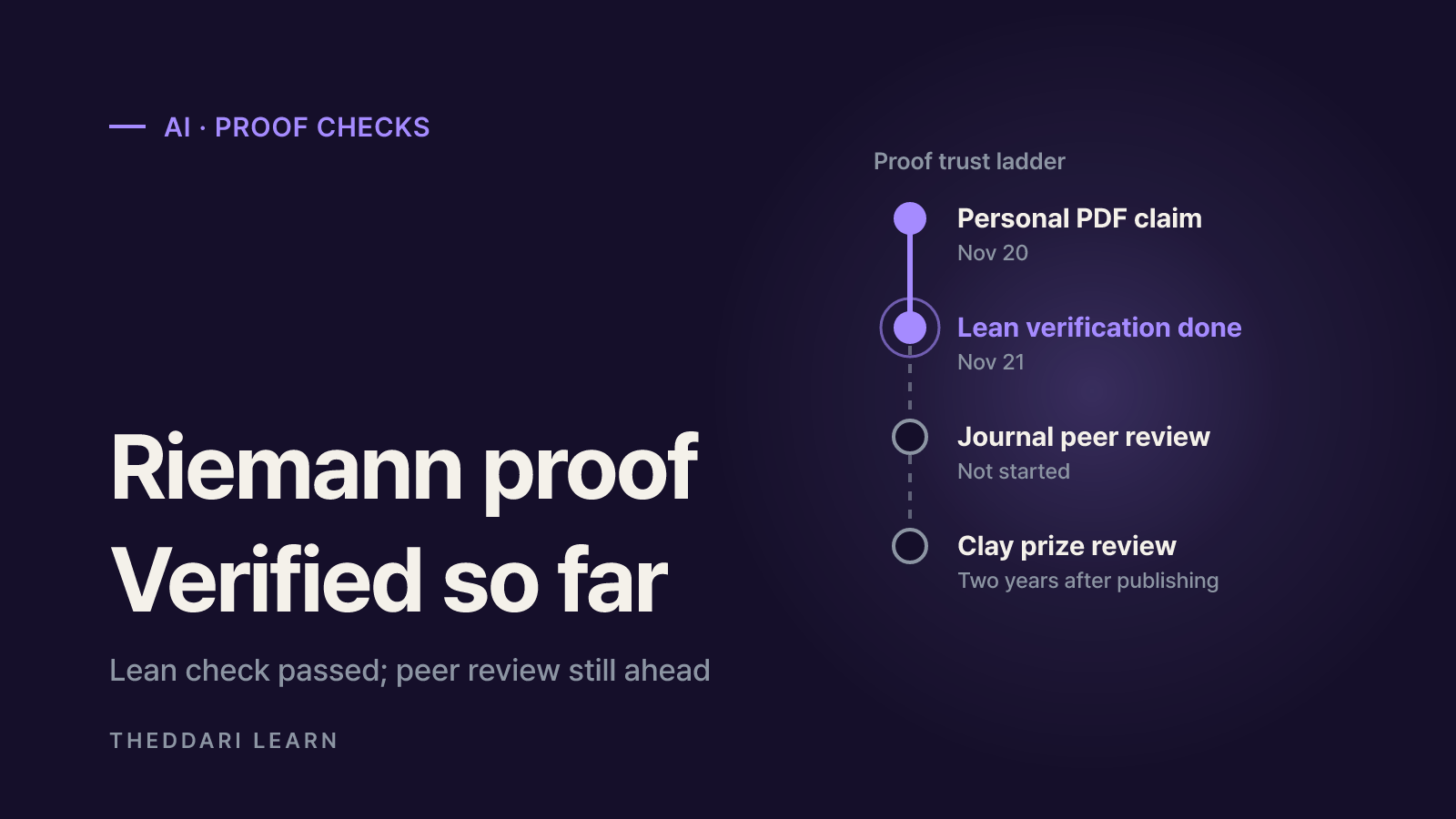
Anthropic's Riemann Hypothesis Proof: Is It Verified?
On November 20, 2026, Anthropic researcher Levent Alpöge said he had proved the Riemann Hypothesis with Claude. A day later the Lean and Mathlib communities certified the formal proof. What that means, what is still missing, and a checklist for judging big proof claims.
 AI
AgentRoboCritic: Can Frontier AI Agents Control Robots?
A November 2026 arXiv study from Carnegie Mellon, UIUC and Bosch scores every action a frontier AI agent sends to a robot. Here is what it found about recovery, grasping, alignment, zero-shot success and latency, and how far to trust it.
 AI
Inkling 2 Mini vs Inkling 2 Small: Specs, Local Use, Limits
Thinking Machines released Inkling 2 Mini on November 20, 2026: a 26.4B-parameter open-weights model with a ~20GB checkpoint that runs on 32GB Macs. Here is how it compares with Inkling 2 Small and what to check before you deploy it.