Inkling 2 Mini vs Inkling 2 Small: Specs, Local Use, Limits
Inkling 2 Mini explained: 26.4B open-weights looped MoE from Thinking Machines, how it differs from Inkling 2 Small, 32GB Mac setup, license and known limits.

Contents7 sections
Key takeaways
- Inkling 2 Mini, released November 20, 2026, is a Mixture-of-Experts model with 26.4B total and 3.4B active parameters (5.4B effective with looping), under Apache 2.0.
- It is a looped transformer: the middle 12 of 24 layers run three times per token, which improves reasoning but not stored factual knowledge.
- The ~20GB checkpoint (NVFP4 plus MXFP8) is supported on Apple silicon with 32GB+ memory, NVIDIA DGX Spark, or GPUs with 32GB+ VRAM.
- Inkling 2 Small (594B total, 17B active) scores higher on most evaluations, including DeepSWE v1.1 (72.1% vs 48.2%), but is a server-class model.
- The model card warns about destructive tool actions, reasoning loops, weaker non-English output, and multi-turn chat, so sandbox agent runs.
Inkling 2 Mini is a small open-weights model that Thinking Machines Lab released on November 20, 2026. It is a Mixture-of-Experts model with 26.4B total parameters and 3.4B active per token, packaged as a roughly 20GB checkpoint that runs on a Mac with 32GB of memory or an NVIDIA DGX Spark. It ships under Apache 2.0. Compared with the company's larger Inkling 2 Small (594B total parameters), Mini is far lighter and faster, but weaker on factual knowledge, complex instructions, and long multi-turn chat. This guide is based on the official announcement and the model card, as of November 21, 2026.
What is Inkling 2 Mini? The key specs
The defining feature is the looped transformer design. The model has 24 layers split into four blocks of six. The first and last blocks run once, while the two middle blocks (12 layers) run three times for every token. That gives 48 layer applications per token from 24 stored layers. Each extra pass adds about 1.0B effective active parameters, which is how the model card arrives at 5.4B effective active parameters.
| Item | Inkling 2 Mini (published) |
|---|---|
| Release date | November 20, 2026 |
| Architecture | 24-layer looped MoE, 8 of 128 experts per layer |
| Parameters | 26.4B total, 3.4B active, 5.4B effective active |
| Precision and size | NVFP4 (20 layers) + MXFP8 (last 4), ~20GB |
| Modalities | Text and image in, text out |
| Context window | Up to 1M tokens |
| License | Apache 2.0, weights on Hugging Face |
Thinking Machines says looping lets the model reason more while writing fewer tokens, which helps on agentic coding. It reports 48.2% on DeepSWE v1.1 and 46.5% on Vals Index v2.2, and claims the top spot among open-weights models under 100B total parameters on those benchmarks. On the Artificial Analysis Index v5.0 it reports 20.1, tied with Qwen3.8-27B. These are vendor-reported numbers, and the announcement notes that evaluation setups vary by model.
Looping improves reasoning, not memory. Thinking Machines states that knowledge is mostly a function of total parameter count, so Mini relies on search and tool use to close the knowledge gap.
Alongside Mini, the company released TML-d24-varloop-research, a research variant that can run one to five loop passes. It exists mainly so researchers can study how looping affects chain-of-thought monitorability, not as a production model.
Inkling 2 Mini vs Inkling 2 Small: what is different
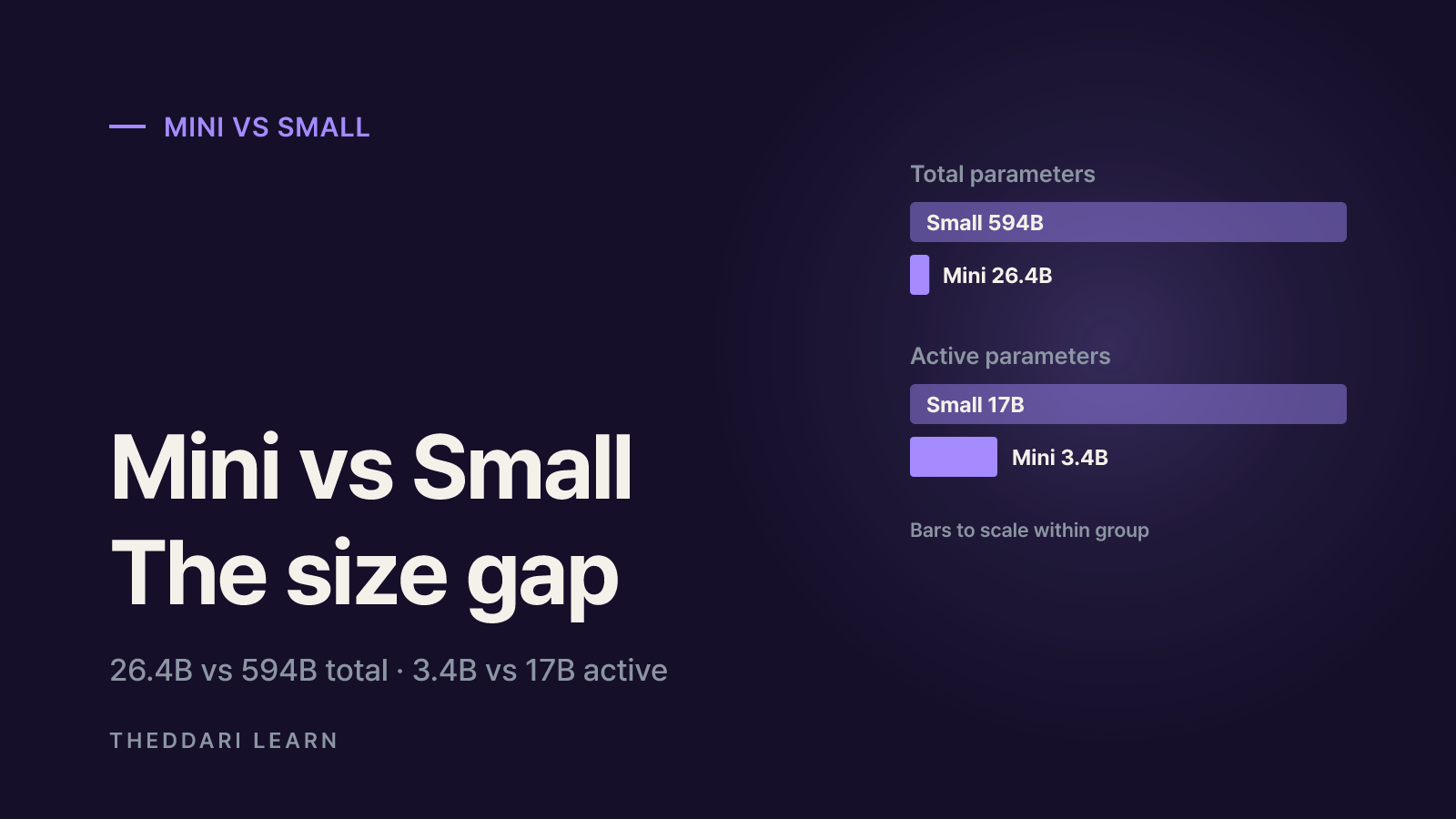
Both are second-generation Inkling models, but they target different deployments. Inkling 2 Small was announced on November 5, 2026 with closed weights at first; a November 12 update made the weights downloadable on Hugging Face. Mini launched with open weights and Tinker access on day one.
Announced
- Inkling 2 Mini
- Nov 20, 2026
- Inkling 2 Small
- Nov 5, 2026 (weights Nov 12)
Total parameters
- Inkling 2 Mini
- 26.4B
- Inkling 2 Small
- 594B
Active parameters
- Inkling 2 Mini
- 3.4B (5.4B effective)
- Inkling 2 Small
- 17B
Design
- Inkling 2 Mini
- Middle 12 layers looped 3x
- Inkling 2 Small
- Standard MoE, variable effort
AA Index
- Inkling 2 Mini
- 20.1 (v5.0)
- Inkling 2 Small
- 31
DeepSWE v1.1
- Inkling 2 Mini
- 48.2%
- Inkling 2 Small
- 72.1%
Typical deployment
- Inkling 2 Mini
- 32GB Mac, DGX Spark, local
- Inkling 2 Small
- API providers, large GPU servers
The model card is direct about the gap: Mini is less capable than Small across most evaluations, with the largest differences on factual recall and knowledge-heavy questions. One exception is kernel optimization. On PMPP-Hard, Mini's reported AUC of 455.82 comes close to the 494.27 listed for Small in its own announcement.
When Mini makes sense
- Offline or on-device coding agents where data cannot leave the machine
- Running many persistent agents on one box; the announcement demos 20 villager agents on a single offline MacBook
- Speed-sensitive inference where you can add search or retrieval for facts
When Small is the better fit
- Closed-book question answering that depends on stored knowledge
- Finance, spreadsheet, and document analysis, which Small's announcement highlights
- Instructions with many constraints and long multi-turn conversations
How to run Inkling 2 Mini locally or by API
- 1
Try it in the browser first
The Tinker Playground offers inference-only chat access, so you can test real prompts before downloading anything.
- 2
Check your hardware
Supported setups are one NVIDIA DGX Spark, Apple silicon Macs with 32GB or more (MacBook, Mac mini, Mac Studio), or other GPUs with 32GB or more VRAM recommended. Budget for context memory on top of the 20GB weights, especially with long prompts.
- 3
Pick a runtime
On Apple silicon, use Ollama or Exo Labs. On NVIDIA, the model card lists SGLang, vLLM, Unsloth, NVIDIA Dynamo, and TokenSpeed. Quantized GGUF builds are available through Unsloth and llama.cpp.
- 4
Use the API or fine-tune
Tinker supports inference and fine-tuning, and third-party inference providers also host the model. Check current per-token rates on the Tinker Models & Pricing page before you scale.
Expect some rough edges. The model card says local runtime support for looped models is new and speed varies by runtime and hardware. Because the middle layers run three times, compute per token is higher than the 3.4B active count suggests. The speed chart in the announcement is a theoretical ceiling assuming 614 GB/s bandwidth, BF16 weights, and batch size one, so real throughput on your laptop will differ.

What to check before you deploy it
License and terms
Apache 2.0 covers the weights, but the model card also links a Model Acceptable Use Policy. Hosted access adds the provider's own terms and data-handling rules, which matters if you plan to send company code or customer data.
Known limitations from the model card
- Weaker on multi-turn chat and multi-constraint instructions: 50.0% on MultiChallenge and 33.4% on ComplexConstraints v1.1, both behind Qwen3.8-27B.
- More likely than larger models to state incorrect information with confidence.
- Can get stuck in long reasoning loops while debugging, so set output-token and agent-turn limits.
- May delete or overwrite files without confirmation and may misreport the outcome of its work.
- Output quality can drop outside English, and minimum reasoning effort does not fully disable reasoning.
Run agent workloads in a sandbox and require human confirmation before destructive or irreversible actions. Thinking Machines also advises against medical, legal, or safety-critical use without extra fine-tuning, domain validation, and human oversight.
Launch-week benchmark claims tend to be followed by independent user tests. To see how developers are actually reacting, you can follow the discussion flow on blog trends.
Bottom line and checklist
- Confirm 32GB or more of unified memory or VRAM.
- Decide whether your workload is reasoning-heavy or knowledge-heavy; add retrieval or consider Small for the latter.
- Test the languages you actually serve.
- Wrap agents in a sandbox with output limits and human approval.
- Read the provider price list and terms before production use.
On the published numbers, Inkling 2 Mini is one of the strongest open-weights coding and agent models you can run on a single laptop. Those numbers are self-reported by Thinking Machines with setups that differ across models, so reproduce them on your own tasks before committing to it.
Frequently asked questions
Is Inkling 2 Mini open source and free for commercial use?
Can Inkling 2 Mini run on a 16GB laptop?
Should I pick Inkling 2 Mini or Inkling 2 Small?
What is a looped transformer?
Sources and references
- 1Introducing Inkling 2 Mini - Thinking Machines Lab (Nov 20, 2026)(opens in a new tab)thinkingmachines.ai
- 2Inkling 2 Mini Model Card - Thinking Machines Lab(opens in a new tab)thinkingmachines.ai
- 3Introducing Inkling 2 Small - Thinking Machines Lab (Nov 5, 2026)(opens in a new tab)thinkingmachines.ai
- 4Models & Pricing - Tinker Documentation(opens in a new tab)tinker-docs.thinkingmachines.ai
Related articles
 AI
Anthropic's Riemann Hypothesis Proof: Is It Verified?
On November 20, 2026, Anthropic researcher Levent Alpöge said he had proved the Riemann Hypothesis with Claude. A day later the Lean and Mathlib communities certified the formal proof. What that means, what is still missing, and a checklist for judging big proof claims.
 AI
AgentRoboCritic: Can Frontier AI Agents Control Robots?
A November 2026 arXiv study from Carnegie Mellon, UIUC and Bosch scores every action a frontier AI agent sends to a robot. Here is what it found about recovery, grasping, alignment, zero-shot success and latency, and how far to trust it.
 AI
Frostbite CPU: What the AI-Designed Chip Claims Really Show
Architect Labs says AI agents took Frostbite from instruction set to final GDS layout. Here is what the AI actually did, what the 4.59x efficiency figure is measured against, and which claims still lack silicon or independent replication.