Contents7 sections
You can legally reduce your Korea crypto tax, but you cannot legally make it disappear. As of November 2026, South Korea's Income Tax Act says that residents' income from selling, swapping or lending crypto on or after January 1, 2027 is taxed as "other income" under a separate flat-rate regime. The legal levers are limited and specific: a KRW 2.5 million annual deduction, a deemed cost basis for coins held before the start date, average-cost accounting, netting within the year, and deducting real transaction fees. Hiding income through borrowed accounts or destroyed records is a different matter: it can be prosecuted as tax evasion. This guide applies to Korean tax residents only and is based on the National Tax Service (NTS) overview and the text of Article 3 of the Punishment of Tax Offenses Act.
How the Korea crypto tax works from 2027
The NTS says virtual assets will be taxed separately as other income for transfers and lending made on or after January 1, 2027, following the December 2024 amendment to the Income Tax Act. A "transfer" includes selling for Korean won and swapping one coin for another, such as trading on a BTC or USDT market. Because this income is taxed separately, it is not added to salary or business income and does not climb Korea's progressive brackets.
| Item | Current rule (as of November 2026) |
|---|---|
| Start date | Transfers and lending on or after Jan 1, 2027 |
| Income type | Other income, taxed separately |
| Annual deduction | KRW 2.5 million (no tax if income is at or below this) |
| Rate | 20% national tax; 22% including local income tax |
| Cost basis method | Total average method, per resident |
| Coins held before 2027 | Higher of actual cost or Dec 31, 2026 market price |
| Filing | May 1-31 of the following year; first filing May 2028 |
The formula is short: (proceeds − cost basis and fees − KRW 2.5 million) × 20%, plus local income tax. The NTS asks residents to net the whole year's gains and losses and report them during the May income tax filing season. The tax was first legislated in 2020 and delayed three times; according to Maeil Business News, the 2026 tax reform package did not include another delay. Non-residents follow a different withholding system that this guide does not cover.
Five legal ways to lower the bill
Most of what people call "crypto tax saving" in Korea is simply applying rules the law already contains, and keeping the paperwork to prove it. There is no special loophole; the advantage goes to the investor with clean records.
1. The KRW 2.5 million annual deduction
If your net virtual asset income for the year is KRW 2.5 million or less, no tax is due. Above that, only the excess is taxed. The deduction resets every calendar year, so realizing a large gain in one year versus spreading it across several years changes how many times you can use it. The trade-off is market risk: delaying a sale only for tax reasons means carrying the price swings in the meantime.
2. Deemed cost basis for coins held before 2027
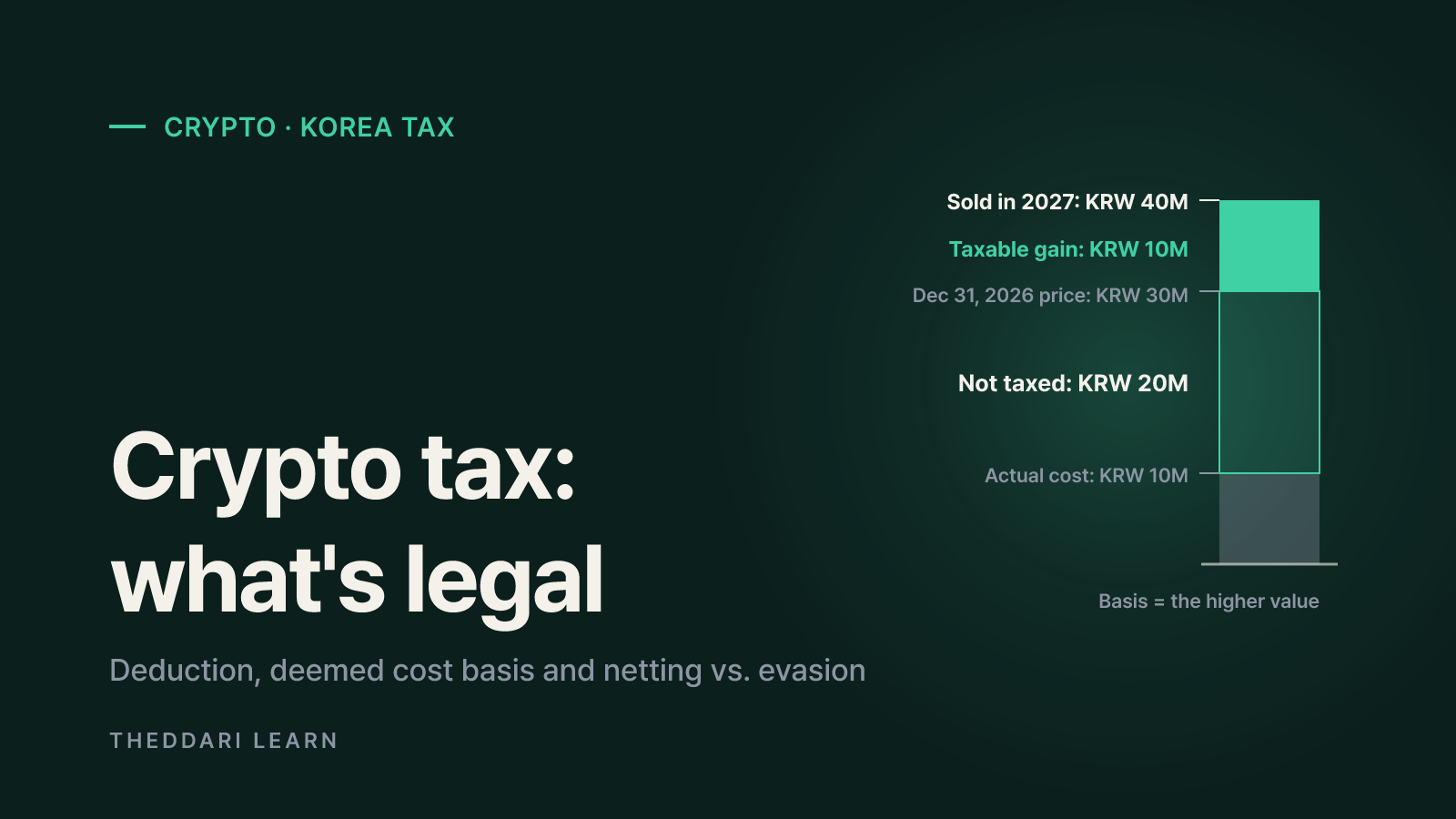
Under Article 37(5) of the Income Tax Act, the cost basis of coins held before January 1, 2027 is the higher of the actual purchase price or the market price on December 31, 2026. In practice, price gains made before the tax starts are not taxed. For coins listed on exchanges designated by the NTS, the market price is the average of prices those exchanges posted at 00:00 on January 1, 2027. If you bought near a peak and your actual cost is higher than the year-end price, you need records to prove it, otherwise you may be stuck with the lower figure.
3. Total average cost, calculated per person
Residents calculate cost basis with the total average method, combining all units of the same coin across every exchange and wallet they own (Enforcement Decree Article 88(1)). Buy one coin for KRW 10 million and another for KRW 50 million, and your average cost is KRW 30 million. Splitting holdings across platforms does not let you pick high-cost lots to sell first, which is a key difference from specific-lot identification used in some other countries.
4. Netting gains and losses within the year
If coin A made a gain and coin B made a loss in the same tax year, only the net amount is taxed. Because crypto income is taxed separately, you cannot offset it against stock gains or salary, and current rules provide no carryforward of unused losses. That makes the timing of a loss sale relevant to that year's bill. Detailed guidance on selling and immediately rebuying the same coin has not been published, so check NTS guidance before relying on that pattern.
5. Deducting real fees
Deductible expenses include the purchase price plus fees paid when buying and selling. Keeping exchange statements and withdrawal fee records reduces taxable income. There is also a fallback for coins acquired from 2027 outside a registered virtual asset service provider when the actual cost cannot be verified: up to 50% of proceeds can be treated as expenses. That fallback excludes separate fees and applies to all units of the same coin, so it can backfire if some of your units actually cost more.
The December 31, 2026 market price is based on Korean won exchange prices, which can differ from global prices. You can compare the domestic-versus-overseas gap on theddari's Kimchi premium tracker.
Worked example: netting and the deduction
The numbers below are a simplified illustration of the rules, not a tax calculation for any real account. Actual results depend on your records, holding history and the final enforcement decree.
- 1
Sell a coin held before 2027
You bought a coin in 2024 for KRW 10 million. Its December 31, 2026 price is KRW 30 million, and you sell it in 2027 for KRW 40 million. The cost basis is the higher figure, KRW 30 million, so income is KRW 10 million.
- 2
Net a loss in the same year
In 2027 you also realize a KRW 5 million loss on another coin. Net income becomes KRW 5 million.
- 3
Apply the deduction
KRW 5 million minus KRW 2.5 million leaves a taxable base of KRW 2.5 million.
- 4
Calculate the tax
KRW 2.5 million × 20% = KRW 500,000, plus KRW 50,000 local income tax, for KRW 550,000 in total. Had the loss been realized in 2028 instead, there would be nothing to net in 2027, and the bill would be (KRW 10 million − 2.5 million) × 22% = KRW 1.65 million.
The example shows the realistic scope of legal tax planning: the KRW 20 million of pre-2027 appreciation is excluded by the deemed cost basis, and the timing of the loss sale changes the 2027 result.
Where tax planning becomes crypto tax evasion
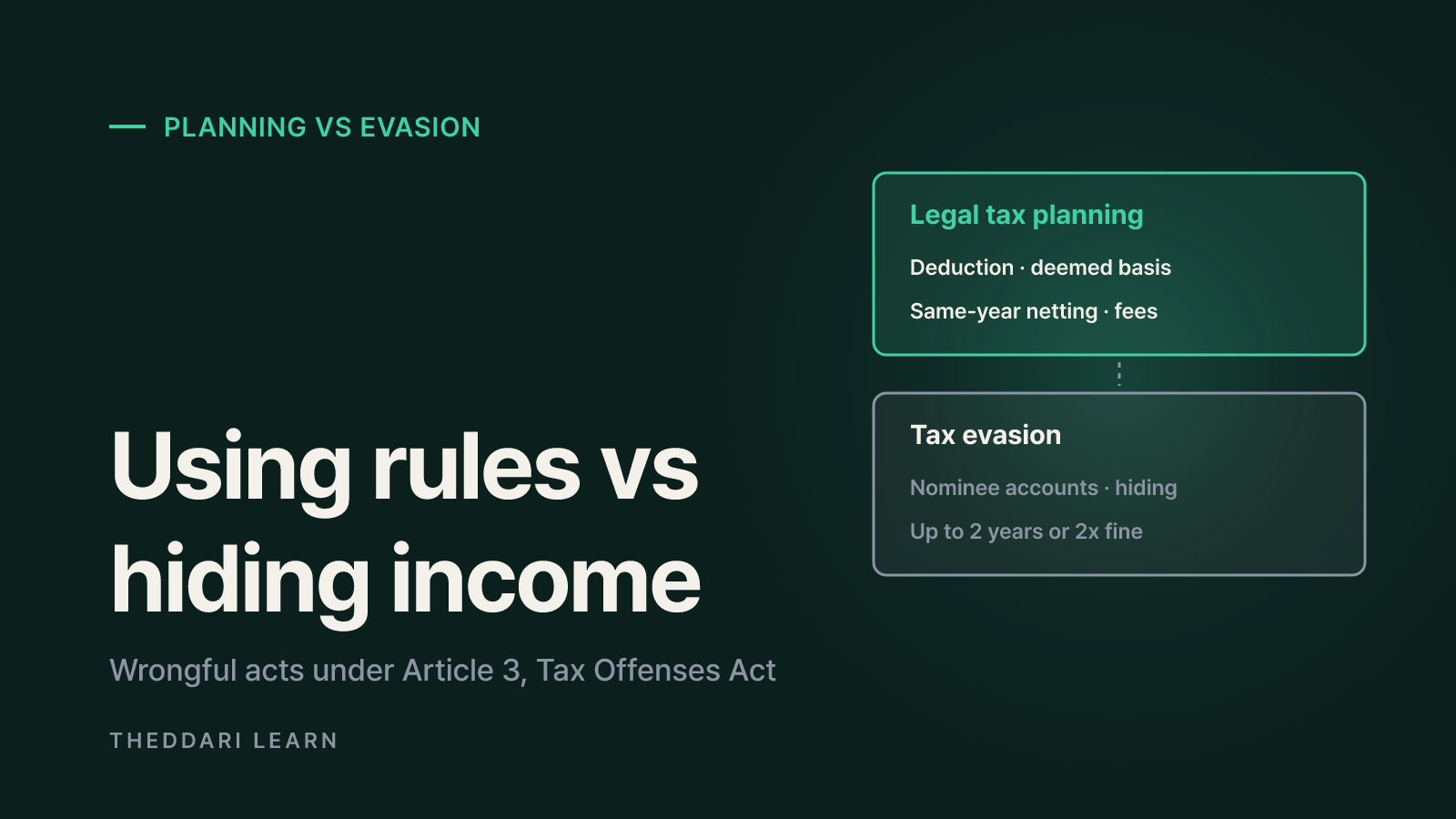
Using the rules and hiding income are legally different acts. Article 3 of the Punishment of Tax Offenses Act provides that evading tax through fraud or other wrongful acts is punishable by up to two years in prison or a fine of up to twice the evaded tax. If the evaded amount is KRW 500 million or more, or KRW 300 million or more and at least 30% of the tax due, the maximum rises to three years or three times the evaded tax.
| Legal planning | Conduct that can be treated as evasion |
|---|---|
| Staying within the KRW 2.5 million deduction | Trading through a relative's or friend's account to hide income |
| Applying the Dec 31, 2026 deemed cost basis | Forging purchase records or submitting false evidence |
| Selling loss positions in the same year to net | Deliberately destroying records or keeping double books |
| Deducting genuine transaction fees | Moving assets offshore to conceal them and skipping the filing |
The Act lists the wrongful acts it means: false bookkeeping including double books, creating or receiving false evidence, destroying books and records, concealing assets, manipulating or hiding income or transactions, and other deceptive conduct that makes assessment or collection impossible or substantially harder. Korean courts have held that using a borrowed account once is not automatically evasion, but splitting deposits across multiple nominee accounts or similar steps that show an active intent to conceal can be. Simply missing a filing brings penalty taxes; adding concealment can turn it into a criminal case.
Offshore exchanges and self-custody wallets
A Maeil Business News column by tax lawyers calls the idea that self-custody wallets hide crypto from Korean authorities a misconception. If your overseas exchange balances exceed KRW 500 million in total on any month-end, you must file a foreign financial account report the following June, and that duty stays even if you later move everything to a wallet. Non-reporting can bring a fine of 10% of the unreported amount, capped at KRW 1 billion, and unreported amounts above KRW 5 billion can lead to criminal charges and public naming. The column also notes that exchanges of information under the OECD Crypto-Asset Reporting Framework (CARF) between early-adopter countries, including Korea, are scheduled to start in 2027.
Fixing mistakes early helps. Filing late on your own before a fine is imposed can reduce it depending on timing, and the Punishment of Tax Offenses Act allows reduced sentences when an amended or late return is filed within set periods after the deadline.
Checklist before December 31, 2026
- Download every buy, sell, deposit and withdrawal record from each exchange and wallet, and store them in one place.
- Record your holdings as of December 31, 2026, and keep purchase proof for any coin whose actual cost may be above the year-end price.
- Check whether your overseas exchange balances ever exceeded KRW 500 million on a month-end and whether you owe a foreign account report.
- From 2027, track realized gains and losses during the year so you can plan the deduction and netting before December.
- Recheck staking, lending and airdrop treatment once the NTS publishes detailed guidance.
Tax news spreads fast in Korean crypto communities, so it helps to watch theddari's crypto Telegram trends for what people are discussing, then confirm the details against the NTS source. If you trade across several exchanges, the exchange arbitrage view shows how prices differ between them. In short, legal crypto tax planning in Korea means using the deduction, cost basis and netting rules correctly, and that depends on records you can prove.