Contents8 sections
- How Ethereum treasury companies work
- How they raise money: ATMs, direct offerings and preferred stock
- What mNAV means and why 1x is the line
- The risks: dilution and falling ETH together
- A checklist for corporate Ethereum holdings stocks
- Treasury stocks vs. holding ETH or a spot ETF
- Frequently asked questions
- Sources and references
Ethereum treasury companies are publicly traded firms that make ether (ETH) their main balance-sheet asset and keep buying more with money raised from selling stock. Owning one of these stocks means you are exposed not only to the ETH price but also to how many new shares the company sells and at what price. That is why two numbers matter most: mNAV, the ratio of market cap to the value of the assets held, and ETH per share. This guide uses U.S. Securities and Exchange Commission (SEC) filings and company data available as of October 2026.
How Ethereum treasury companies work
The playbook is simple: sell securities (common stock, preferred stock, sometimes warrants), use the cash to buy ETH, then stake most of that ETH to earn network rewards. Think of it as the Ethereum version of what Strategy (MSTR) does with bitcoin.
The two largest names are BitMine Immersion Technologies (NYSE: BMNR) and SharpLink (Nasdaq: SBET). Both had other businesses before mid-2025, bitcoin mining and affiliate marketing respectively, and both pivoted to holding ETH as their core strategy.
ETH held
- BitMine (BMNR)
- 6,041,481 ETH (Oct 18, 2026)
- SharpLink (SBET)
- 888,938 ETH (Aug 3, 2026)
How it is held
- BitMine (BMNR)
- Mostly staked (5,067,309 ETH)
- SharpLink (SBET)
- Native ETH plus LsETH and weETH liquid staking tokens
Main funding tools
- BitMine (BMNR)
- At-the-market common stock, Series A preferred (BMNP)
- SharpLink (SBET)
- Registered direct offerings with warrants, ATM
Buybacks
- BitMine (BMNR)
- 22.9 million shares in 2026, $399.6 million
- SharpLink (SBET)
- 4,071,223 shares since Aug 2025, about $41.7 million
Leadership
- BitMine (BMNR)
- Chairman Thomas Lee
- SharpLink (SBET)
- CEO Joseph Chalom, Chairman Joseph Lubin
In its October 19, 2026 release filed with the SEC, BitMine reported 6,041,481 ETH plus $582 million in cash and marketable securities. A week later it said holdings reached roughly 6.05 million ETH, about 4.95% of total supply, according to crypto.news. SharpLink's Q2 2026 results showed 888,938 ETH as of August 3, 2026. Holdings change weekly, so always read the figure together with its date.
Where the revenue comes from
Holding ETH produces almost no cash on its own, so staking rewards are the main revenue line. SharpLink reported $11.5 million in Q2 2026 revenue, of which $11.2 million came from staking. For BitMine, CoinDesk reported that staking produced $10.2 million of $11 million in revenue for the quarter ended February 2026, while general and administrative expenses were $75 million. Staking income does not automatically cover the cost of running a public company.
How they raise money: ATMs, direct offerings and preferred stock
- At-the-market (ATM) programs: the company sells common stock into the market at prevailing prices, a little at a time, up to a registered limit. It is fast and flexible, but it creates steady selling supply.
- Registered direct offerings and private placements: a block of shares, often bundled with warrants, is sold to specific investors. On June 23, 2026, SharpLink sold 10,013,351 shares with warrants at $7.49 per unit, raising $75 million, and said the price was above its net asset value.
- Preferred stock: shares that rank ahead of common stock for dividends and liquidation. BitMine lists its Series A preferred on the NYSE as BMNP. Preferred stock limits common dilution but adds a recurring dividend obligation and a senior claim.
Scale matters. According to CoinDesk's read of BitMine's 10-Q, common shares outstanding went from about 232 million on August 31, 2025 to nearly 494 million on February 28, 2026, while additional paid-in capital grew from $8.36 billion to $18.55 billion. Most of that money went into ETH.
More shares is not automatically bad. If ETH holdings grow faster than the share count, each share ends up backed by more ETH. The metric to watch is ETH per share, not share count.
What mNAV means and why 1x is the line
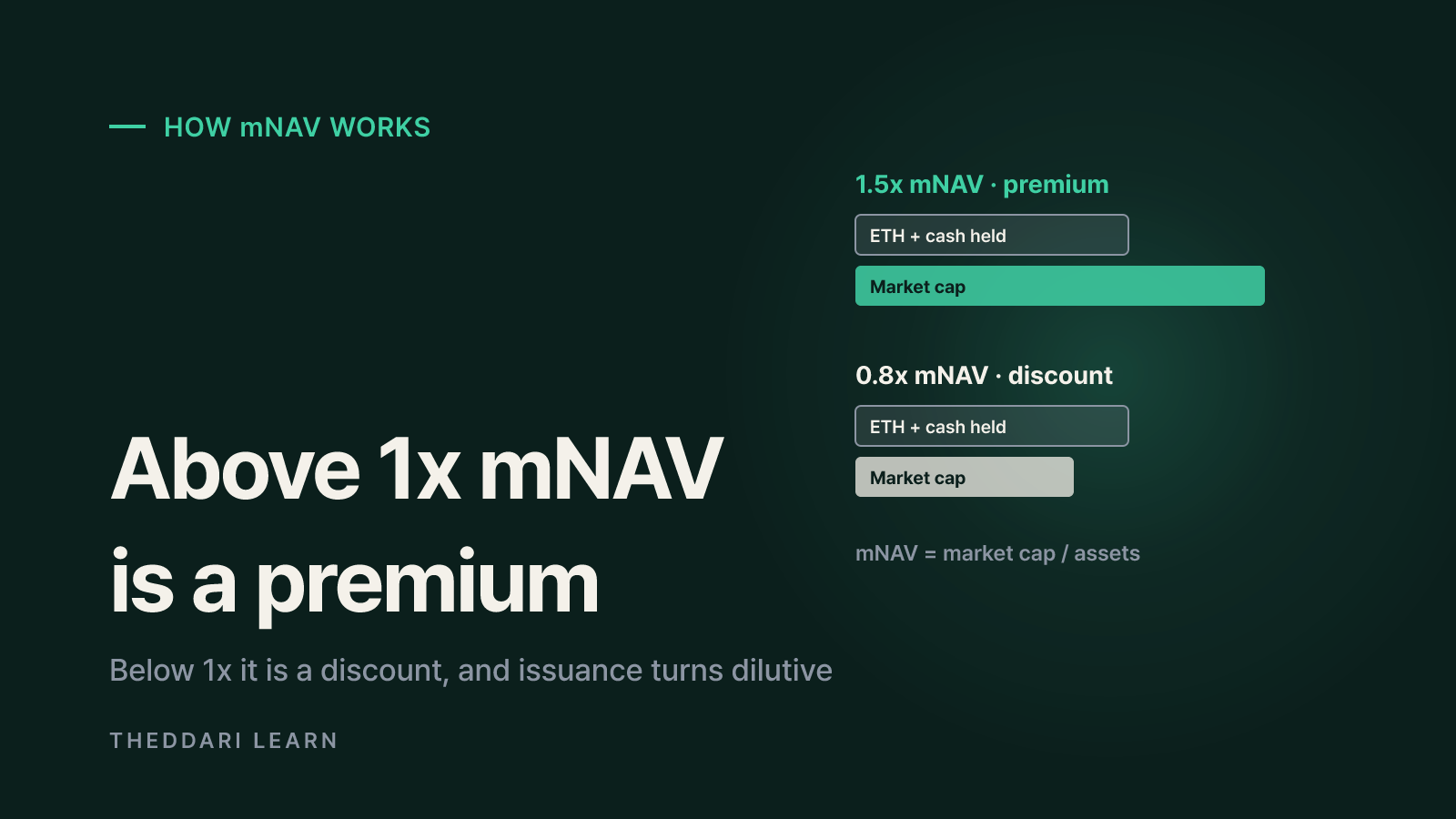
mNAV tells you how many times the market values the company relative to what it owns. On its ETH dashboard, SharpLink defines basic mNAV as market cap (using basic-equivalent shares) divided by SharpLink NAV, where NAV is ETH holdings times the ETH price, plus dollar holdings such as cash and stablecoins, adjusted for fund gains or losses.
- mNAV = market cap / (ETH value + cash and other dollar holdings)
- Above 1 (premium): investors pay more for the stock than the assets behind it.
- Below 1 (discount): the whole company trades for less than its ETH and cash.
Definitions vary. SharpLink also shows a fully diluted mNAV that assumes all warrants and options are exercised, and data sites differ on how they treat debt and preferred stock. SharpLink itself notes that its mNAV is not the same as traditional net asset value and does not account for liabilities. Line up the definitions before comparing mNAV figures from different sources.
A worked example
Assume a company with 100 shares and 100 ETH (1 ETH per share). With ETH at $2,000, assets are worth $200,000, or $2,000 per share. Fees and taxes are ignored.
Share price
- Issue at 1.5x mNAV
- $3,000
- Issue at 0.8x mNAV
- $1,600
- Buy back at 0.8x mNAV
- $1,600
Action
- Issue at 1.5x mNAV
- Sell 10 shares, buy 15 ETH with $30,000
- Issue at 0.8x mNAV
- Sell 10 shares, buy 8 ETH with $16,000
- Buy back at 0.8x mNAV
- Sell 8 ETH, buy back 10 shares for $16,000
After
- Issue at 1.5x mNAV
- 115 ETH / 110 shares
- Issue at 0.8x mNAV
- 108 ETH / 110 shares
- Buy back at 0.8x mNAV
- 92 ETH / 90 shares
ETH per share
- Issue at 1.5x mNAV
- 1.045 (+4.5%)
- Issue at 0.8x mNAV
- 0.982 (-1.8%)
- Buy back at 0.8x mNAV
- 1.022 (+2.2%)
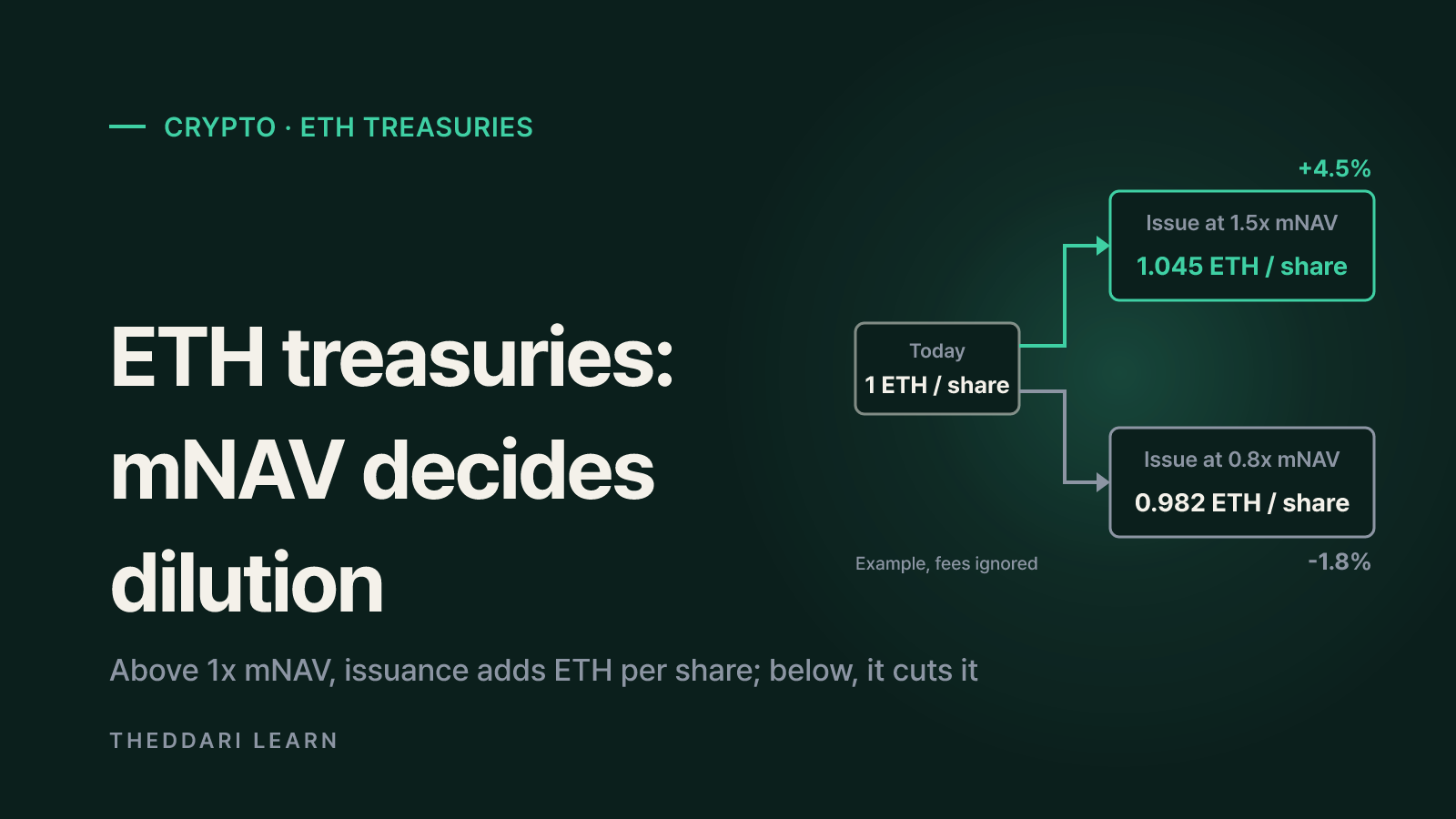
The same share sale lifts ETH per share from 1 to 1.045 at a 1.5x premium but cuts it to 0.982 at a 0.8x discount. That is why discounted treasuries turn to buybacks instead. In September 2025, Decrypt reported that BitMine's and SharpLink's mNAV had slipped to 0.99 and 0.89, and that ATM-funded raises had stalled. BitMine has since repurchased 22.9 million shares in 2026 at an average of $17.48, and SharpLink has bought back 4,071,223 shares since August 2025.
The risks: dilution and falling ETH together
- ETH falls: asset value drops, and under U.S. GAAP fair-value accounting the decline runs through net income. SharpLink's Q2 2026 net loss of $394.3 million included $321.0 million of unrealized losses.
- mNAV compresses: if the stock falls faster than the ETH it holds, the premium can flip to a discount.
- Fundraising dries up: issuing stock at a discount reduces ETH per share, so new raises become hard to justify.
- Buying slows: the company buys less ETH and may spend cash or ETH on buybacks, removing a source of demand the market may have counted on.
Less obvious sources of dilution
- Warrants and options: exercises add shares, which is why fully diluted mNAV is the more conservative number.
- Preferred dividends: these are paid before common holders. If staking income falls short, the company may need to sell ETH or issue more stock to cover them.
- Impairments on liquid staking tokens: SharpLink carries LsETH and weETH at cost and recorded a $76.1 million impairment in Q2 2026, which it says is not reversed if prices recover.
- Operating and staking risk: custody, legal and staff costs are ongoing, and staking carries slashing and technical failure risk.
In a rising market, premium, issuance, more ETH and higher ETH per share look like a flywheel. The same mechanics run in reverse in a falling market, so past growth in ETH per share is not a forecast.
A checklist for corporate Ethereum holdings stocks
- 1
Confirm holdings and the date
Read the latest press release or 8-K. BitMine publishes weekly; SharpLink updates its dashboard weekly. Never compare figures from different dates.
- 2
Match the mNAV definition
Check whether the figure is basic or fully diluted and whether cash, debt and preferred stock are included.
- 3
Track ETH per share
Look for steady growth quarter over quarter. Short dips can happen between a share sale and the ETH purchase.
- 4
Read the funding terms
Check remaining ATM capacity, warrant strike prices and counts, and preferred dividend rates in the 10-Q and 8-K. You can track report dates on the earnings calendar.
- 5
Compare costs with staking revenue
See whether staking income covers G&A plus preferred dividends. If not, the gap is filled by issuance or asset sales.
- 6
Compare with alternatives
Write down why you would choose this stock over holding ETH directly or a spot ether ETF. Paying a premium needs a clear reason.
Treasury purchase announcements and executive comments often spread first on Telegram. Use the crypto Telegram trends page below to see when chatter spikes, then verify numbers against the SEC filing itself.

Treasury stocks vs. holding ETH or a spot ETF
What drives the price
- Holding ETH
- ETH price
- Spot ether ETF
- ETH price minus fees
- Ethereum treasury stock
- ETH price, mNAV moves, management decisions
Dilution
- Holding ETH
- None
- Spot ether ETF
- None (creation/redemption)
- Ethereum treasury stock
- From new shares, warrants and preferred
Staking rewards
- Holding ETH
- Yours if you stake
- Spot ether ETF
- Depends on the fund
- Ethereum treasury stock
- Company revenue, net of costs
Extra risks
- Holding ETH
- Custody and hacks
- Spot ether ETF
- Issuer and fund rules
- Ethereum treasury stock
- Debt, preferred claims, accounting losses
Spot ETFs weakened the case for paying a premium for the same ETH exposure. An investor quoted by Decrypt argued that ETFs give direct exposure without a premium, which reduced demand for treasury stocks. On the other hand, a company that keeps growing ETH per share through staking and buybacks can look cheap on a per-share asset basis while it trades at a discount. Either way, the answer comes from mNAV and ETH per share, not from headlines.
The bottom line: an Ethereum treasury stock is a bet on ETH plus the company's ability to raise capital on good terms. Above 1x mNAV, issuance can help shareholders; that premium can disappear quickly when ETH falls. Both BitMine and SharpLink ran buybacks in 2026 for exactly this reason. Check the filing date and the mNAV definition every time you look at the numbers.