Ethereum Store of Value Debate: Supply, Burn, Digital Gold
Is ETH digital gold? We compare Ethereum's issuance and fee burn with Bitcoin's 21 million cap and gold's supply growth, using November 2026 supply data.
Contents8 sections
- How ETH supply works: issuance minus burn
- ETH vs Bitcoin vs gold: supply rules compared
- The bull case for an ethereum store of value: 'ultrasound money'
- The case against: why 'digital gold' is a stretch
- How to check ETH supply data yourself
- A store-of-value checklist for ETH
- Frequently asked questions
- Sources and references
Key takeaways
- ETH has no hard cap. Supply changes by validator issuance minus the base-fee burn introduced by EIP-1559.
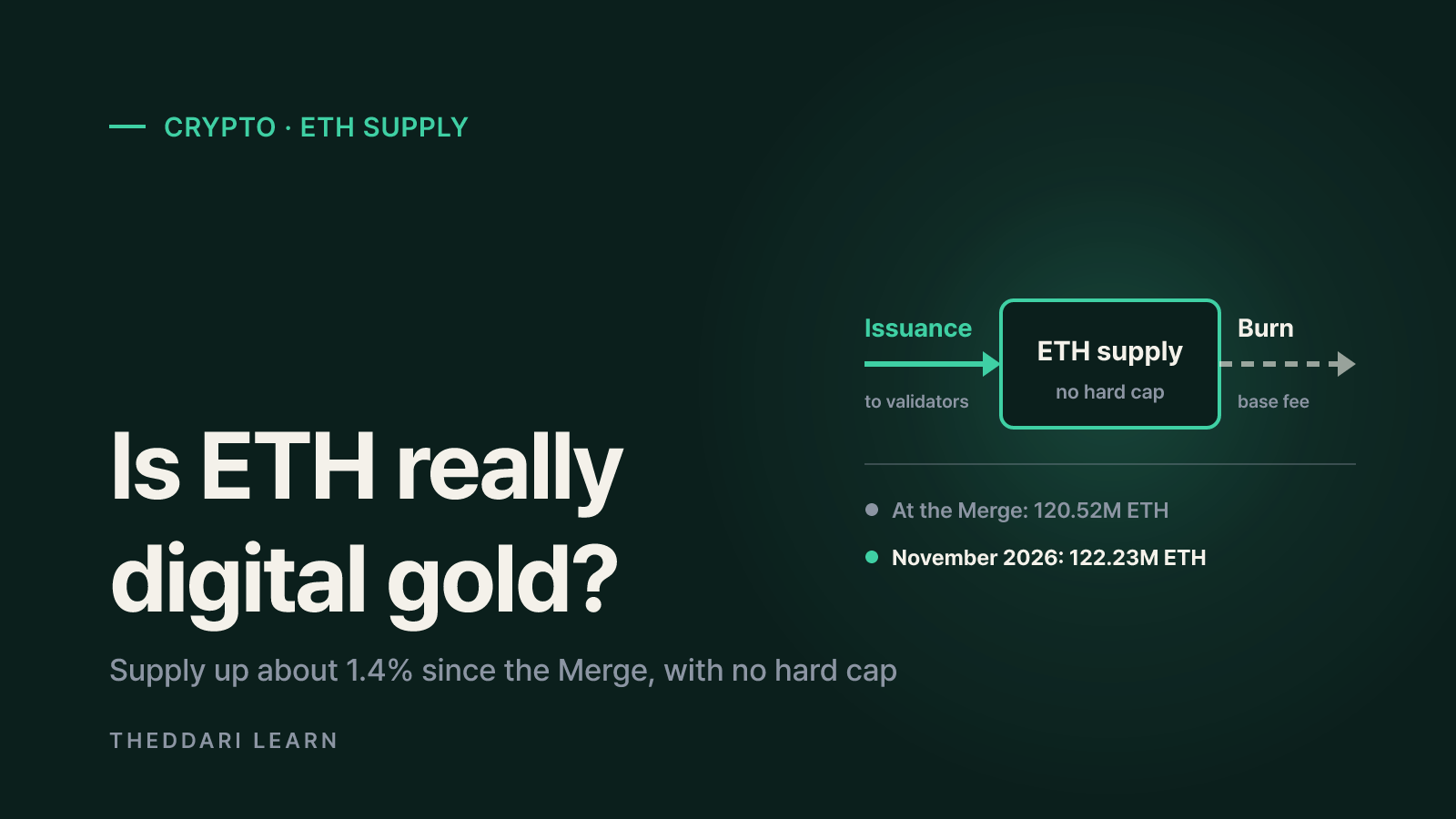
- As of November 18, 2026, ETH supply was about 122.23 million, up roughly 1.4% from about 120.52 million at the Merge in September 2022.
- That is roughly 0.34% a year on average, below gold's ~1.8% annual stock growth, but without a fixed rule like Bitcoin's 21 million cap.
- The burn depends on network demand, so the ultrasound money thesis only holds while blockspace demand stays high.
- A store of value is also judged on volatility and rule stability: ETH traded about 63% below its August 2025 high in November 2026.
Is Ethereum a store of value? The honest answer to the ethereum store of value question is: not proven, and it depends on demand. As of November 18, 2026, ETH supply stood at about 122.23 million (ultrasound.money, CoinGecko), up roughly 1.4% from about 120.52 million at the Merge in September 2022 (ethereum.org). Issuance fell sharply when Ethereum moved to proof-of-stake, but unlike Bitcoin there is no hard cap, and the fee burn that offsets issuance rises and falls with network usage.
This guide explains how ETH supply actually works, compares it with Bitcoin and gold, lays out the 'ultrasound money' case and the main objections, and shows how to check the supply data yourself instead of relying on a headline.
How ETH supply works: issuance minus burn
Two forces set ETH supply. Issuance creates new ETH as rewards for validators who secure the network. Burning permanently destroys ETH. According to ethereum.org, the balance between the two decides whether supply grows or shrinks over a given period.
Issuance: much lower since the Merge, but tied to staking
Under proof-of-work, miners received roughly 13,000 ETH a day. After the Merge only validator rewards remain. In ethereum.org's worked example, which assumes 14 million ETH staked, that comes to about 1,700 ETH a day, an annualized issuance rate of about 0.52% versus about 4.61% before the Merge: a cut of roughly 88%.
That 1,700 figure is an example, not a constant. Validator rewards scale with the total amount staked, and more validators means more ETH issued in total. On November 18, 2026, the supply breakdown on ultrasound.money showed about 44.66 million ETH in beacon chain balances, far above the 14 million in the example. Using the old example would understate today's issuance.
Burn: the EIP-1559 base fee
Since the London upgrade in August 2021, EIP-1559 burns the base fee paid by every transaction; block producers keep only the priority fee (tip). The base fee rises when blocks are busier than the target and falls when they are quieter, so the burn is effectively a live measure of blockspace demand. Penalties and slashing also remove ETH from validator balances.
Notably, the EIP itself admits the trade-off: once the base fee is burned, ETH supply can no longer be held constant, and because user demand for blockspace cannot be controlled, nobody can say in advance whether ETH will end up inflationary or deflationary.
ethereum.org gives a rule of thumb: the average gas price needed to offset X ETH of daily issuance is X/108 gwei (assuming a 15 million gas target per block and 12-second blocks), or about 16 gwei for 1,700 ETH a day. When we checked ultrasound.money on November 18, 2026, it displayed gas at about 0.1 Gwei. The formula's inputs reflect when that page was written and may not match current protocol parameters, so use the dashboard's live burn and issuance figures for the real net change.
ETH vs Bitcoin vs gold: supply rules compared
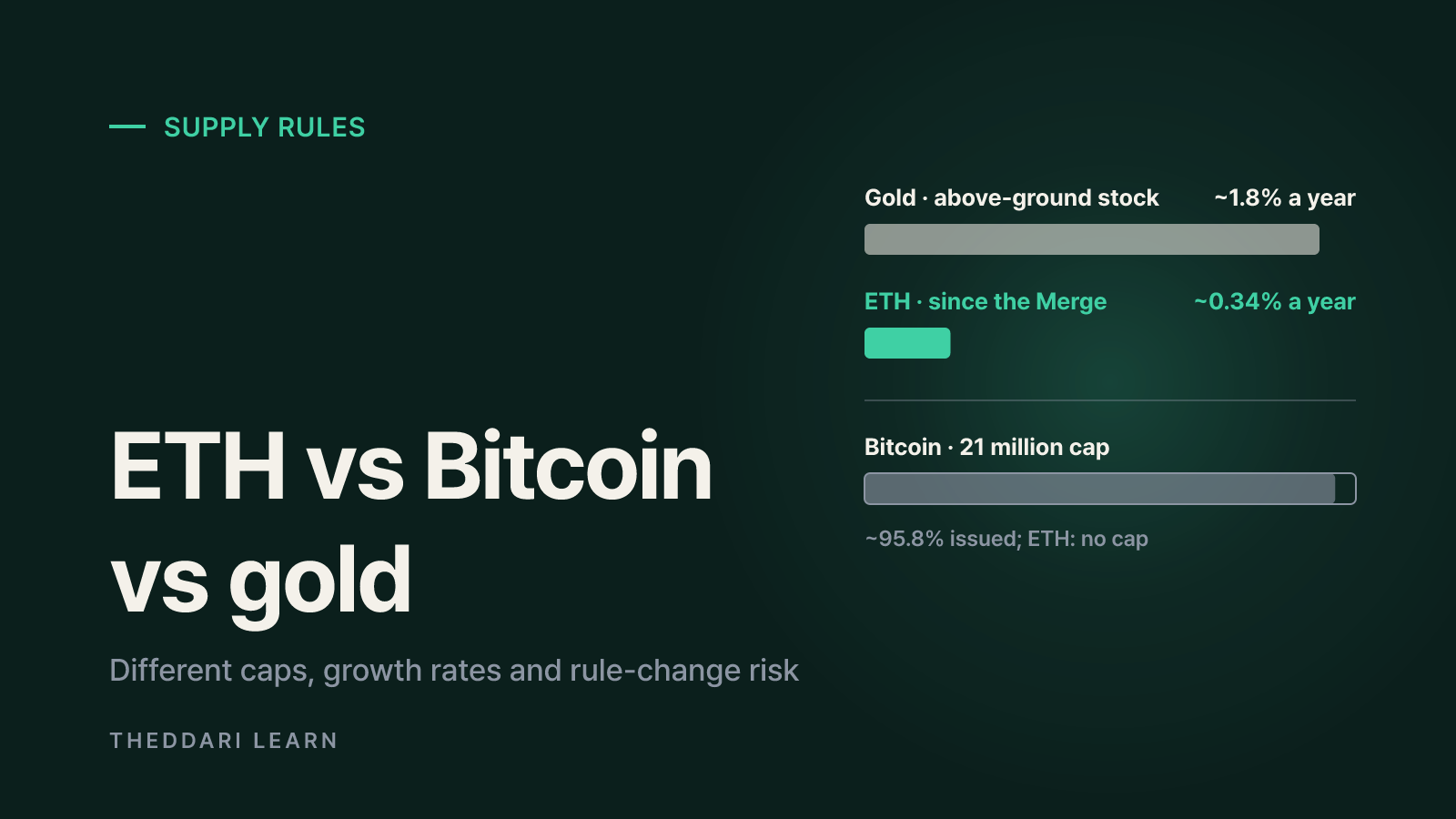
Most of the debate is really an argument about which supply model makes a better long-term store of value. Here is how the three compare on the questions that matter: how supply grows, whether it can shrink, and who can change the rules.
Supply cap
- Bitcoin
- 21 million coins
- Gold
- No fixed cap (limited by mining)
- Ethereum
- No fixed cap
New supply
- Bitcoin
- Mining rewards that halve over time
- Gold
- Mine production
- Ethereum
- Validator (staking) rewards
Can supply shrink?
- Bitcoin
- No, only lost coins leave circulation
- Gold
- Practically no; gold is rarely destroyed
- Ethereum
- Yes, via base-fee burn and penalties
Recent supply data
- Bitcoin
- About 20.11 million issued, ~95.8% of the cap
- Gold
- About 220,000 tonnes above ground, ~1.8% a year growth
- Ethereum
- About 1.4% net growth since the Merge, ~0.34% a year
Rule changes
- Bitcoin
- Require broad user and node consensus
- Gold
- Not applicable
- Ethereum
- Protocol upgrades can adjust rewards or the burn
The Bitcoin figure divides CoinGecko's circulating supply of 20,113,584 BTC on November 18, 2026 by the 21 million cap; bitcoin.org explains that issuance halves over time until it stops at 21 million. The gold figures are end-2025 estimates from the World Gold Council, and the ~1.8% is the ten-year average growth of the above-ground stock from new mining.
The ETH rate of roughly 0.34% a year is a simple average of ~1.4% net growth over the ~4.2 years since September 15, 2022. On that measure ETH's supply has grown more slowly than gold's. But ETH's future supply cannot be read off a fixed schedule like Bitcoin's, and it lacks gold's centuries of monetary use and central bank demand (the WGC estimates central banks hold about 38,600 tonnes).
The bull case for an ethereum store of value: 'ultrasound money'
Supporters sum up their view with the meme 'ultrasound money'. As ultrasound.money puts it: if capped-supply gold is sound money, decreasing-supply ether is ultra sound. The phrase grew out of a 2020 Vitalik Buterin joke about 'supersonic money' and Justin Drake's posts, and Bankless popularized it in 2021.
- Low issuance: the Merge cut issuance by roughly 88%, and net supply growth since then has run below gold's mining rate.
- Scarcity tied to usage: the more the network is used, the more base fee is burned, so rising demand reduces net supply growth.
- Fees payable only in ETH: EIP-1559's authors argue that burning the base fee ensures only ETH can pay for transactions, anchoring ETH's value to the platform.
- A way to avoid dilution: new ETH goes to validators, so holders who stake can offset much of the issuance that dilutes non-stakers.
- Auditable supply: anyone can verify issuance, burn and total supply on-chain or through public dashboards.
The case against: why 'digital gold' is a stretch
Skeptics argue ETH behaves less like a monetary commodity and more like an asset whose value depends on demand for a platform. Their main points:
- Supply has grown. Net supply is up about 1.4% since the Merge. Even ethereum.org frames deflation as something that happens during periods of high network activity, not as a default.
- The burn is demand-dependent. The EIP-1559 text itself says the long-run direction of supply cannot be predicted. When gas prices are low, issuance outpaces the burn.
- The rules can change. ethereum.org notes that future protocol changes could adjust staking rewards or burning. There is no socially locked number comparable to Bitcoin's 21 million.
- Volatility is high. Per CoinGecko, ETH hit an all-time high of $4,946 on August 24, 2025 and traded near $1,811 on November 18, 2026, about 63% lower. Bitcoin was about 49% below its own high the same day, so neither acted as a stable short-term store of value.
- Avoiding dilution requires staking risk. Offsetting issuance means staking, which brings slashing, exit queues, and custody or provider risk. Holding gold or bitcoin in cold storage has no equivalent requirement.
From EIP-1559: since we cannot control user demand for block space, we cannot assert at the moment whether ETH will end up inflationary or deflationary.
How to check ETH supply data yourself
When you see claims like 'ETH is deflationary again' or 'ultrasound money is dead', the fastest way to judge them is to check the time window and the baseline.
- 1
Read current supply
Compare ultrasound.money's supply breakdown (EVM balances plus beacon chain balances minus beacon chain deposits) with CoinGecko's total supply. Small gaps come from different update times.
- 2
Compare issuance and burn by period
Switch the dashboard between 1-day, 7-day and 30-day windows and compare ETH burned, ETH issued and the annualized supply growth. Do not draw a long-run conclusion from one short window.
- 3
Measure against the Merge
Subtract the roughly 120.52 million ETH at the Merge from today's supply to get the cumulative net change under proof-of-stake.
- 4
Check how much is staked
Larger beacon chain balances generally mean more issuance, so confirm which staking level any quoted issuance figure assumes.
- 5
Separate supply from price
Lower supply growth does not by itself move the price. Look at derivatives positioning and regional price gaps separately.
For the price side, theddari's funding rate page shows whether perpetual futures traders are crowded on one side, and the kimchi premium page tracks the gap between Korean and global exchange prices. Both help separate leverage-driven moves from the supply story.

To see whether narratives like ultrasound money are trending again among crypto communities, check the crypto Telegram trends page.
A store-of-value checklist for ETH
- Does the supply claim state its time window (since the Merge, or just the last week)?
- Which staking level does the issuance figure assume, and is it current?
- Is a falling burn caused by weaker demand or by changes in where and how fees are paid?
- Have you weighed the risk of rule changes against Bitcoin's fixed cap and gold's long track record?
- How does ETH's drawdown from its high compare with the stability you expect from a store of value?
- If you stake to avoid dilution, can you accept slashing, exit delays and custody risk?
Bottom line: Ethereum is unusual. Issuance dropped sharply at the Merge and the fee burn gives it a built-in way for supply to shrink. Yet as of November 2026 supply is higher than at the Merge, the burn depends on usage, and the rules remain open to upgrades. Whether ETH earns the 'digital gold' label depends less on any single supply number than on whether demand for Ethereum blockspace holds up over many years.
Frequently asked questions
Is ETH deflationary?
Does Ethereum have a maximum supply like Bitcoin?
Which fees get burned on Ethereum?
Is ETH a better store of value than Bitcoin?
Can staking protect me from dilution?
Sources and references
- 1How The Merge impacted ETH supply - ethereum.org(opens in a new tab)ethereum.org
- 2ETH supply and issuance - ethereum.org(opens in a new tab)ethereum.org
- 3EIP-1559: Fee market change for ETH 1.0 chain(opens in a new tab)eips.ethereum.org
- 4ultrasound.money - ETH supply and burn dashboard(opens in a new tab)ultrasound.money
- 5CoinGecko API - Bitcoin and Ethereum market data(opens in a new tab)api.coingecko.com
- 6Bitcoin FAQ - bitcoin.org(opens in a new tab)bitcoin.org
- 7Gold Market Primer: Market size and structure - World Gold Council(opens in a new tab)www.gold.org
Related articles
 Crypto
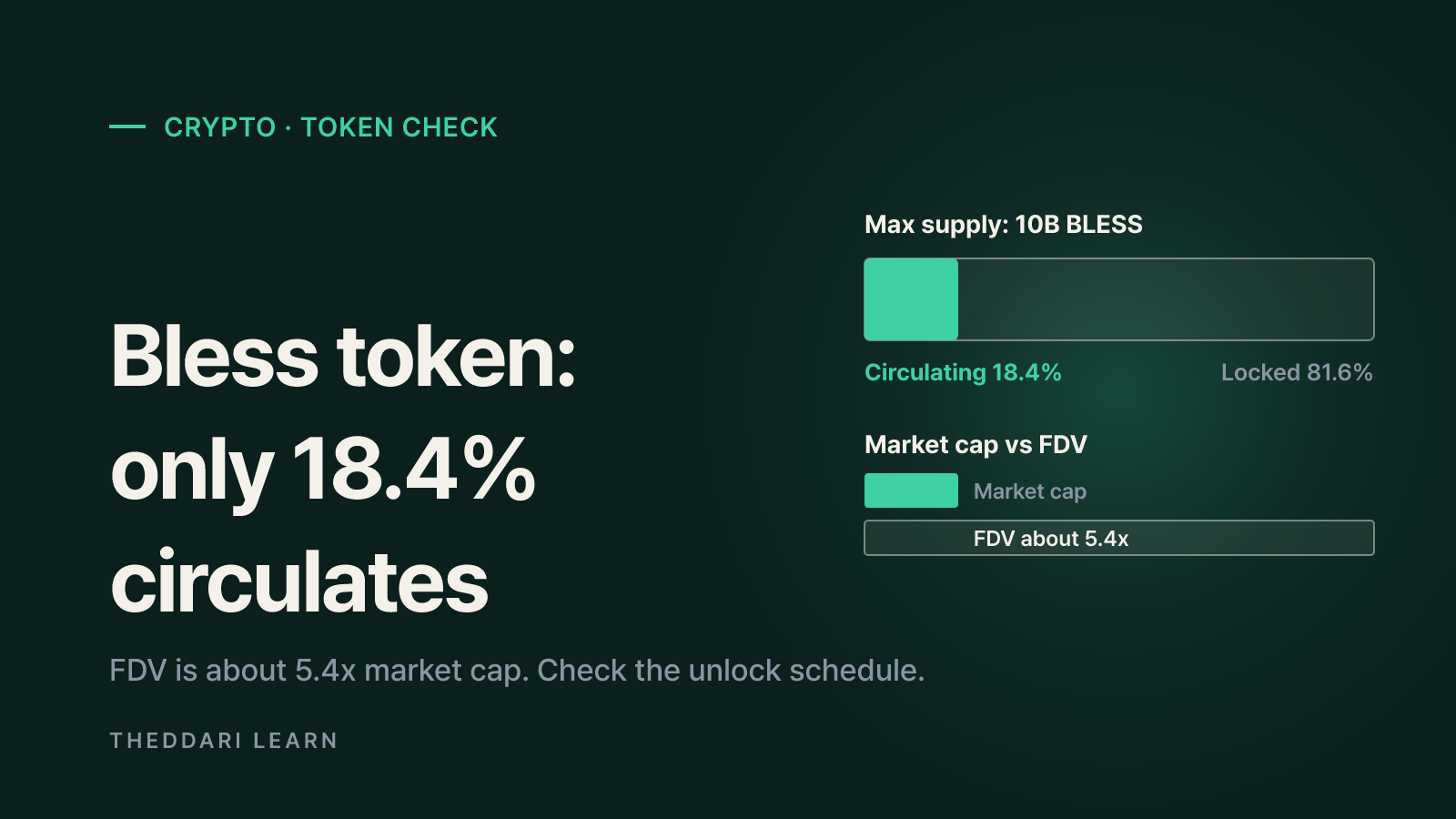
What Is the Bless Token? CoinGecko Trending Coin Checklist
Bless (BLESS) is a DePIN token that pools spare compute from everyday devices. Before buying the CoinGecko trending coin, check supply unlocks, where volume really trades, and the two official contract addresses.
 Crypto
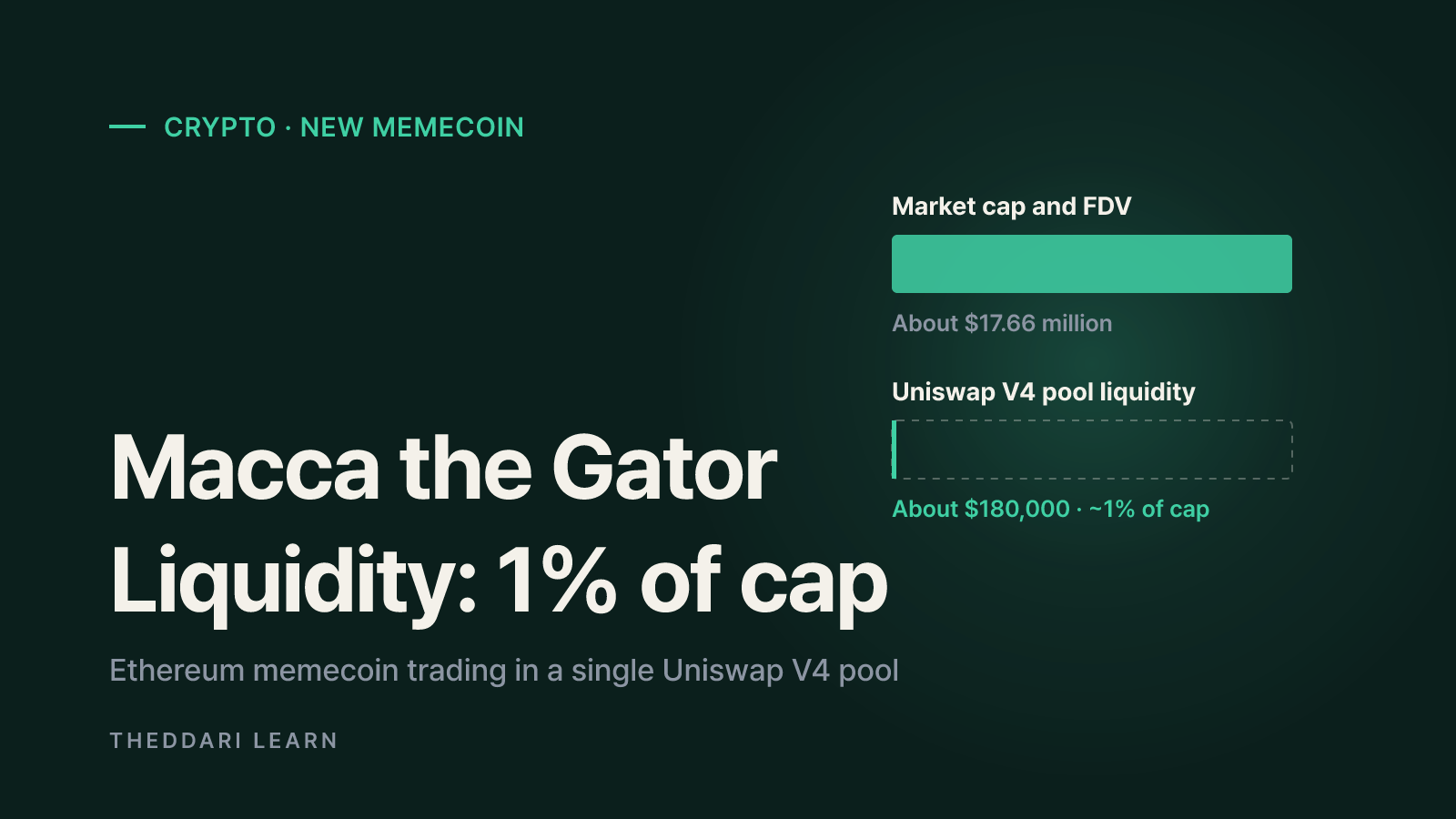
What Is Macca the Gator (MACCA)? Checks Before You Buy
Macca the Gator (MACCA) is a day-old Ethereum memecoin that hit #1 on CoinGecko trending. Here is what on-chain data shows, what it does not show, and how to check the token yourself.
 Crypto
What Is Bitcoin Capitulation? Signals and Their Limits
Capitulation is when underwater holders give up and sell at a loss in size. Here is how analysts read realized loss, volume and long-term holder data, and where those readings break down.