Contents8 sections
An Ethereum hard fork is a planned network upgrade in which every node switches to a new set of protocol rules at the same moment. If you simply hold ETH, you do not need to do anything; only people who run nodes or validators have to install updated software. Upgrades can change fees, capacity and staking mechanics, but they do not dictate where the price goes. This guide, written as of October 2026, uses ethereum.org and Ethereum Foundation announcements to explain how upgrades are decided, where the next one (Glamsterdam) stands, who needs to act, and how to think about price.
What an Ethereum hard fork actually is
Traditional software ships an update from a central company. Ethereum has no owner, so changing the rules means thousands of independently run nodes must adopt client software that enforces the new rules from a specific epoch. ethereum.org describes forks as major technical upgrades that change the rules of the protocol, typically originating from Ethereum Improvement Proposals, or EIPs (ethereum.org fork timeline).
It is called a hard fork because the new rules are not backward compatible: a node that does not support them cannot follow the upgraded network after activation. That is why schedules are agreed in advance, so clients switch in unison and the upgraded chain simply remains the main chain. When agreement breaks down, a permanent split is possible. The best-known case is the 2016 DAO fork, after which a minority kept running the old chain as Ethereum Classic (ethereum.org governance).
Why upgrades have double names
Ethereum runs as two layers: the execution layer, which processes transactions, and the consensus layer, which handles proof-of-stake agreement. Execution upgrades are named after Devcon and Devconnect host cities; consensus upgrades are named after stars. Since the Merge both layers upgrade together, so names get blended: Shanghai plus Capella became Shapella, Prague plus Electra became Pectra, Osaka plus Fulu became Fusaka. Glamsterdam combines Amsterdam and Gloas, and the one planned after it, Hegotá, combines Bogotá and Heze.
Who decides an Ethereum update, and how
There is no coin vote. According to ethereum.org, Ethereum governance happens offchain, with ETH holders, app users, developers, node operators, validators and client teams all playing a role. Core developers cannot force anyone to run new software, so they generally avoid changes whose controversy outweighs the benefit (ethereum.org governance).
- 1
Write an EIP
A proposed change is specified as a Core EIP. Anyone can author one, but it has to justify its security and value.
- 2
Discuss on All Core Devs calls
Client developers review it publicly. It may be considered for a future upgrade, sent back for changes, or deprioritized.
- 3
Implement and bundle
Multiple independent client teams implement the change and test it on devnets. Because coordinating everyone is expensive, several EIPs are bundled into one upgrade.
- 4
Activate on public testnets
The upgrade goes live on testnets such as Sepolia and Hoodi first. Problems found here push the schedule back.
- 5
Announce and activate on mainnet
Once testnets look healthy, developers pick a mainnet epoch, and the Ethereum Foundation blog publishes it with supported client versions. At that slot the new rules take effect.
The next upgrade: Glamsterdam status as of October 2026
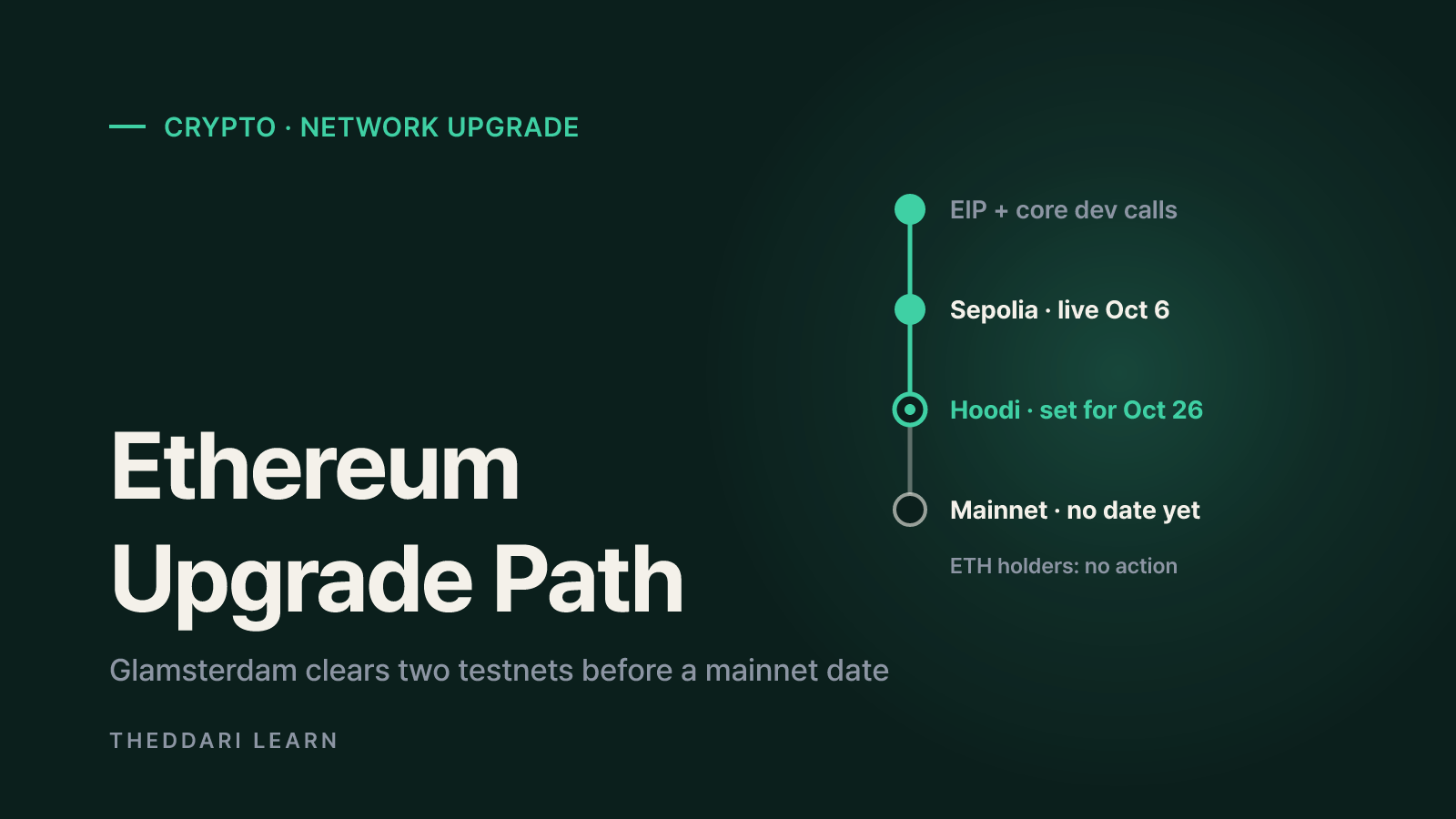
Glamsterdam follows Fusaka, which activated on December 3, 2025. ethereum.org lists its mainnet timing as expected in Q4 2026, date not yet confirmed. The Foundation scheduled Sepolia for October 6, 2026 at 13:53:36 UTC and said Hoodi and mainnet dates had not been decided. Since then, the official Hoodi configuration repository has recorded October 26, 2026 at 17:42:48 UTC (eth-clients/hoodi). Early-December mainnet dates circulating in the press are estimates, not announcements.
First public test
- Network
- Sepolia
- Status as of October 2026
- Activated October 6, 13:53:36 UTC (EF announcement)
Second public test
- Network
- Hoodi
- Status as of October 2026
- Configured for October 26, 17:42:48 UTC
Production
- Network
- Mainnet
- Status as of October 2026
- No date set; ethereum.org expects Q4 2026
What Glamsterdam changes
- Enshrined proposer-builder separation (EIP-7732): moves the hand-off between block proposers and block builders into the protocol, reducing reliance on third-party relays and widening the data propagation window from about 2 seconds to about 9 seconds.
- Block-level access lists (EIP-7928): each block records which accounts and storage it touches, enabling parallel disk reads and setting up parallel validation.
- Gas repricing (EIP-8037 and EIP-8038): creating and reading state gets priced closer to its real hardware cost, targeting state growth of around 120 GiB per year.
- Cheaper basic transfers (EIP-2780): a plain ETH transfer between existing accounts is designed to cost up to 71% less gas; sending to a brand-new address carries an account-creation surcharge.
- Faster exits (EIP-8061): exit capacity scales with total stake, roughly four times today's level, which could shorten withdrawal queues.
The Foundation says Glamsterdam's scope is frozen, but the meta EIP is still a draft and details can change before mainnet. The percentages above are design targets from ethereum.org; actual fees you pay will still depend on network demand.
What you need to do, by user type
Holding ETH on an exchange or wallet
- Action
- Nothing
- Watch out for
- Any request to upgrade or convert ETH is a scam
Staking via exchange or pool
- Action
- Usually nothing
- Watch out for
- Provider notices on withdrawal timing
Solo staker
- Action
- Update execution, consensus and validator clients
- Watch out for
- Release notes, such as default gas limit settings
Non-staking node operator
- Action
- Update execution and consensus clients
- Watch out for
- Outdated nodes fall off the upgraded chain
App or contract developer
- Action
- Test gas estimation on testnets
- Watch out for
- Hardcoded gas values may break after repricing
The biggest practical risk around an upgrade is fraud, not the upgrade itself. ethereum.org is explicit that balances stay the same and that nobody needs to convert ETH. Never connect your wallet to, or type a seed phrase into, a site promising to upgrade your coins.
Around mainnet activation, some exchanges briefly pause ETH and token deposits and withdrawals. When transfers between venues are paused, prices for the same asset can drift apart across exchanges. If you trade on Korean and international platforms, the Korea premium (kimchi premium) tracker shows that gap in real time.

Ethereum upgrades and ETH price
Upgrades change fundamentals such as fee mechanics, throughput, issuance and staking liquidity. London introduced EIP-1559 in 2021, and Dencun cut data costs for layer 2 rollups in 2024. How and when such changes show up in price depends on demand and the wider market, not on the activation date itself.
The Merge (Paris)
- Mainnet date
- Sep 15, 2022
- ETH price on the day (per ethereum.org)
- $1,472
Shapella
- Mainnet date
- Apr 12, 2023
- ETH price on the day (per ethereum.org)
- $1,917
Dencun
- Mainnet date
- Mar 13, 2024
- ETH price on the day (per ethereum.org)
- $3,984
Pectra
- Mainnet date
- May 7, 2025
- ETH price on the day (per ethereum.org)
- $2,222
Fusaka
- Mainnet date
- Dec 3, 2025
- ETH price on the day (per ethereum.org)
- $3,149
These are the activation-day prices listed on the ethereum.org fork timeline. Five data points cannot show whether upgrades push price up or down, and each figure mostly reflects the market backdrop at the time. The one safe takeaway is that an upgrade date is not a reliable signal of a top or a bottom.
What to check before trading an upgrade narrative
- Timelines are public: testnet dates are known weeks ahead, so expectations are often priced in before mainnet.
- Delays happen: Glamsterdam is already later than its original target, and testnet issues can push mainnet again.
- Leverage builds up: when bullish bets crowd into perpetual futures, funding rates climb and small surprises can trigger liquidations.
- Benefits arrive gradually: gas limit increases are voted in by validators block by block, so throughput gains phase in over time.
To see whether upgrade optimism is turning into leverage, compare ETH funding rates across exchanges on the funding rate arbitrage page; persistently high positive funding suggests crowded longs. For schedule news, skim crypto Telegram trends, then confirm anything important against the Ethereum Foundation blog.
How to track the Ethereum upgrade roadmap
- Check the upgrade's page on the ethereum.org roadmap for its current status and expected window.
- Read Protocol Announcements on the Ethereum Foundation blog for exact activation times and supported client versions; mainnet gets its own separate announcement.
- If you run a node, cross-check the eth-clients testnet configs and each client's release notes.
- Read your exchange or staking provider's notices for deposit pauses and withdrawal changes.
- When you see a date online, ask whether it is an official announcement, a developer-call discussion, or a media estimate.
The bottom line: an Ethereum hard fork is a scheduled rule change first and a market story second. Holders should ignore anyone asking them to upgrade coins and keep an eye on exchange notices; operators need to install supported clients before the deadline. As of October 2026 Glamsterdam has no official mainnet date, so it is safer not to build trading plans around rumored ones.