What Does the Ethereum Foundation Do? Treasury and ETH Sales
What the Ethereum Foundation funds, how its 15% opex and 2.5-year buffer policy drives ETH sales, recent 2025-2026 sales, and how to judge the price impact.
Contents7 sections
- What does the Ethereum Foundation actually do?
- How the Ethereum Foundation treasury policy drives ETH sales
- Ethereum Foundation ETH sales in 2025-2026
- How to check whether an EF sale moved the ETH price
- Reading the Ethereum problem narrative without overreacting
- Frequently asked questions
- Sources and references
Key takeaways
- The Ethereum Foundation (EF) is a non-profit that funds protocol research, client development, ecosystem grants, the bug bounty and Devcon; it does not control Ethereum.
- Its June 2025 treasury policy targets annual spending of 15% of the treasury and a 2.5-year fiat-denominated buffer, and those two numbers set the size and cadence of ETH sales.
- In 2025-2026 the EF announced sales of 1,000 to 10,000 ETH at a time through CoW Swap TWAP orders and over-the-counter deals with Bitmine.
- Whether a sale moves the price depends on the execution method, its size relative to market activity and everything else happening in the market at the same time.
- Sales attributed to 'EF-linked' wallets by on-chain trackers should be treated as unconfirmed until the foundation itself announces them.
The Ethereum Foundation (EF) is a non-profit that pays for much of Ethereum's protocol research, client development and ecosystem grants. It does not own or control the network, but it does hold a large ETH treasury and sells part of it on a schedule to cover its costs. That is why every "Ethereum Foundation selling ETH" headline tends to set off debate about price. As of October 2026, this guide explains what the foundation actually funds, how its June 2025 treasury policy decides when to sell, which sales were disclosed in 2025-2026 and a practical way to judge whether a sale really moved the market. It does not offer trade timing, and figures come from the sources linked below.
What does the Ethereum Foundation actually do?
According to ethereum.org's foundation page, the EF funds protocol development, grows the ecosystem and advocates for Ethereum. The same page is unusually direct about its limits: the EF is not a company, does not control or lead Ethereum and is not the only organisation funding critical development. Node software comes from several independent client teams, and protocol changes are agreed through public Ethereum Improvement Proposals and core developer calls.
Protocol
- What the EF funds or runs
- Client development, research, network upgrades, bug bounty
- Worth knowing
- No unilateral power to ship upgrades
Ecosystem grants
- What the EF funds or runs
- Ecosystem Support Program (ESP) for open-source public goods
- Worth knowing
- 388 projects and $29.1M in 2025
Research
- What the EF funds or runs
- Cryptography, consensus, scaling, privacy, security
- Worth knowing
- Separate academic grants track
Community
- What the EF funds or runs
- Devcon developer conference
- Worth knowing
- Events are part of the operating budget
The ESP site publishes yearly totals: 397 projects and $30.0M in 2022, 498 projects and $61.1M in 2023, 677 projects and $44.4M in 2024, and 388 projects and $29.1M in 2025. The foundation's published mandate puts censorship resistance, open source, privacy and security (CROPS) at the top of its priorities. Almost none of this spending generates revenue, so the money has to come from the treasury: mostly ETH, plus a growing stream of staking and DeFi yield.
How the Ethereum Foundation treasury policy drives ETH sales
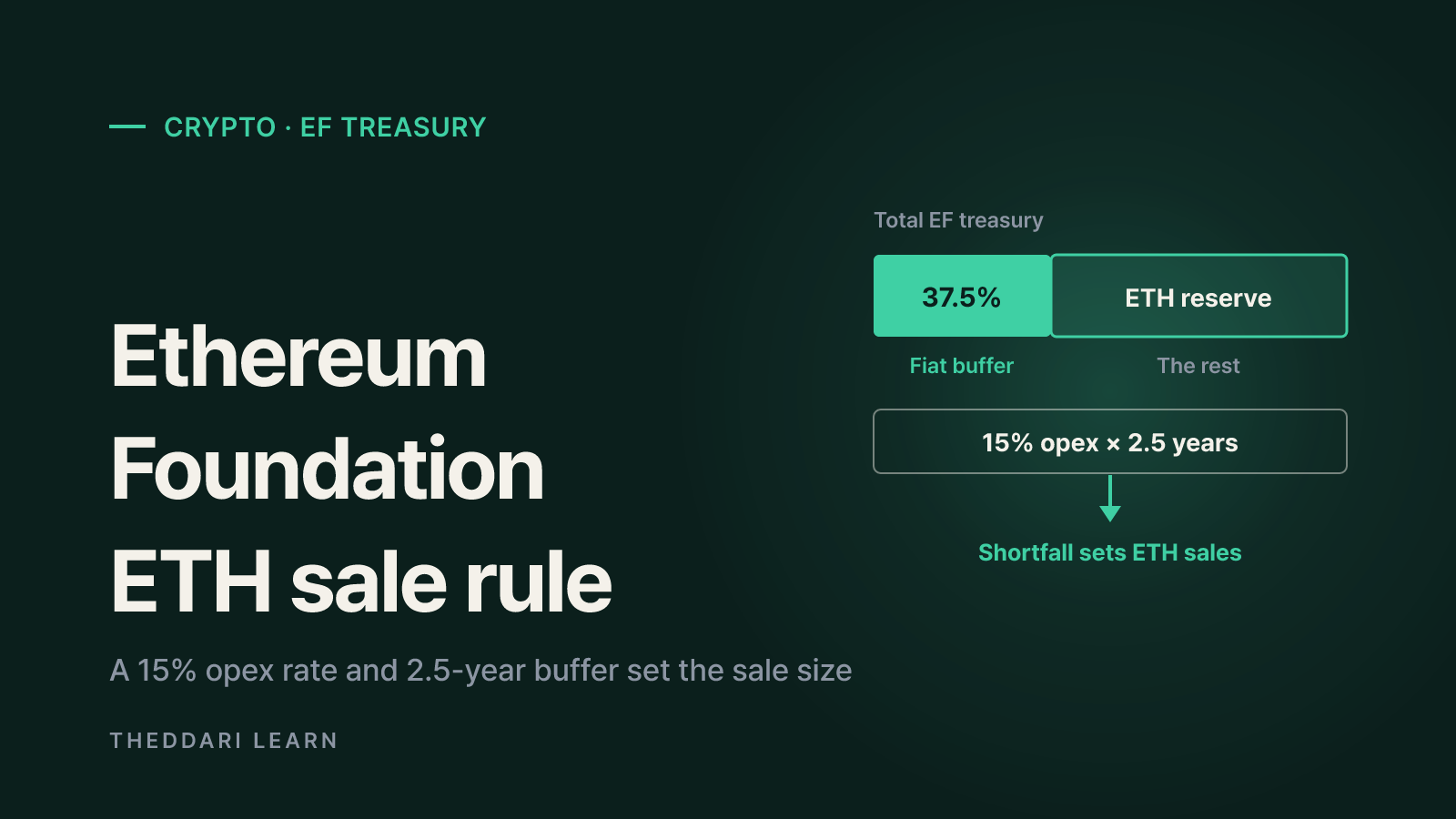
On June 4, 2025, the EF published its first formal treasury policy. It rests on two variables. A is annual operating expenses expressed as a percentage of the total treasury. B is the number of years of operating runway kept in reserve. Multiply them and you get the target size of fiat-denominated holdings such as cash, bonds or stablecoins. The policy says that target "directly informs the size and the cadence of ETH sales". Whatever is left after subtracting A×B stays in ETH.
- Current targets: A = 15% and B = 2.5 years, which implies roughly 37.5% of the treasury (15% × 2.5) held in fiat-denominated assets.
- Glide path: the EF intends to cut annual spending roughly linearly over five years to a long-term 5% baseline, and says it will review that path as conditions change.
- Sale decisions: the EF periodically measures how far its fiat reserve sits from the buffer target and decides how much ETH, if any, to sell over the next three months.
- Execution: sales typically go through fiat off-ramps or on-chain swaps into fiat-denominated assets.
- Deployments: idle ETH can be solo-staked or supplied as wETH to established lending protocols, and moving funds between protocols is explicitly not an anti-endorsement.
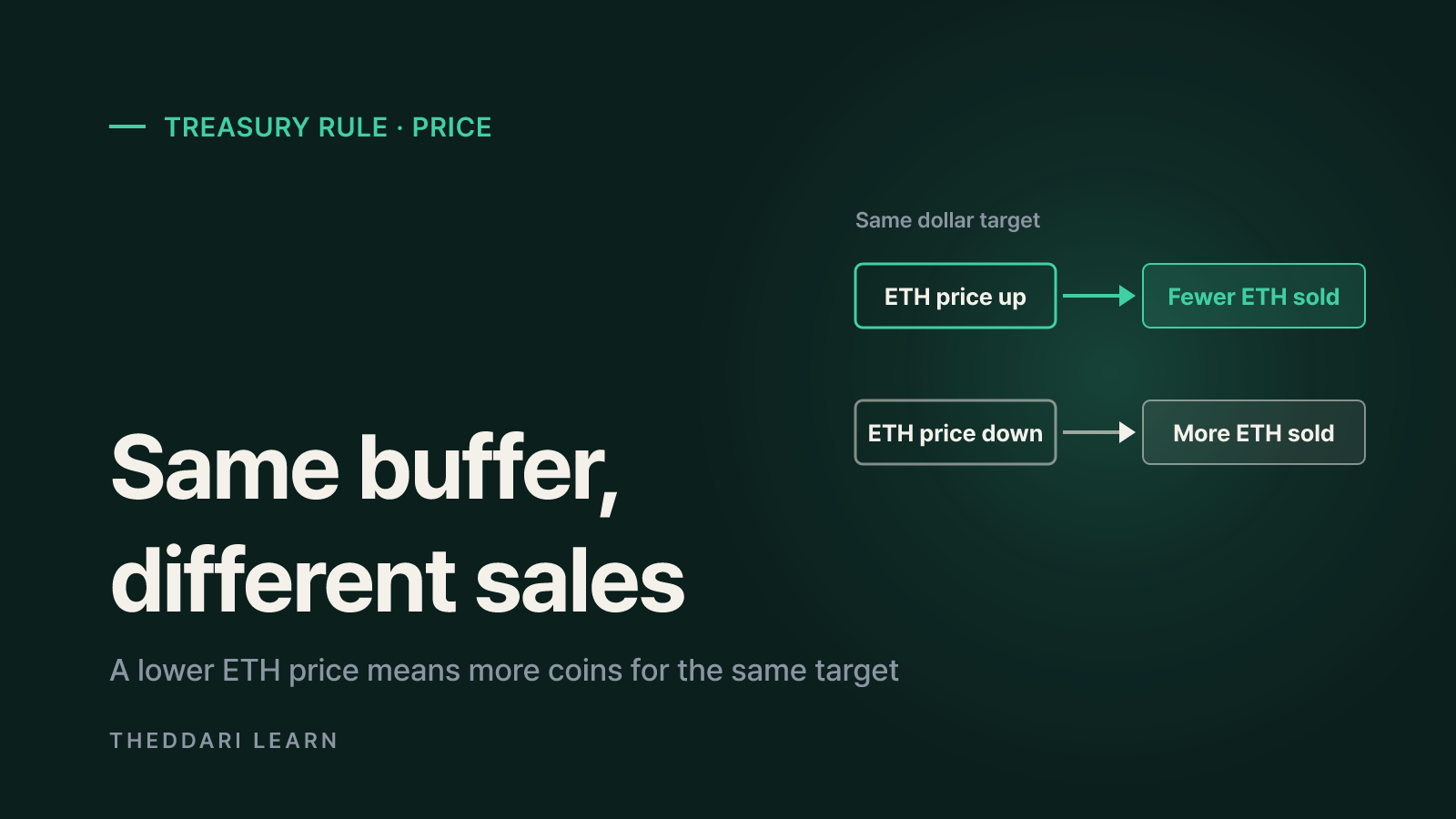
Two practical consequences follow. First, sales are driven by a budgeting rule, not a price call. Second, the rule cuts both ways: when ETH rises, the treasury grows and fewer coins are needed to top up the reserve; when ETH falls, the same dollar target can require selling more coins. The policy also describes a counter-cyclical stance, increasing support in downturns and moderating it in bull runs. On disclosure, the finance team reports quarterly to the board and management, while the public annual report summarises allocations such as fiat, idle ETH and deployed ETH. The quarterly reports are internal, so the public does not see every position change as it happens.
Ethereum Foundation ETH sales in 2025-2026
The table below lists sales described in the reporting read for this guide. It is not a complete ledger, and dollar values are as reported at the time.
Sep 2025
- Size
- 10,000 ETH (reported ~$43.6M)
- Method
- Centralised exchanges
- Basis
- Bankless, citing EF announcement
Oct 3, 2025
- Size
- 1,000 ETH (~$4.5M)
- Method
- CoW Swap
- Basis
- Bankless, citing EF announcement
Mar 2026
- Size
- 5,000 ETH (~$10M)
- Method
- OTC with Bitmine
- Basis
- The Block
Apr 8, 2026
- Size
- 5,000 ETH (~$11M)
- Method
- CoW Swap TWAP
- Basis
- EF post on X, via Bankless
Apr 24, 2026
- Size
- 10,000 ETH at avg $2,387
- Method
- OTC with Bitmine
- Basis
- EF post on X, via The Block
Oct 25, 2026
- Size
- 2,785 ETH (~$6.42M)
- Method
- CoW Swap
- Basis
- On-chain tracker label only; confirm with EF
The Block reported that the April 24, 2026 deal was an over-the-counter sale of 10,000 ETH at an average of $2,387 to Bitmine, the listed ether treasury company chaired by Tom Lee, with the EF saying proceeds fund protocol R&D, ecosystem development and community grants. Bankless covered the April 8 conversion of 5,000 ETH to stablecoins using CoW Swap's time-weighted average price feature, and noted the EF had staked enough to bring its position to 69.5k ETH, close to the 70k ETH staking target announced in February 2026. Staking income is now a real second funding source alongside sales.
The October 25, 2026 item is different in kind. Blockchain.News relayed an on-chain analyst's claim that an EF-linked address swapped 2,785 ETH on CoW Swap. That rests on wallet labelling, not a foundation statement, so treat it as an attributed sale until the EF confirms it.
How to check whether an EF sale moved the ETH price
When the next headline lands, this sequence separates confirmed facts from guesses. The aim is not to predict direction but to know what you actually know.
- 1
Look for the official announcement
Check the EF's X account (@ethereumfndn) and blog.ethereum.org for size, method and purpose. Recent OTC sales disclosed the counterparty and average price. If there is no announcement, log the tracker's claim as unconfirmed.
- 2
Identify the execution method
An OTC trade has a buyer lined up and does not hit exchange order books directly. A TWAP order spreads the sale over time. A deposit to a centralised exchange may precede a sale by hours or days, or not lead to one at all. Each method implies very different short-term pressure.
- 3
Size it against the market
Compare the amount with that day's spot volume, US spot ether ETF flows and purchases by large treasury companies. The buyer in the April 24 deal, Bitmine, reported holding 4,976,485 ETH that week, so 10,000 ETH was about 0.2% of a single buyer's stack.
- 4
Account for everything else
Price moves around a sale also reflect macro releases, liquidations and other large wallets. When The Block published its story, ETH was trading near $2,315, below the OTC average, but nothing in the reporting ties that gap to the foundation alone.
- 5
Track sentiment separately
How loudly a sale is discussed and whether regional prices diverge are signals of attention, not supply. Keep them in a separate note from the volume numbers.
To gauge attention, theddari's Telegram crypto trends page shows how often topics such as the foundation are mentioned across tracked crypto channels. Rising mentions show interest, not direction.

If you want to see whether a headline coincides with unusual price gaps between exchanges, the arbitrage dashboard compares quotes across venues. Gaps can open for many reasons, including fees and withdrawal limits, so treat them as context.
Reading the Ethereum problem narrative without overreacting
Popular videos about Ethereum having a "big problem" often cite foundation sales as evidence of weak conviction. The Block notes the EF has long faced criticism for recurring sales. Whether that criticism is fair and whether sales move the price are separate questions. These checks help.
- "They sold the top" is easy to claim in hindsight. Under the policy, sales are triggered by the reserve gap, so timing alone does not prove intent.
- A wallet movement can be staking, a DeFi deposit or withdrawal, or internal reshuffling. The Block reported the EF seeded a DeFi ecosystem wallet with 50,000 ETH in January 2025, which was not a sale.
- The EF does not control Ethereum, which argues against "if the foundation sells, Ethereum is over". The reverse also holds: EF staking or buying is no guarantee of gains.
- Tracker labels can be wrong. Addresses that received ETH from the foundation years ago may be grouped as EF-linked, so cross-check with official posts.
- If annual spending really glides from 15% toward 5%, the budget-driven need to sell should shrink over time. The EF says it may adjust that path, so confirm it in the latest annual report.
Most EF sales can be explained once you know how much was sold, how it was executed and why. Recording those facts with the date, the market context and the source gives you a consistent yardstick for the next headline. Holdings and policy targets will change, so note the date of every figure and update it when a new annual report is published.
Frequently asked questions
Does the Ethereum Foundation selling ETH crash the price?
Why does the Ethereum Foundation sell ETH at all?
How much ETH does the Ethereum Foundation hold?
Is the Ethereum Foundation the same as Ethereum?
Sources and references
- 1Ethereum Foundation Blog: Ethereum Foundation Treasury Policy (June 4, 2025)(opens in a new tab)blog.ethereum.org
- 2ethereum.org: Ethereum Foundation(opens in a new tab)ethereum.org
- 3Ethereum Foundation ESP: Ecosystem Support Program(opens in a new tab)esp.ethereum.foundation
- 4The Block: Ethereum Foundation sells nearly $24 million of ETH to Tom Lee's Bitmine (April 24, 2026)(opens in a new tab)www.theblock.co
- 5Bankless: Ethereum Foundation Announces 5k ETH TWAP Sale (April 8, 2026)(opens in a new tab)www.bankless.com
- 6Blockchain.News: Ethereum Foundation Sells 2785 ETH via Cowswap (October 25, 2026)(opens in a new tab)blockchain.news
Related articles
 Crypto
What Is the Bless Token? CoinGecko Trending Coin Checklist
Bless (BLESS) is a DePIN token that pools spare compute from everyday devices. Before buying the CoinGecko trending coin, check supply unlocks, where volume really trades, and the two official contract addresses.
 Crypto
What Is Macca the Gator (MACCA)? Checks Before You Buy
Macca the Gator (MACCA) is a day-old Ethereum memecoin that hit #1 on CoinGecko trending. Here is what on-chain data shows, what it does not show, and how to check the token yourself.
 Crypto
What Is Bitcoin Capitulation? Signals and Their Limits
Capitulation is when underwater holders give up and sell at a loss in size. Here is how analysts read realized loss, volume and long-term holder data, and where those readings break down.