Contents8 sections
- What CoinGecko trending actually measures
- Why newly launched small caps carry outsized risk
- A seven-step new token due diligence checklist
- Rug pull red flags and common false comfort
- Tools for tracking the hype around a trending token
- If something goes wrong, and the bottom line
- Frequently asked questions
- Sources and references
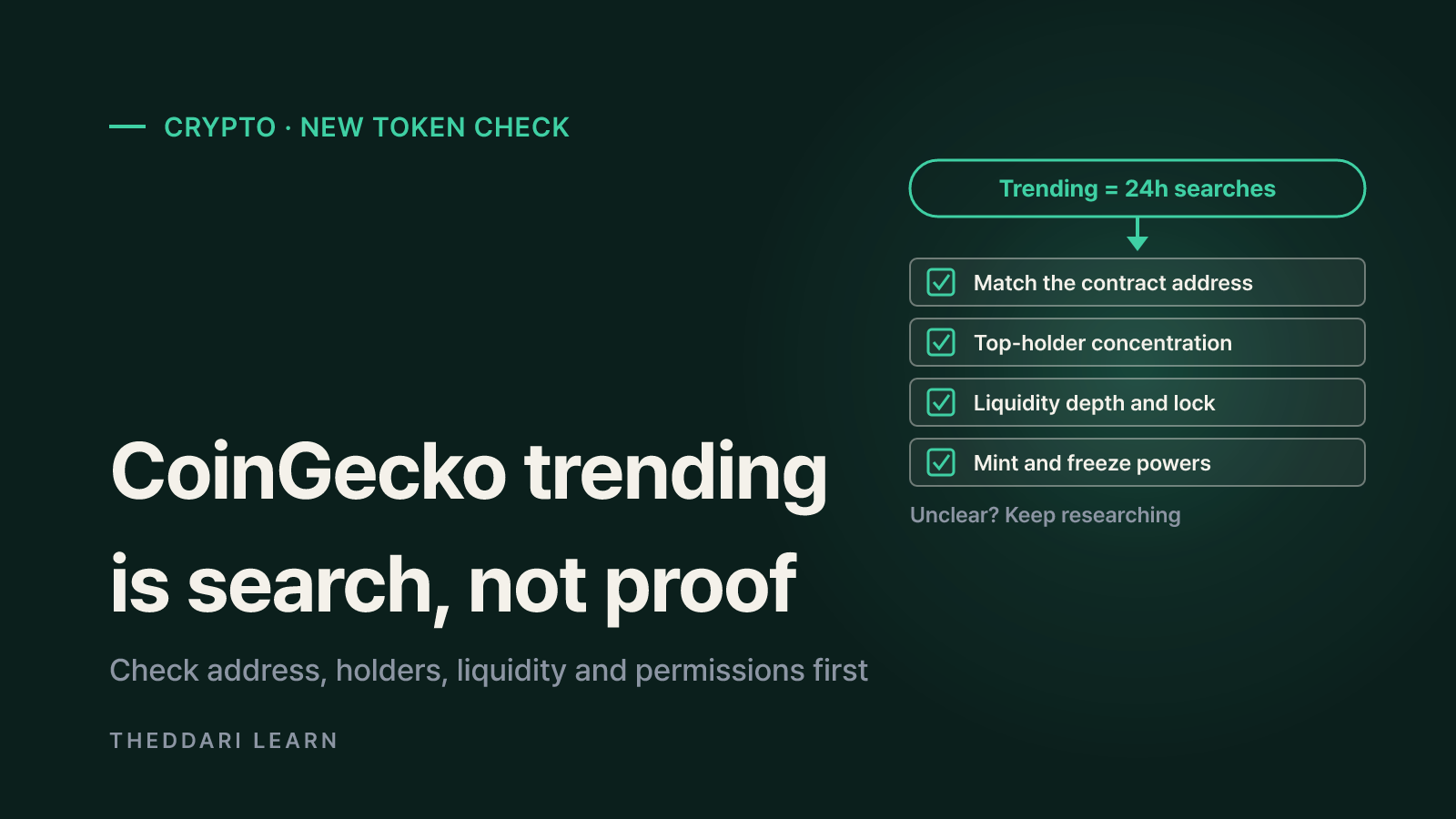
A token on the CoinGecko trending list is a token people are searching for, not a token anyone has vetted. Before buying a newly launched small-cap coin, check its contract address, how concentrated its holders are, how deep and how locked its liquidity is, what powers the contract gives the deployer, and where else it can be sold. This guide reflects CoinGecko's documentation and warnings from the U.S. Commodity Futures Trading Commission (CFTC) and South Korea's Financial Supervisory Service (FSS) as of October 2026. It does not recommend any token or forecast prices.
What CoinGecko trending actually measures
According to CoinGecko's API documentation, the trending list shows the top 15 coins by the most popular searches on CoinGecko over the last 24 hours, and the data refreshes roughly every 10 minutes. The ranking signal is search interest. Market capitalization, trading volume, audits and team transparency are not part of the ranking, which is why a large established asset and a token launched days ago can appear side by side.
On the morning of October 13, 2026 (UTC), for example, the top of the list included lightly documented tokens such as Identity.md 6900, Bunker Mode, Crawlerpad, Claudia and Pearl. When the list was checked again later the same day, a different token held the top spot. That churn is the point: trending captures where attention is flowing right now. The attention may come from genuine development news, but it can just as easily come from paid promotion, a coordinated group, or people searching after spotting a vertical price chart.
Use the trending list to decide what to research, not whether to buy.
Why newly launched small caps carry outsized risk
In June 2026 the FSS published guidance for decentralized exchange (DEX) users and described a case prosecutors had recently charged (Edaily report, in Korean). The suspects minted about one billion memecoins on a token-launch platform, bought more than half the supply cheaply, then spread false announcements on X, KakaoTalk open chats and Threads. As buyers piled in, the price rose 1,001x within 26 hours of launch. The insiders sold, and 256 investors lost roughly KRW 900 million in total.
The same FSS material cites CoinGecko data showing that about 20 million distinct coins traded in 2025, up from about 3 million in 2024, and that 53.2% of them had failed, including by ceasing to trade. No-code launch tools mean thousands of tokens can appear in a single day, many of them copying the name or logo of a well-known project. Thin liquidity means small orders move the price sharply, and on-chain trades generally cannot be reversed if something goes wrong.
Rug pull vs. pump-and-dump vs. copycat token
Rug pull
- How it works
- Insiders drain the liquidity pool or dump a large pre-held supply, collapsing the price
- First things to check
- Top-holder share, liquidity lock status, deployer wallet activity
Pump-and-dump
- How it works
- An organized group hypes a token on social media, pushes the price up, then sells first
- First things to check
- Single-source tips, countdown-style buy signals, volume collapsing after the spike
Copycat token
- How it works
- A new contract reuses a popular name or ticker to catch mistaken buyers
- First things to check
- Mismatch with the official contract address; volume or holder counts unlike the real project
The CFTC's pump-and-dump advisory says these schemes occur in thinly traded or new tokens and are organized anonymously through messaging apps and social media. In one example it describes, the entire buy-and-sell cycle was over in less than eight minutes. Some schemes use fake news stories claiming a famous tech figure is about to invest heavily in a small coin. Organizers typically exit first, leaving late buyers holding the losses.
A seven-step new token due diligence checklist
- 1
Verify the contract address
Searching by name or ticker can surface several look-alike tokens. Copy the contract address published on the project's official site or account and confirm it matches what your wallet, the DEX and the block explorer show. Official accounts can themselves be compromised, so cross-check more than one channel.
- 2
Check top-holder concentration
Open the Holders tab on a block explorer and look at the share held by the top ten wallets. After excluding the liquidity pool, burn addresses and disclosed lock contracts, a handful of wallets holding most of the supply means a few sales could crater the price. Many fresh wallets holding identical amounts may be a disguised single holder.
- 3
Measure liquidity and confirm any lock
Compare the pool's liquidity with the size of the trade you are considering. If the team claims the liquidity is locked, find the lock contract and confirm its duration and the percentage covered. A wide slippage setting can fill your order at a far worse price than you expected.
- 4
Read the contract permissions
Look for owner functions that can mint new supply, freeze or blacklist wallets, or change sell taxes. A renounced-ownership label does not rule out an admin role elsewhere or an upgradeable proxy. Check whether ordinary holders have actually managed to sell, since honeypot contracts allow buys but block sales.
- 5
Confirm launch date, team and documents
Note when the contract was deployed, what the documentation says will be built and who is accountable. An anonymous team is not proof of fraud, but it removes anyone to hold responsible. A website domain registered days ago that claims a long history is a mismatch worth noting.
- 6
Map your exit route
If the token trades on a single DEX pool and nowhere else, there may be no counterparty when you want out. Treat claims of an upcoming centralized exchange listing as unverified until the exchange announces it through its own official channels.
- 7
Audit the pitch and set your loss limit
Urgency, promised returns and requests to move the conversation to Telegram or another private chat are warning signs. Decide in writing how much you could lose entirely without harm and what would make you exit, before you buy anything.
Rug pull red flags and common false comfort
- Volume and holder counts exploded overnight: wash trading between controlled wallets and wallet splitting can fake both.
- The source code is verified: that only means it can be read, not that the people running it can be trusted.
- Liquidity is locked: a lock does not stop insiders from selling tokens they hold outside the pool.
- A scanner shows no warnings: automated tools are supplementary and cannot predict what insiders intend to do.
- The community is huge: the CFTC notes that in groups with thousands of members it can be hard to tell real people from accounts set up to build credibility.
The CFTC's digital asset fraud page notes that most crypto frauds originate on social media and that being pushed from a main platform onto a private messaging app is an early tip-off. It also stresses that there is no such thing as a risk-free investment and that fraudsters manufacture urgency because fear of missing out is a powerful motivator. Those warnings come from a U.S. regulator, but the playbook is the same across jurisdictions.
Tools for tracking the hype around a trending token
To see whether a trending coin is also being pushed in crypto Telegram channels, theddari's Telegram crypto trends page lets you follow how mentions build up over time. A sudden burst of mentions from a few sources is itself a signal worth investigating. For tokens already listed on both Korean and international exchanges, the kimchi premium page compares Korean won prices with overseas prices, which can reveal whether a move is concentrated in one market. Both are research aids; neither predicts price direction.

If something goes wrong, and the bottom line
DEX trades execute through smart contracts, so no exchange operator can reverse a mistaken transfer or a fraudulent sale. The FSS advises double-checking the contract address and amount before every trade and periodically revoking token approvals on wallets you rarely use. If you encounter insiders buying early and then spreading false information, preserve the posts, wallet addresses and transaction hashes and report them to the relevant authority where you live.
CoinGecko trending is a window into what people are looking up right now. Before buying a newly launched small-cap token, work through the contract address, holder concentration, liquidity and locks, contract permissions, team and documents, exit route and the way it is being promoted. If you cannot explain any one of those items, your research is not finished. Record the date and links you checked so you can compare when conditions change.