What Is the CLARITY Act? Senate Vote and Key Issues
The CLARITY Act is the US crypto market structure bill. See what it covers, why a 49-50 Senate cloture vote failed in Sept 2026, and how to verify it.
Contents9 sections
Key takeaways
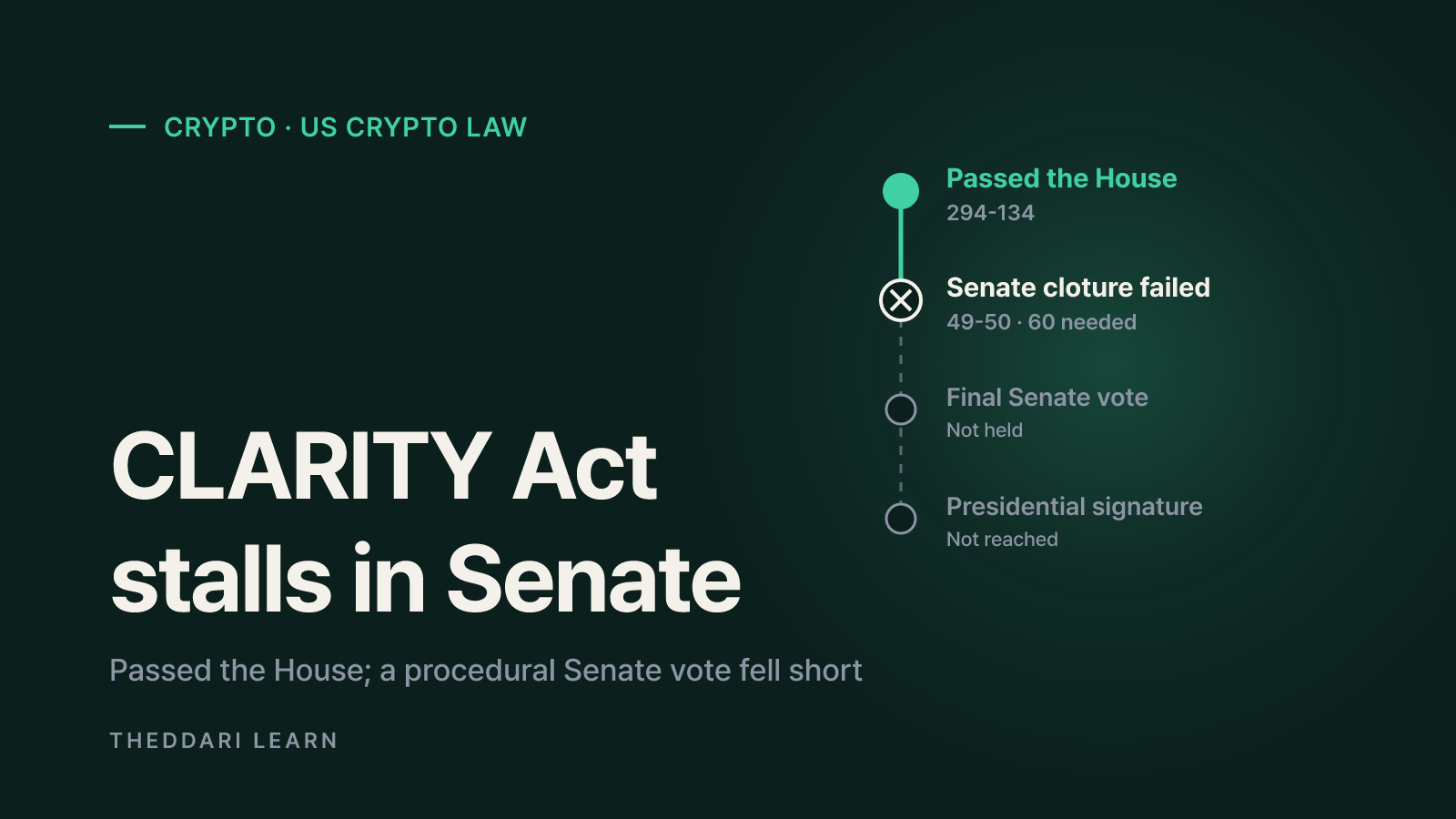
- The CLARITY Act (H.R.3633) would split oversight of crypto tokens between the SEC and the CFTC, shifting most tokens toward CFTC supervision.
- The House passed it 294-134 on July 17, 2025.
- On September 15, 2026, the Senate failed to invoke cloture on the motion to proceed, 49-50, short of the 60 votes needed. It was not a vote on final passage.
- As of late October 2026, no new Senate vote was scheduled; if the 119th Congress ends without action, the bill must be reintroduced.
- Payment stablecoins are covered by the separate GENIUS Act, whose issuer regime is set to take effect January 18, 2027.
The CLARITY Act (the Digital Asset Market Clarity Act, H.R.3633) is the main US crypto market structure bill: it would decide which tokens the Securities and Exchange Commission (SEC) oversees as securities and which the Commodity Futures Trading Commission (CFTC) oversees as digital commodities. As of late October 2026, it has passed the House but stalled in the Senate. Headlines saying the bill was "rejected" refer to a procedural cloture vote on September 15, 2026 that failed 49-50, not to a final up-or-down vote on the bill itself.
This guide covers US federal law only. It explains what the bill tries to settle, which disputes stopped it, how it differs from the stablecoin law already on the books, and how to read the congressional record yourself when the next headline lands.
What the CLARITY Act would do
The core question in US crypto policy is whether a given token is a security, subject to SEC registration and the Howey Test, or a commodity, whose markets the CFTC supervises. According to CoinMarketCap's summary, the CLARITY Act aims to answer that question in statute for most tokens and shift primary oversight toward the CFTC.
- Jurisdiction: defines digital commodities and divides responsibilities between the SEC and the CFTC.
- Intermediaries: sets registration, custody and customer-asset rules for digital commodity exchanges, brokers and dealers.
- Fundraising: lets token projects raise money within capped exemptions in exchange for disclosure.
- Banks: expands what banks may do with crypto assets, a part of the bill banks wanted, as American Banker reported.
It is not a tax bill. As crypto.news notes, tax legislation answers different questions, such as when gains are recognized and what brokers must report. An exchange could get clear tax forms and still face unresolved registration questions.
The disputes that stalled the bill in the Senate
Ethics rules for officials
American Banker reported that talks over an ethics provision broke down before the vote, according to Senate Minority Leader Chuck Schumer. Democrats wanted broader, more enforceable limits on federal officials and their families profiting from crypto, a fight tied to President Trump's family crypto ventures. Sen. Ruben Gallego, who led Democratic ethics negotiations, voted no.
Stablecoin rewards versus bank deposits
For banks, the leading issue was how far stablecoin firms could offer yield-like rewards. Community banks fear deposits draining into stablecoins. Sen. Jerry Moran argued that weak limits could leave Kansas farms short of local bank credit.
Investor protection and fundraising caps
Sen. Cynthia Lummis said Republicans accepted Democratic requests to cut the annual crypto fundraising exemption from $75 million to $50 million and add a $200 million lifetime cap. Democrats counter that their objection was the unresolved ethics language, not the caps (CoinMarketCap). When each side tells a different story about the same vote, a single senator's post is not proof of why it failed.
The CLARITY Act vote: what happened on September 15, 2026
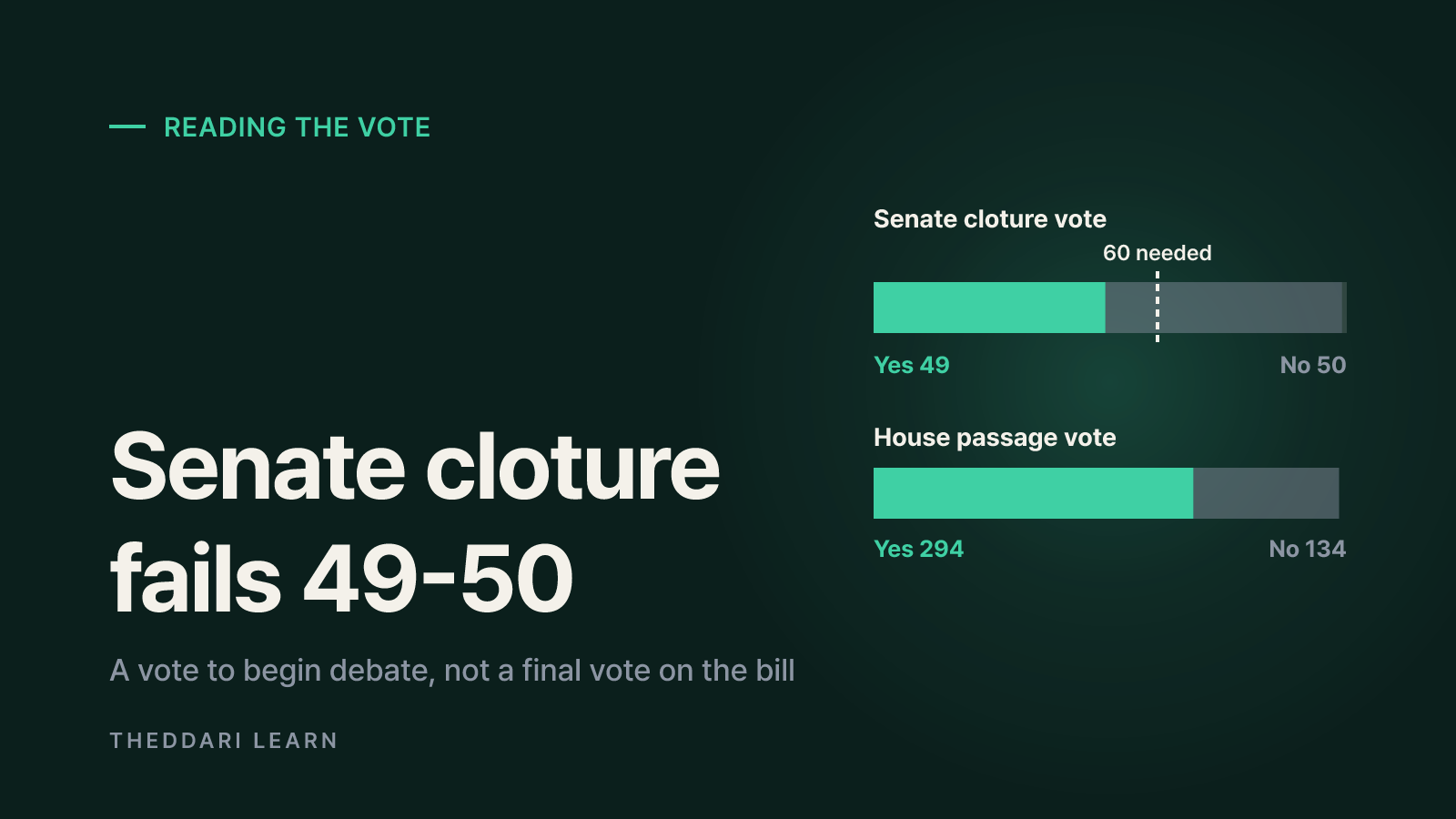
A bill becomes law after House passage, Senate committee action, a successful Senate cloture vote to begin debate, Senate passage, agreement on identical text, and the President's signature. The CLARITY Act stopped at the step where the Senate decides whether to start debating it.
House passage
- Date
- July 17, 2025
- Result
- 294 yes, 134 no
Senate cloture on motion to proceed
- Date
- September 15, 2026
- Result
- 49 yes, 50 no, 1 not voting; 60 needed
Senate final passage
- Date
- Not held
- Result
- —
Presidential signature
- Date
- Not reached
- Result
- —
TokenPost stresses that this procedural vote was not a final vote on the legislation. Four Republicans, Moran, Susan Collins, Josh Hawley and Thom Tillis, joined every Democrat who voted in opposing cloture. Tillis voted no to preserve his right to move to reconsider.
"Failed" is accurate for the cloture motion, while "rejected" overstates it: the Senate never voted the bill text down. As of late October 2026 no new vote was scheduled, and American Banker reported the outcome likely pushes market structure legislation to the next Congress, after the November 2026 midterm elections.
CLARITY Act vs GENIUS Act
Covers
- GENIUS Act
- Payment stablecoin issuers
- CLARITY Act
- Other tokens plus exchanges, brokers, dealers
Status (Oct 2026)
- GENIUS Act
- Enacted July 18, 2025
- CLARITY Act
- Passed House; Senate cloture failed
Key rules
- GENIUS Act
- At least $1 of eligible reserves per coin; monthly reserve disclosure
- CLARITY Act
- SEC/CFTC split; intermediary registration and custody
Effective
- GENIUS Act
- Issuer regime set for January 18, 2027
- CLARITY Act
- Not law
Regulators are acting in the meantime. Per TokenPost, the SEC, joined by the CFTC, issued an interpretation in March 2026 on how securities laws apply to crypto asset categories, then proposed two offering exemptions: one capped at $5 million over four years and another at $75 million per 12 months. On October 5, 2026 the CFTC sought comment on a possible retail crypto framework. These remain proposals. On taxes, the House Ways and Means Committee advanced H.R.10357 by 38-5 on September 16, 2026, but the full House had not voted (crypto.news).
How to verify a crypto bill vote yourself
- 1
Search the bill number
On congress.gov, search
H.R.3633and confirm it is the 119th Congress version, not an older bill or a Senate draft with a similar name. - 2
Read Latest Action and the tracker
If the status tracker stops at Passed House, the bill has not reached Passed Senate or Became Law.
- 3
Check the action wording
In All Actions,
cloture on the motion to proceed ... not invokedmeans debate could not begin;passed Senateoron passageis the final vote. - 4
Open the roll call
Use the record vote number listed in the action to find the senator-by-senator tally under Roll Call Votes on senate.gov. House roll calls are on clerk.house.gov.
- 5
Compare with the headline
Match the date, vote type and tally against the article or video. When they disagree, trust the record.
Risks to keep in mind when markets react
- Vote type: a failed procedural vote, a committee vote and final passage carry very different weight.
- Timing: older votes often get recycled as breaking news; check the record date.
- Jurisdiction: this is US federal law; it does not directly change rules for non-US exchanges or other countries' tax codes.
- Politics: a new Congress after the November 2026 midterms could rewrite the bill rather than revive it.
If you follow Korean markets, US regulatory headlines can move Korean won prices differently from global prices. The kimchi premium tracker shows that gap.

To see how quickly claims about the bill spread through crypto Telegram channels, the crypto Telegram trends page is a useful gauge, but treat what you find there as a lead to verify, not a source.
Bottom line
As of late October 2026, the CLARITY Act passed the House but stalled when a Senate cloture vote to begin debate failed 49-50 on September 15, 2026. It was not a final rejection, reconsideration remains technically possible, and no new vote was scheduled. Stablecoin issuers are governed separately by the GENIUS Act. Before reacting to the next headline, check four things: the bill number, the vote type, the date and the roll call.
Frequently asked questions
Did the CLARITY Act fail or is it still alive?
Why does a Senate bill need 60 votes?
What is the difference between the CLARITY Act and the GENIUS Act?
Can I still buy and trade crypto in the US without the CLARITY Act?
Does the CLARITY Act affect crypto taxes?
Sources and references
- 1American Banker – Crypto market structure bill fails in Senate vote, 49-50 (Sept 15, 2026)(opens in a new tab)www.americanbanker.com
- 2TokenPost – Senate Fails to Advance CLARITY Act as SEC Proposes Crypto Rules (Oct 20, 2026)(opens in a new tab)www.tokenpost.com
- 3CoinMarketCap – Senate Crypto Bill Tightened Fundraising Caps, Democrats Still Said No (Oct 2026)(opens in a new tab)coinmarketcap.com
- 4crypto.news – The CLARITY Act stalled. Can Congress pass crypto tax rules first? (Oct 23, 2026)(opens in a new tab)crypto.news
Related articles
 Crypto
Ethereum Treasury Companies Selling ETH: Why mNAV Matters
Some Ethereum treasury companies are now selling ETH below cost. Using BTCS's November 2026 filings, BitMine's data and DefiLlama figures, this guide explains why firms sell, how Aave liquidation lines work and how to check a sale claim.
 Crypto
ETH Whales Selling at a Loss? Reading On-Chain Whale Data
Headlines about Ethereum whales dumping at a loss are often read as a bottom signal or a warning. Here is how to check the wallet cohorts, exchange inflows and labels behind them, using November 2026 data.
 Crypto
Anthropic PreStocks Token: How It Works, Risks After IPO
The ANTHROPIC token from PreStocks offers economic exposure only, with no shareholder rights. Here is how it is structured, why Anthropic disputes SPV transfers, and what the Nasdaq listing changes for holders.