Ethereum ETF Korea: Can You Buy Spot ETFs? Rules and Taxes
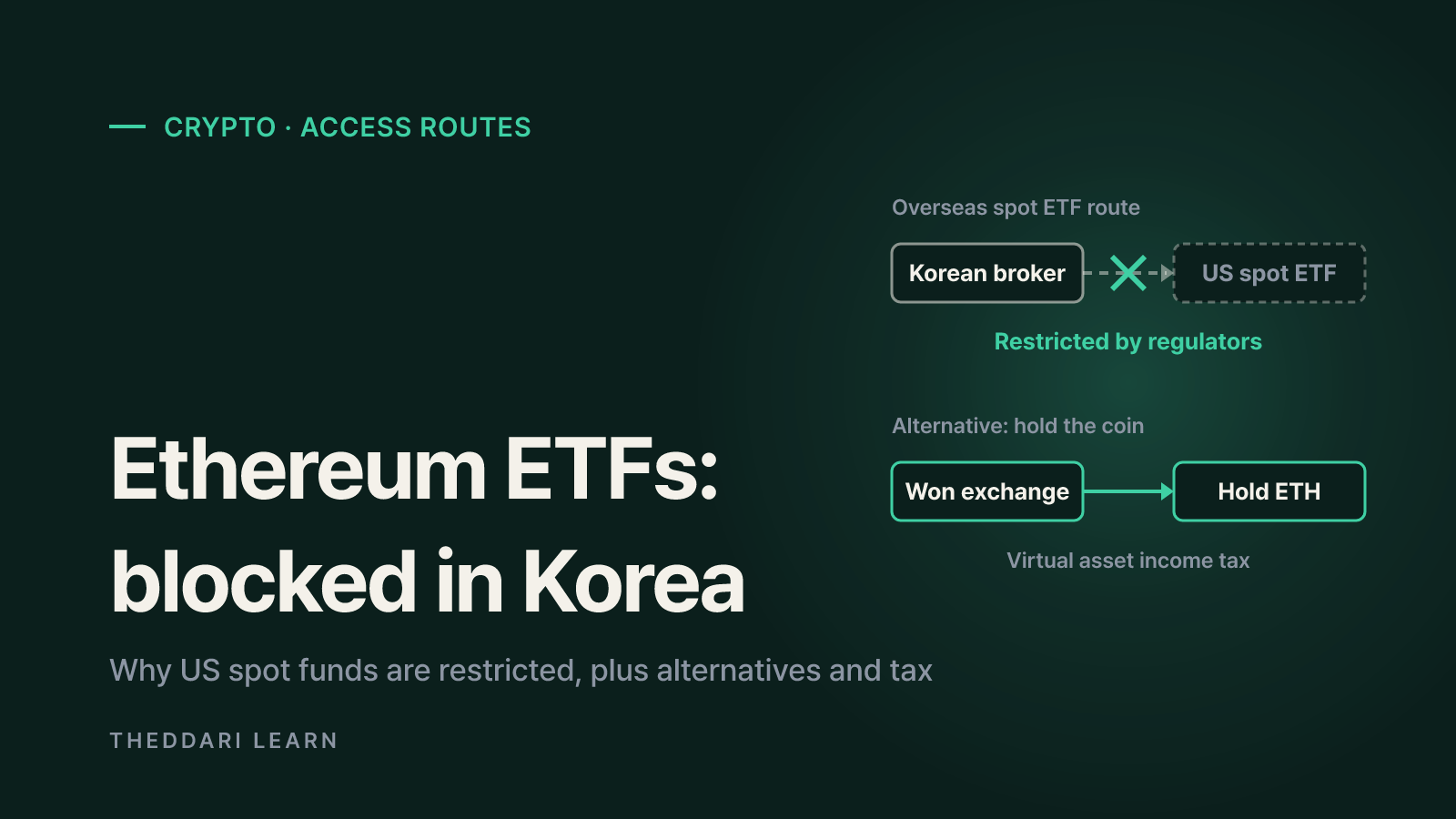
As of October 2026, Korean brokers block US spot Ethereum ETFs like ETHA. Learn why, what alternatives exist and how each is taxed for Korean residents.
Contents7 sections
- Can you buy an Ethereum ETF in Korea right now?
- Why access is blocked and when Korea may list its own
- Ethereum ETF alternatives compared: coins, futures funds and stocks
- Ethereum ETF tax in Korea: how each route is taxed
- How to invest in Ethereum from Korea: a pre-trade checklist
- Frequently asked questions
- Sources and references
Key takeaways
- As of October 2026, Korean brokerages restrict trading in US-listed spot Ethereum ETFs such as ETHA, FETH and ETHE at the request of financial regulators.
- Korea's FSC said in January 2024 that brokering overseas spot crypto ETFs may breach the Capital Markets Act; a July 2026 plan proposes amending that law.
- The government's plan named a spot Bitcoin ETF first. No crypto spot or futures ETF is listed on the Korea Exchange yet, and Ether's timing is unconfirmed.
- Korean tax residents pay foreign-stock capital gains tax (22% above KRW 2.5 million) on overseas ETFs; directly held crypto faces a separate 22% tax from 2027.
- Reports in late October 2026 say the crypto income tax may be delayed again, but the current law stands until the National Assembly amends it.
Short answer: as of October 2026, you cannot open a new position in a US-listed spot Ethereum ETF through a Korean brokerage. Products such as BlackRock's ETHA, Fidelity's FETH and Grayscale's ETHE are on Korean brokers' restricted lists at the request of financial regulators, and the Korea Exchange has no crypto ETF of its own. Investors in Korea who want exposure to Ether's price therefore choose between alternatives with very different structures: holding the coin directly, futures-based funds, or shares of crypto-related companies. This guide is written for individual investors who are tax residents of Korea. It covers why access is blocked, what the planned law change actually says, and how each alternative is treated for Korean tax.
Can you buy an Ethereum ETF in Korea right now?
Spot Ether ETFs began trading in the United States on 23 July 2024. Korean brokerages blocked them almost immediately, and the block remains in place. A Daishin Securities notice, reissued on 3 February 2026, states that spot Bitcoin and spot Ethereum ETFs are restricted "at the request of the financial authorities" and lists the following Ether products.
ETHA
- Fund
- iShares Ethereum Trust
- Korean brokerage trading
- Restricted
ETHE
- Fund
- Grayscale Ethereum Trust
- Korean brokerage trading
- Restricted
ETH
- Fund
- Grayscale Ethereum Mini Trust
- Korean brokerage trading
- Restricted
FETH
- Fund
- Fidelity Ethereum Fund
- Korean brokerage trading
- Restricted
ETHW
- Fund
- Bitwise Ethereum ETF
- Korean brokerage trading
- Restricted
ETHV
- Fund
- VanEck Ethereum ETF
- Korean brokerage trading
- Restricted
EZET
- Fund
- Franklin Ethereum ETF
- Korean brokerage trading
- Restricted
QETH
- Fund
- Invesco Galaxy Ethereum ETF
- Korean brokerage trading
- Restricted
The same notice also restricts a spot XRP ETF (XRPC), multi-coin index ETFs such as the 21Shares FTSE Crypto 10 products and a Bitcoin-linked income ETF. In practice, the rule targets overseas-listed funds that hold crypto directly, not just products with Ethereum in the name. Each broker maintains its own list, so if you see a newly launched crypto fund, check your broker's overseas-market notices before trying to place an order. The restriction is tied to the product and the Korean broker, so it applies to foreign residents with Korean brokerage accounts as well.
Search results for Ethereum ETFs mix spot funds with futures, options-income and leveraged products, and sometimes with blockchain-themed equity funds that hold no Ether at all. Confirm the ticker and the underlying assets in the prospectus before treating two products as equivalent.
Why access is blocked and when Korea may list its own
The root issue is Korea's Financial Investment Services and Capital Markets Act. It defines eligible underlying assets as financial investment products, currencies and general commodities, and regulators have interpreted that list as excluding virtual assets such as Bitcoin and Ether. When the US approved spot Bitcoin ETFs in January 2024, the Financial Services Commission (FSC) said that Korean brokers intermediating those overseas funds may violate the Act, and brokers halted new purchases, as the Korea Economic Daily recounts. Spot Ether ETFs were blocked on the same reasoning after their launch.
The 2026 plan to amend the law
On 14 July 2026, the government published its second-half 2026 economic growth strategy. In it, the FSC plans to amend the Capital Markets Act so that virtual assets can serve as ETF underlying assets, specifically to introduce a spot Bitcoin ETF. If that passes, investors could gain crypto exposure through an ordinary securities account rather than a crypto exchange. The announcement did not confirm whether spot Ether ETFs would be allowed at the same time, and no Ether-specific timeline had been published as of October 2026.
An October 12, 2026 report by thebell confirms that no spot crypto ETF trades on the Korean market and that neither futures-based nor spot crypto ETFs are listed on the domestic exchange. Even after the Act changes, regulators still need rules for custody, reference pricing and whether financial firms may hold crypto, so a launch could take time. Nothing announced so far says that a domestic listing would automatically lift the restriction on overseas spot ETFs.
Ethereum ETF alternatives compared: coins, futures funds and stocks
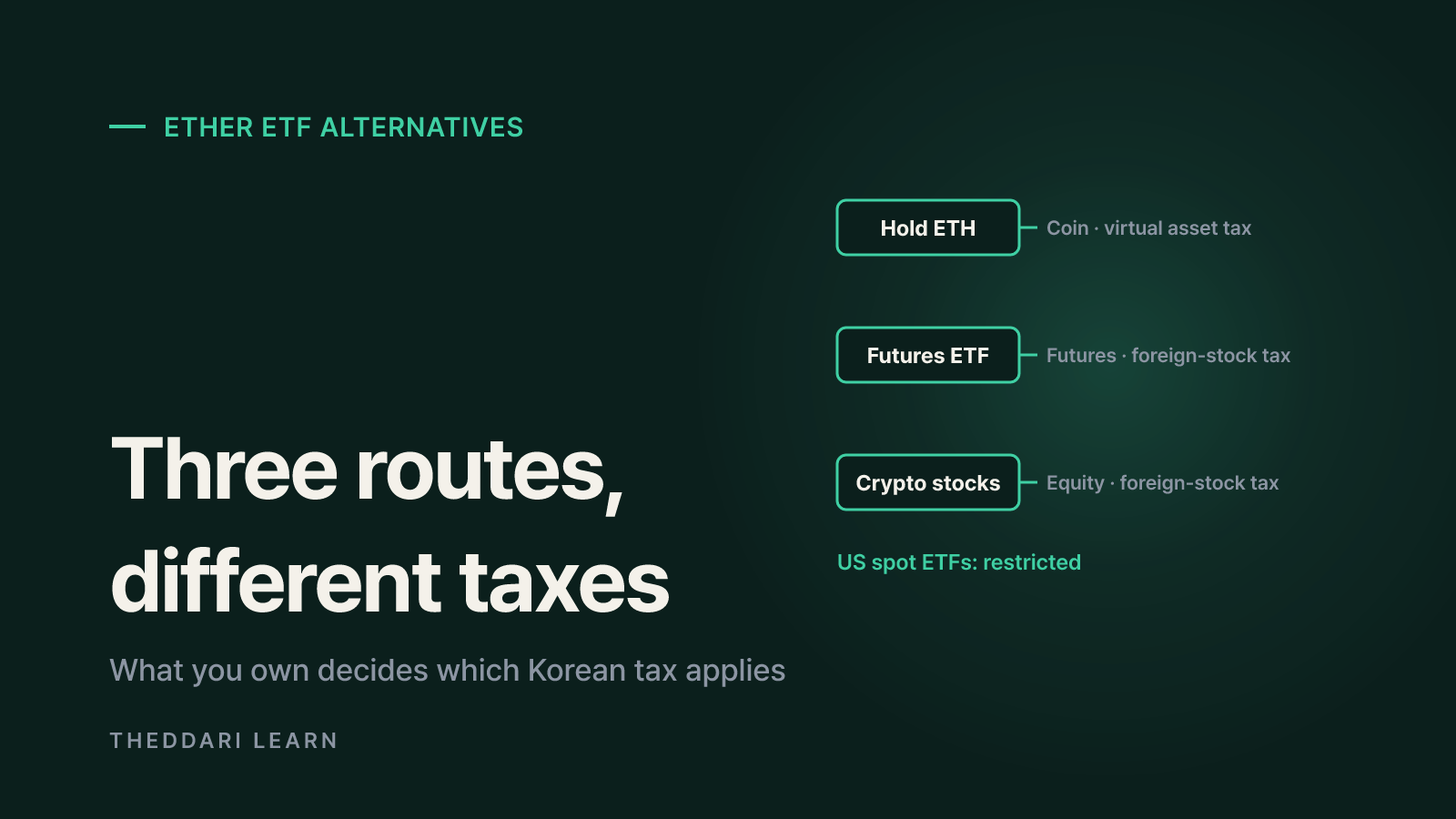
With overseas spot funds off the table, three routes come up most often. They differ in what you actually own, what the price tracks and which Korean tax applies.
Buy ETH on a Korean won exchange
- What you own
- The coin itself, on the exchange or in your wallet
- Link to Ether price
- Most direct, but the won price can differ from global prices
- Main risks
- Kimchi premium, exchange or wallet security, 24/7 volatility
- Korean tax (residents)
- Virtual asset income tax, scheduled from 2027
Overseas futures-based ETF
- What you own
- Shares of a fund holding futures contracts
- Link to Ether price
- Tracks futures; roll gains and losses can cause drift
- Main risks
- Roll costs, broker availability, currency risk
- Korean tax (residents)
- Foreign-stock capital gains tax
Crypto-related company stocks
- What you own
- Equity in a company
- Link to Ether price
- Indirect; adds company-specific risk
- Main risks
- Business, balance-sheet and currency risk
- Korean tax (residents)
- Foreign-stock capital gains tax for overseas shares
(Reference) Overseas spot ETF
- What you own
- Shares of a fund holding the coin
- Link to Ether price
- Tracks spot price
- Main risks
- Restricted at Korean brokers
- Korean tax (residents)
- Not applicable for new purchases
Holding Ether directly: watch the local price gap
Buying ETH on Upbit or Bithumb gives the most direct price exposure, but the Korean won price sometimes trades above or below the dollar price on overseas exchanges. If you buy while that gap, often called the kimchi premium, is wide, you can lose money when it narrows even if Ether's global price is unchanged. The theddari kimchi premium tracker shows the current domestic-versus-overseas gap so you can see it before ordering. You also need a plan for custody: leaving coins on an exchange and moving them to a personal wallet carry different security risks.

Futures-based funds: not the same return as spot
A futures fund holds contracts instead of coins and must roll into the next contract as each one approaches expiry. As thebell explains, the gains or losses from rolling can make returns diverge from holding the coin, and Korean investors can still trade overseas-listed Bitcoin futures ETFs through local brokers. Availability of Ether futures products varies by broker, and leveraged products may require pre-trading education or a minimum deposit, so check each ticker. Leveraged and inverse funds target daily moves, which can make multi-month results differ sharply from Ether's own performance.
Related stocks: Ether exposure plus company risk
Shares of listed companies that hold large amounts of Ether, or that operate crypto exchanges, are another indirect route. Their prices also respond to debt levels, new share issuance, earnings and regulation, and they often trade at a premium or discount to the value of the coins they hold. Treat them as company investments with their own disclosures rather than as a stand-in for an Ethereum ETF.
Ethereum ETF tax in Korea: how each route is taxed
For Korean tax residents, the tax depends on what you bought. Overseas-listed ETFs and shares are taxed as foreign stocks, while coins bought on an exchange fall under a separate virtual asset category. The summary below reflects National Tax Service guidance and reporting checked through October 2026. Amounts are in Korean won (KRW).
Overseas ETFs and stocks: foreign-stock capital gains tax
According to the National Tax Service, gains on foreign stocks are taxable for residents who have kept a domicile or residence in Korea for five or more consecutive years up to the date of sale. Gains and losses on taxable domestic and foreign shares are netted, and the KRW 2.5 million annual basic deduction applies once across them. The Korea Council for Investor Education notes a flat 22% rate including local income tax, with the return due in May of the following year. For example, a net gain of KRW 10 million leaves KRW 7.5 million after the deduction, giving KRW 1.65 million in tax. If a fund pays distributions, the US withholds 15%, and interest plus dividend income above KRW 20 million a year can move into Korea's comprehensive income taxation.
Coins held directly: virtual asset income tax
The National Tax Service overview states that income from transferring or lending virtual assets on or after 1 January 2027 is separately taxed as other income. Annual net gains are reduced by KRW 2.5 million, then taxed at 20% (22% with local income tax), and reported each May. For coins held before 2027, the acquisition cost is the higher of the 31 December 2026 market price or the actual purchase cost. This category is not netted against stock gains.
The start date is still in play. The Seoul Economic Daily reported on 25 October 2026 that the presidential office was leaning toward another delay, and bills to push the start to 2029 are pending in the National Assembly. If no amendment passes, the current law applies from January 2027. Do not plan around either outcome until the year-end tax bill review is complete.
Tax category
- Overseas ETFs and stocks
- Foreign-stock capital gains tax
- Coins on Korean exchanges
- Virtual asset other income (separate)
Annual deduction
- Overseas ETFs and stocks
- KRW 2.5 million, shared with taxable domestic shares
- Coins on Korean exchanges
- KRW 2.5 million
Rate
- Overseas ETFs and stocks
- 22% including local tax
- Coins on Korean exchanges
- 22% including local tax
Filing
- Overseas ETFs and stocks
- May of the following year
- Coins on Korean exchanges
- May of the following year
Status
- Overseas ETFs and stocks
- In force
- Coins on Korean exchanges
- Scheduled for January 2027; further delay under discussion
How to invest in Ethereum from Korea: a pre-trade checklist
- 1
Confirm the structure
Check the ticker and prospectus to see whether the fund holds spot Ether, futures or company shares. A product with Ethereum in its name can still be a leveraged or options-income fund.
- 2
Check your broker's restrictions
Look for the ticker in your broker's restricted list, and check whether leveraged products need pre-trading education or a minimum deposit.
- 3
Price the hidden costs
For coins, note the domestic price gap. For futures funds, note the expense ratio and roll costs. For any overseas product, note currency conversion fees and exchange-rate exposure.
- 4
Map your tax filings
Overseas ETFs and shares go on the foreign-stock capital gains return, while coins are calculated as virtual asset income. Keep annual trade records and cost data ready.
- 5
Set review dates
Track the Capital Markets Act amendment, any domestic ETF launch notice and the year-end decision on the crypto tax, then recheck your approach against the same criteria.
Policy headlines on this topic move fast, and early reports are often revised. The theddari Telegram crypto trends page shows which issues Korean crypto channels are discussing most. Use it to spot new developments, then confirm them against primary sources such as FSC press releases or your broker's notices before acting.
To sum up: as of October 2026, Korean residents cannot buy US-listed spot Ether ETFs through domestic brokers, and no Korean-listed crypto ETF exists. The government plans to amend the law, starting with spot Bitcoin, but timing for Ether and the tax treatment of any domestic product remain open. When comparing alternatives, weigh ownership structure, price gaps, custody risk and the tax category before expected returns, and revisit the comparison when the rules change.
Frequently asked questions
Can I buy ETHA through a Korean brokerage app?
Can foreigners living in Korea buy a spot Ethereum ETF through a Korean broker?
Will Korea list its own spot Ethereum ETF?
How would a Korean-listed spot crypto ETF be taxed?
Do I pay tax on Ether bought on Upbit or Bithumb?
Sources and references
- 1Daishin Securities: Trading restriction notice for spot Bitcoin and Ethereum ETFs (Korean, 2026-02-03)(opens in a new tab)money2.daishin.com
- 2Korea Economic Daily: Spot Bitcoin ETF to come to Korea (Korean, 2026-07-14)(opens in a new tab)www.hankyung.com
- 3thebell: No spot crypto ETF on the Korean market yet (Korean, 2026-10-12)(opens in a new tab)www.thebell.co.kr
- 4National Tax Service: Overview of virtual asset income tax for residents (Korean)(opens in a new tab)www.nts.go.kr
- 5National Tax Service: Capital gains tax calculation, foreign stocks and loss netting (Korean)(opens in a new tab)www.nts.go.kr
- 6Korea Council for Investor Education: Reporting overseas stock tax in May (Korean)(opens in a new tab)www.kcie.or.kr
- 7Seoul Economic Daily: Presidential office leans toward delaying crypto tax (Korean, 2026-10-25)(opens in a new tab)www.sedaily.com
Related articles
 Crypto
GTA 6 Memecoins on CoinGecko Trending: What to Check First
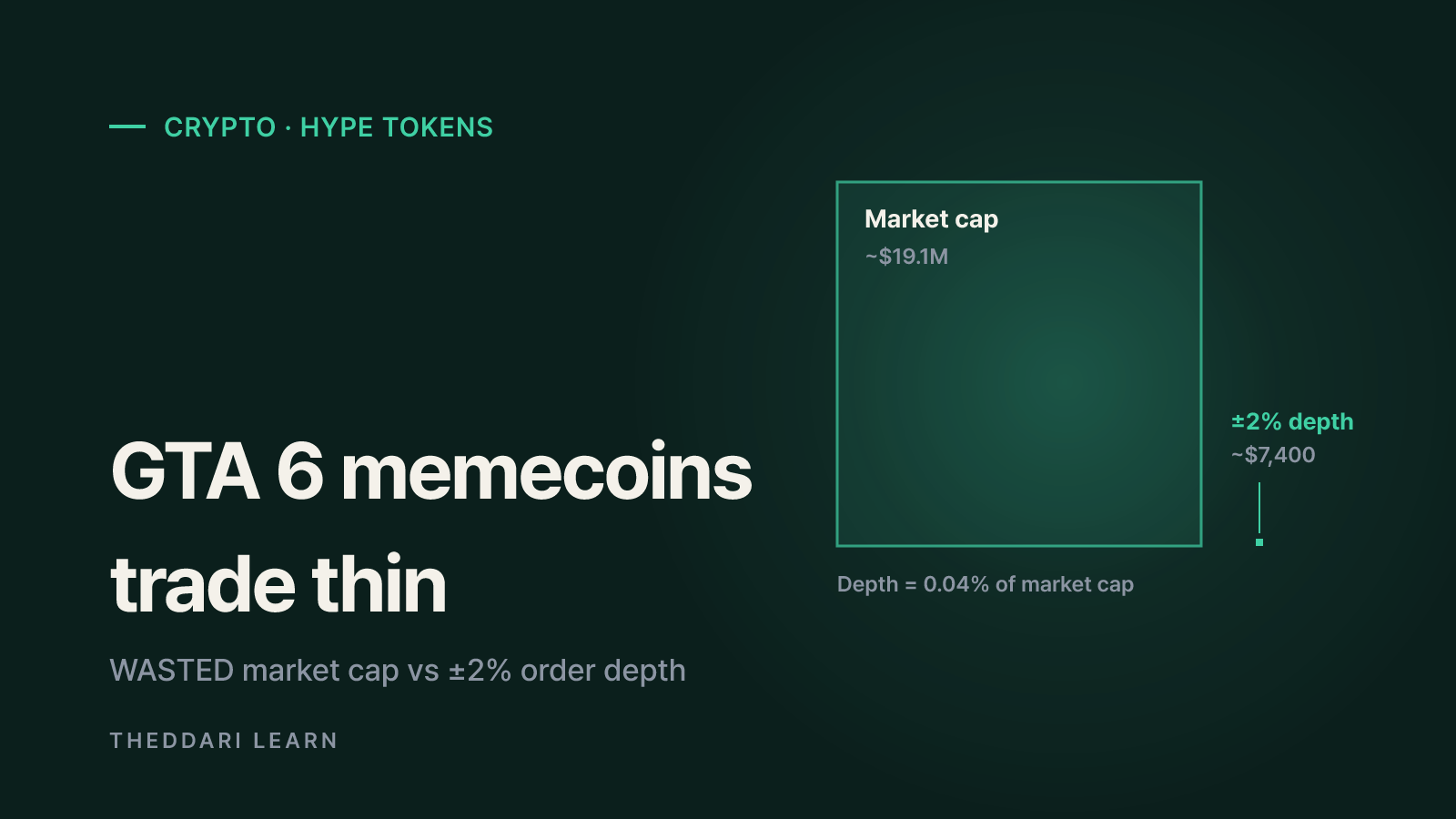
On November 19, 2026, GTA 6 launch day, three GTA-themed tokens hit CoinGecko's trending list. Here is what the data showed, why market cap misleads, and a step-by-step checklist before buying a hype token.
 Crypto
Ethereum Store of Value Debate: Supply, Burn, Digital Gold
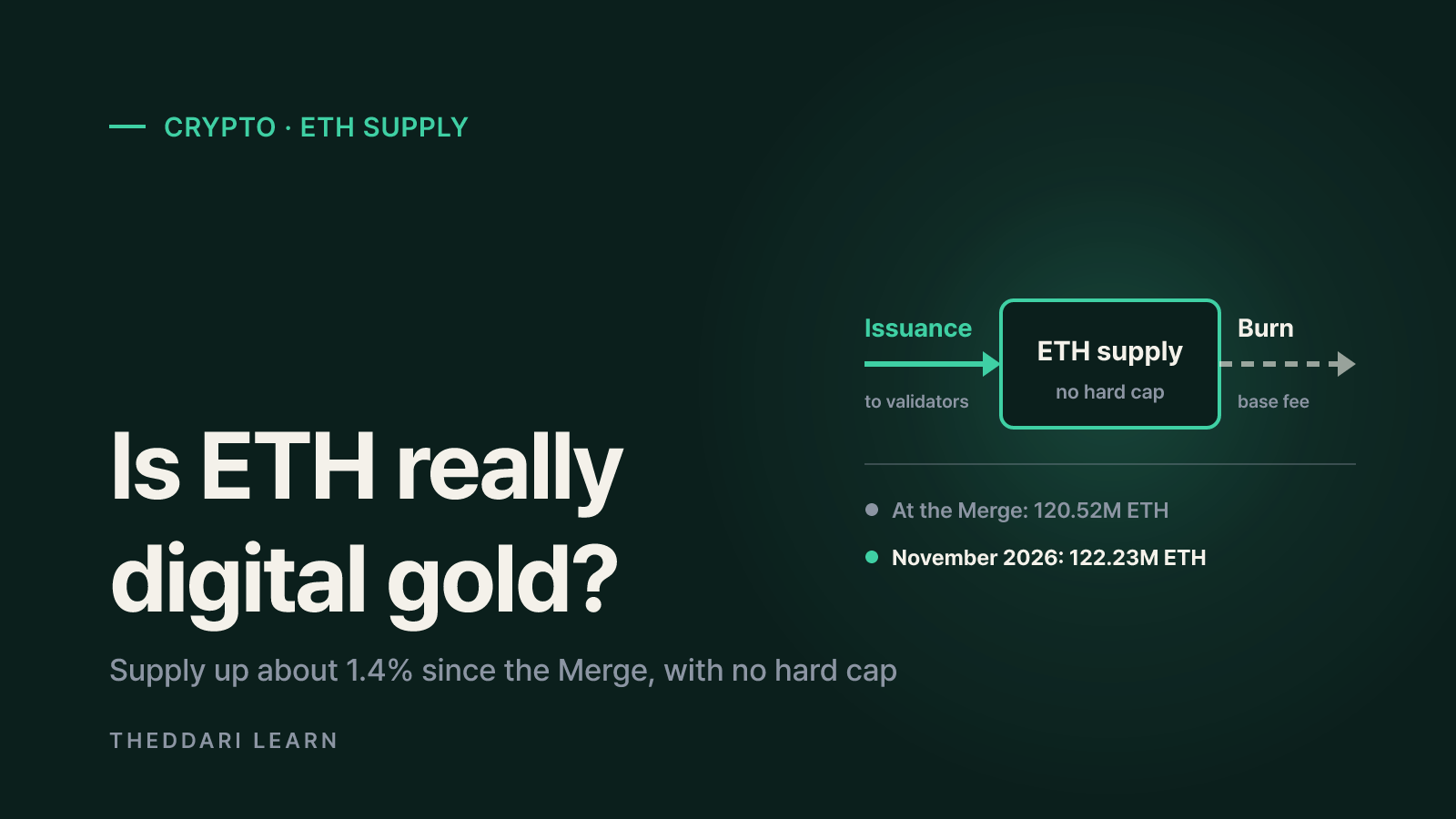
Ethereum has no supply cap: its supply moves with validator issuance minus the EIP-1559 fee burn. Here is what November 2026 data says about the ultrasound money and digital gold claims.
 Crypto
What Is the Bless Token? CoinGecko Trending Coin Checklist
Bless (BLESS) is a DePIN token that pools spare compute from everyday devices. Before buying the CoinGecko trending coin, check supply unlocks, where volume really trades, and the two official contract addresses.