OpenAI Math Breakthrough: How to Verify AI Proof Claims
OpenAI posted 372 AI-generated math results in October 2026. How to check an AI math proof claim: the paper, Lean formalization, expert review and acceptance.
目录8 个章节
核心要点
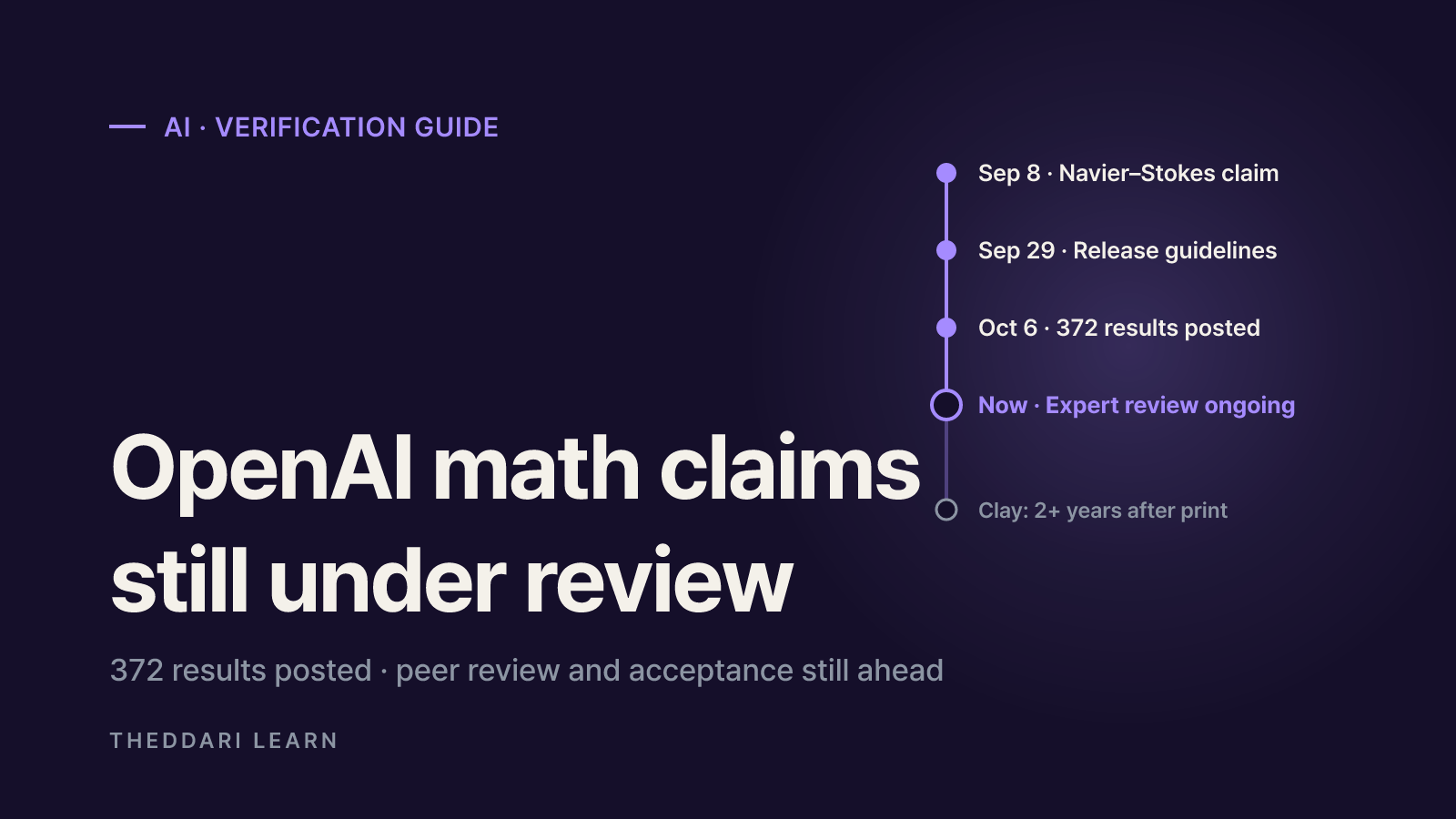
- The openai math headlines are based on real releases: a claimed Navier–Stokes solution on September 8, 2026, and 372 results from an internal model posted to GitHub on October 6, 2026.
- Released is not the same as verified. The model is unreleased, per-problem prompts were not published, and OpenAI said many results are not yet understood even by its own mathematicians.
- Lean formalization is strong evidence, but someone still has to check that the formal statement matches the theorem claimed in English.
- Clay Millennium Prize rules require publication in a qualifying outlet, at least two years, and general acceptance, so no claim can be officially settled on announcement day.
- Check in order: primary source, paper and reproducibility details, formalization scope, independent expert reaction, then peer review and community acceptance.
Short answer: the openai math story is real, but "solved math" overstates where things stand. As of October 2026, OpenAI has published a claimed solution to the Navier–Stokes Millennium Prize Problem (September 8) and a large batch of results from an internal model (October 6). Those are public claims with papers and partial computer checks. They are not yet results the mathematical community has fully reviewed and accepted. This guide explains what was released and gives you a repeatable way to judge any AI math proof claim you see in a video or a viral post.
Mathematics has an unusually slow and strict standard for truth. A proof has to be written down, checked line by line, rebuilt by independent experts, refereed by a journal, and absorbed by the field. That normally takes months or years. Headlines move in hours. Knowing the stages lets you place any announcement on the map yourself.
OpenAI Math Claims in 2026: What Was Actually Released
Two announcements drive most of the current openai math breakthrough coverage, plus a set of outside guidelines that shaped the second one.
Sep 8
- Release
- Navier–Stokes solution
- What OpenAI said
- An agent system on an internal model produced a proof and Lean formalization that a smooth fluid can develop a finite-time singularity
- Caveats
- About 10,000 concurrent agents ran for about 88 hours; OpenAI says it will not claim the prize
Sep 29
- Release
- Advisory group guidelines
- What OpenAI said
- An independent group at the Institute for Advanced Study published norms for releasing AI-generated math
- Caveats
- OpenAI says it drew on them but is not bound by them
Oct 6
- Release
- Bulk release on GitHub
- What OpenAI said
- Results from an internal model, Lean formalizations of many proofs, and 10 reasoning summaries
- Caveats
- Model unreleased; no per-problem prompts; only average compute disclosed
Oct 15
- Release
- Follow-up funding
- What OpenAI said
- $5 million to a new Simons Foundation initiative
- Caveats
- Supports workshops and programs to help humans understand AI results
The Navier–Stokes claim
According to OpenAI, its system showed that an initially smooth fluid at rest, under a smooth applied force and with finite energy, can develop a singularity in finite time. OpenAI says this establishes statements C and D in the official Clay problem description. The system used an internal model described as significantly more capable than GPT-6 Astra. The winning agent group had roughly 10,000 concurrent agents and reached its answer about 88 hours after launch; Lean formalization and verification took another 17 hours. OpenAI states it does not intend to claim the Millennium Prize.
The October batch: 372 results
Scientific American reported that the October 6 release contained 372 results that OpenAI says resolve or substantially advance major open questions in mathematics and theoretical computer science. OpenAI's own post says the average result used compute roughly equal to three hours of ChatGPT Pro thinking. A spokesperson told the magazine that almost every result came from a single prompt to a single agent, while adding that some may have taken multiple attempts, and acknowledged that many results are not yet understood by the company's own mathematicians.
Five Steps to Verify an AI Math Proof Claim
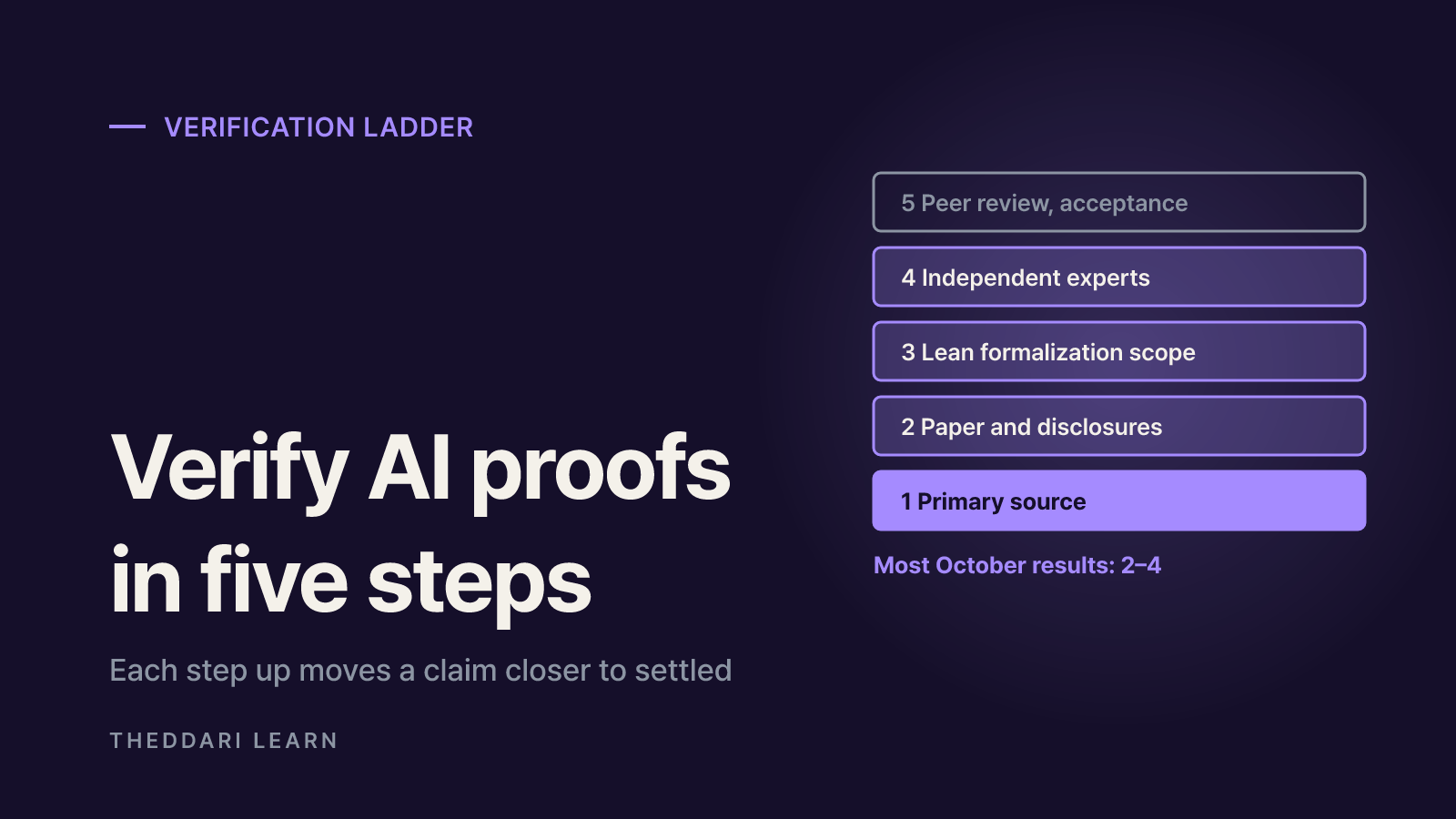
The path to trust is the same whether a human or a model wrote the proof. Each step up the ladder moves a claim closer to settled.
- 1
1. Go to the primary source
Skip the video summary. Open the official post, the paper PDF, and the repository. Note the date, the exact theorem name, and whether the wording is solved, progress, or a special case. Summaries often turn a weaker variant into a full solution.
- 2
2. Check what was disclosed
Look for the full proof, the model name, the prompts, compute time and cost, and how many problems were tried and failed. Without failure statistics you cannot tell whether you are seeing a cherry-picked highlight reel.
- 3
3. Read the formalization scope
If a proof assistant such as Lean was used, find out which statements were formalized, whether they match the paper, and whether any placeholders or new axioms remain. Partly formalized and fully formalized are very different claims.
- 4
4. Collect independent expert reaction
Search for named researchers in that subfield commenting, flagging errors, or reproducing the argument, plus any withdrawal or revision notices. An outside expert rebuilding the proof is a major credibility signal.
- 5
5. Wait for peer review and acceptance
Journal publication, conference talks, and follow-up papers that build on the result are what turn a claim into accepted mathematics.
Placed on this ladder, most of OpenAI's October results sit somewhere between steps 2 and 4. MIT mathematician Andrew Sutherland told Scientific American that until the model is released and people can replicate the results, claims about one-shotting problems with a single agent should be treated as unverified: "We should ask for receipts."
A Disclosure Checklist Built From the Experts' Own Rules
On September 29, 2026, the Advisory Group on Mathematics and AI at the Institute for Advanced Study published recommendations shaped by more than 600 responses from mathematicians. They double as a practical checklist for readers.
Model name, prompts, summarized reasoning, time and cost per result
- Why it matters
- Reproducibility and selection bias
- October OpenAI release
- 10 reasoning summaries and average compute; no per-problem prompts
How many comparable problems failed and how problems were chosen
- Why it matters
- Real success rate
- October OpenAI release
- Attempted-problem statistics published
Formalize where possible or state formalization status
- Why it matters
- Mechanical error checking
- October OpenAI release
- Lean files for many proofs, more promised
Cite prior work behind the ideas
- Why it matters
- Novelty and credit to human researchers
- October OpenAI release
- Better citations promised for future releases
Deposit in a repository not controlled by the lab
- Why it matters
- Persistent IDs and revision history
- October OpenAI release
- Posted on OpenAI's GitHub; alternatives under review
Fund human understanding
- Why it matters
- Turning output into knowledge
- October OpenAI release
- $5 million to a Simons Foundation initiative
The advisory group opened by saying it does not endorse labs testing advanced problems on proprietary models and asked them to stop, and it urged labs not to use math results as marketing. Meeting some checklist items does not mean mathematicians approve of how the results were released.
What Lean Formalization Does and Does Not Prove
Lean is a programming language for proofs: you write each step, and the computer checks that every inference is valid. When a formalization passes, you can be highly confident that the coded statement follows from the coded assumptions. That is why published Lean files are a genuine step forward for AI theorem proving.
The catch is that Lean checks the statement you gave it, not the sentence in the abstract. Three things still need human eyes:
- Statement match: is the formal theorem the same as the one in the paper's title, or does it add conditions that make it weaker?
- No gaps: are there leftover
sorryplaceholders or new axioms? Those are assumptions, not proofs. - Correct definitions: are key objects, such as what counts as a solution or finite energy, defined the standard way? A different definition means a different problem.
Why Nothing Is Officially Settled on Day One
The Clay Mathematics Institute rules set three conditions before it will even consider a Millennium Prize solution: publication in a qualifying outlet, at least two years since publication, and general acceptance in the global mathematics community. Clay does not accept direct submissions. Any headline saying a $1 million prize has been awarded weeks after an announcement does not match how the process works.
If you are tracking how fast this story spreads compared with how fast it is verified, the theddari AI Telegram trends page shows which AI topics are being shared, and the blog trends view shows how different writers frame the same claim. Volume tells you about attention, not about which verification step a result has reached.

Bottom Line for Readers and Investors
- Does the original source say solved, or progress?
- Are the proof, prompts, compute, and failure counts public?
- Does the Lean file verify the same statement the paper claims?
- Have named outside experts confirmed the argument or found errors?
- How far is the result from peer review and community acceptance?
Treat the 372 results individually, not as one verdict. Remember that OpenAI is a private company, so math news is not a direct route to any stock or token, and coins borrowing its name are a known scam pattern. As of October 2026, mathematicians are saying "astonishing" and "show us the receipts" at the same time. Using these five questions keeps you from being swept up by a viral title while still noticing when real verification arrives.
常见问题
Did OpenAI actually solve a Millennium Prize Problem?
If a proof is checked in Lean, does that mean it is correct?
How is AI theorem proving different from AI solving math benchmarks?
Should I buy stocks or tokens because of AI math news?
来源与参考资料
- 1OpenAI — Sharing AI progress in mathematics (Oct 6, 2026; updated Oct 15)(在新标签页中打开)openai.com
- 2OpenAI — On the Navier–Stokes Millennium Prize Problem (Sep 8, 2026)(在新标签页中打开)openai.com
- 3Advisory Group on Mathematics and AI — Responsible Release of AI-Generated Mathematics (Sep 29, 2026)(在新标签页中打开)agmai.org
- 4Scientific American — OpenAI unleashes hundreds more math results upon a field already in shock (Oct 6, 2026)(在新标签页中打开)www.scientificamerican.com
- 5Clay Mathematics Institute — Rules for the Millennium Prize Problems(在新标签页中打开)www.claymath.org
相关文章
 AI
Anthropic's Riemann Hypothesis Proof: Is It Verified?
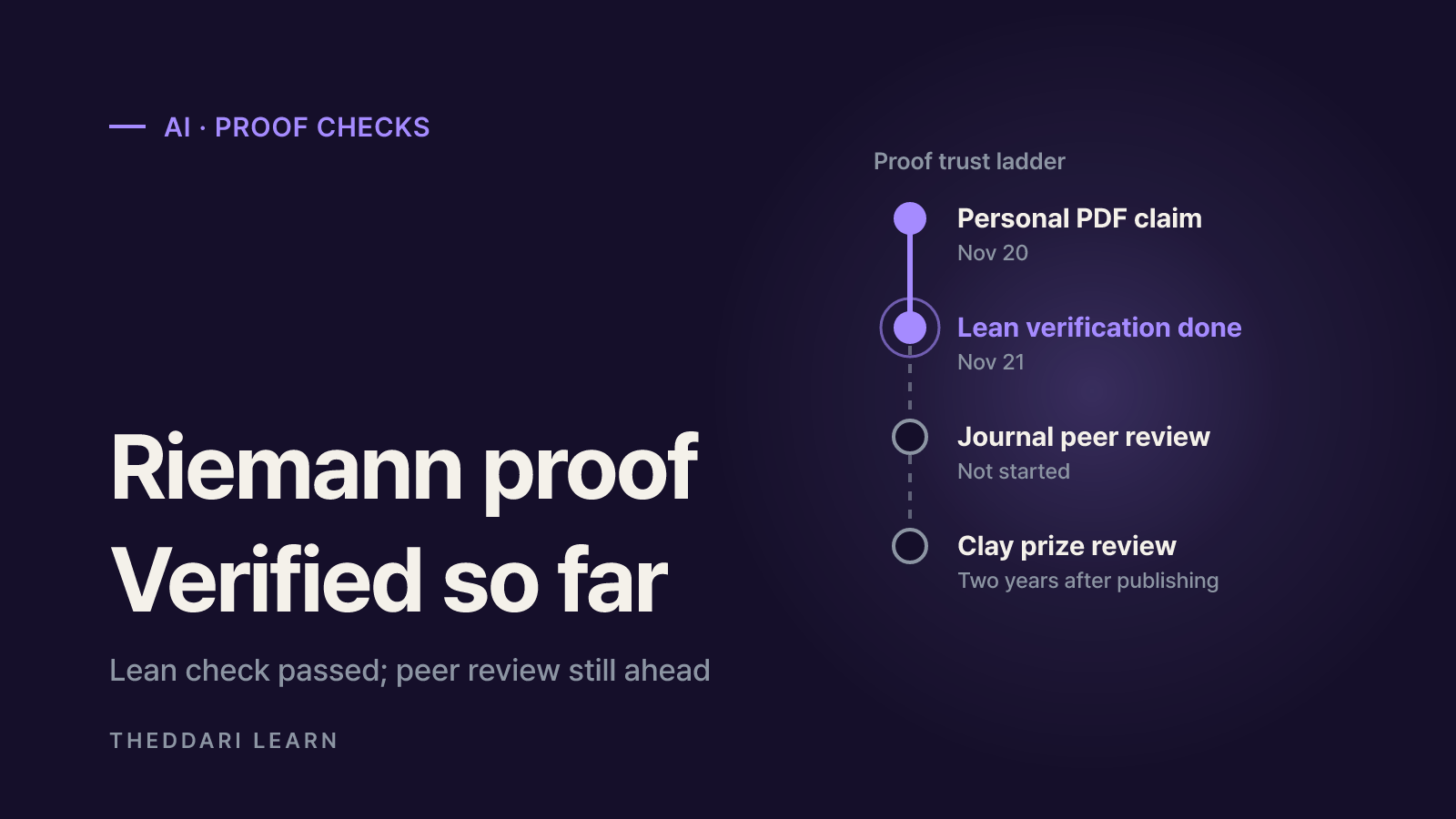
On November 20, 2026, Anthropic researcher Levent Alpöge said he had proved the Riemann Hypothesis with Claude. A day later the Lean and Mathlib communities certified the formal proof. What that means, what is still missing, and a checklist for judging big proof claims.
 AI
AgentRoboCritic: Can Frontier AI Agents Control Robots?
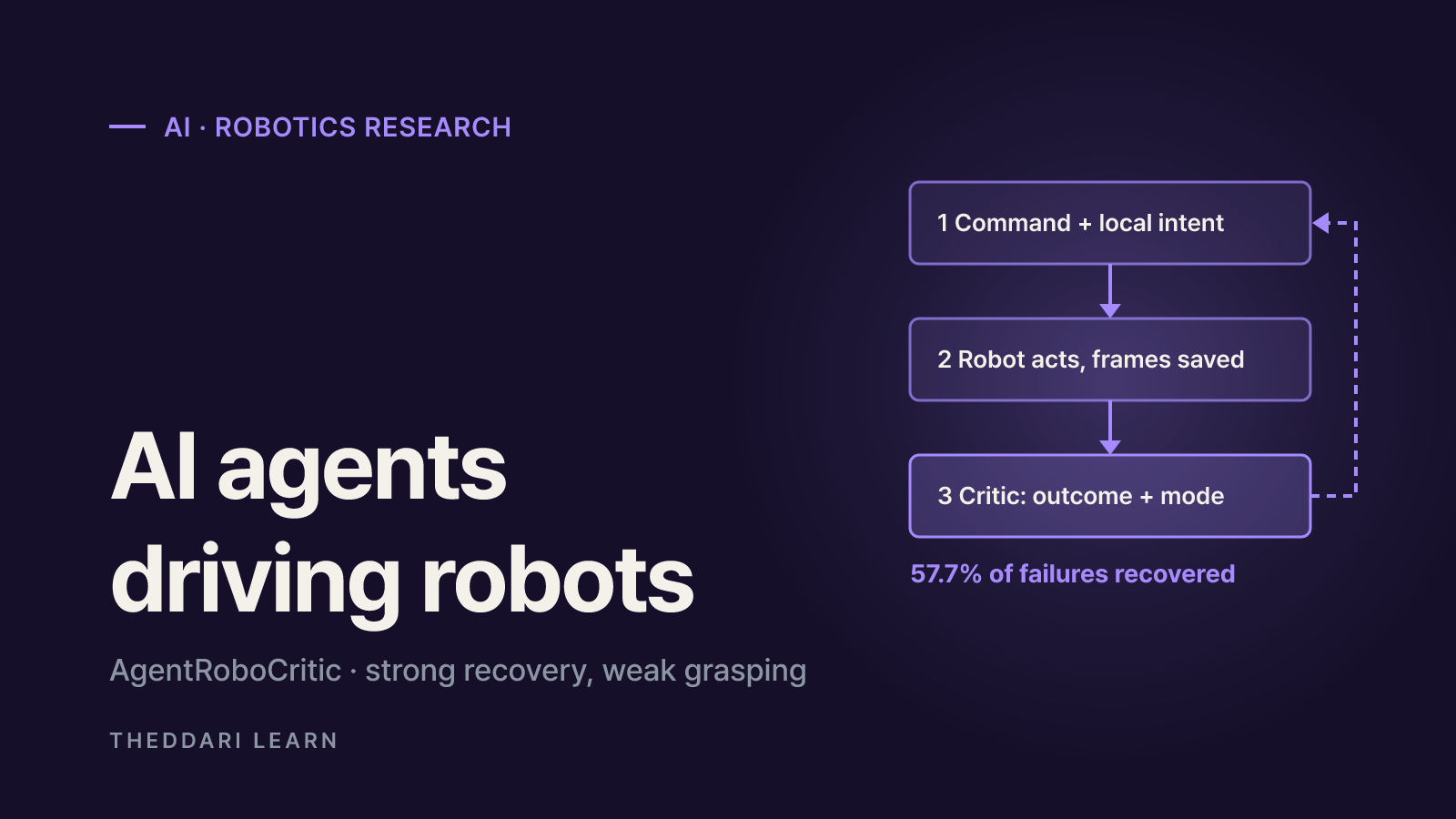
A November 2026 arXiv study from Carnegie Mellon, UIUC and Bosch scores every action a frontier AI agent sends to a robot. Here is what it found about recovery, grasping, alignment, zero-shot success and latency, and how far to trust it.
 AI
Inkling 2 Mini vs Inkling 2 Small: Specs, Local Use, Limits
Thinking Machines released Inkling 2 Mini on November 20, 2026: a 26.4B-parameter open-weights model with a ~20GB checkpoint that runs on 32GB Macs. Here is how it compares with Inkling 2 Small and what to check before you deploy it.