Anthropic's Riemann Hypothesis Proof: Is It Verified?
Where the Anthropic Riemann Hypothesis proof stands: what Lean verification proved, what peer review and the Clay prize still need, and how to check.
目录7 个章节
核心要点
- On November 20, 2026, Anthropic's Levent Alpöge posted a four-page note and Lean code claiming a proof of the Riemann Hypothesis, including the Generalized Riemann Hypothesis, found with Claude.
- On November 21, the Lean and Mathlib communities issued a joint statement certifying that both the statement and the proof are correct; the 17-million-line library passed several independent checkers.
- Formal verification is very strong evidence of logical correctness, but there is no human-readable paper or journal peer review yet.
- The Clay Mathematics Institute's $1 million prize requires publication in a qualifying outlet, at least two years of waiting, and general acceptance by mathematicians.
- To judge similar claims, ask four questions in order: right statement, does it compile, does the proof match the statement, and do independent kernels agree.
Short answer: as of November 22, 2026, the Riemann Hypothesis proof announced by Anthropic researcher Levent Alpöge has passed formal, machine-checked verification, but it has not yet gone through the human steps that usually make a result settled. Alpöge posted a four-page note on his personal site on November 20 saying he had found a proof "working with Claude," and on November 21 the Lean and Mathlib communities issued a joint statement certifying that both the statement and the proof are correct. This guide explains what that certification covers, what is still missing, and how to judge the next headline that says a famous problem has been solved.
Where the Riemann Hypothesis proof claim stands
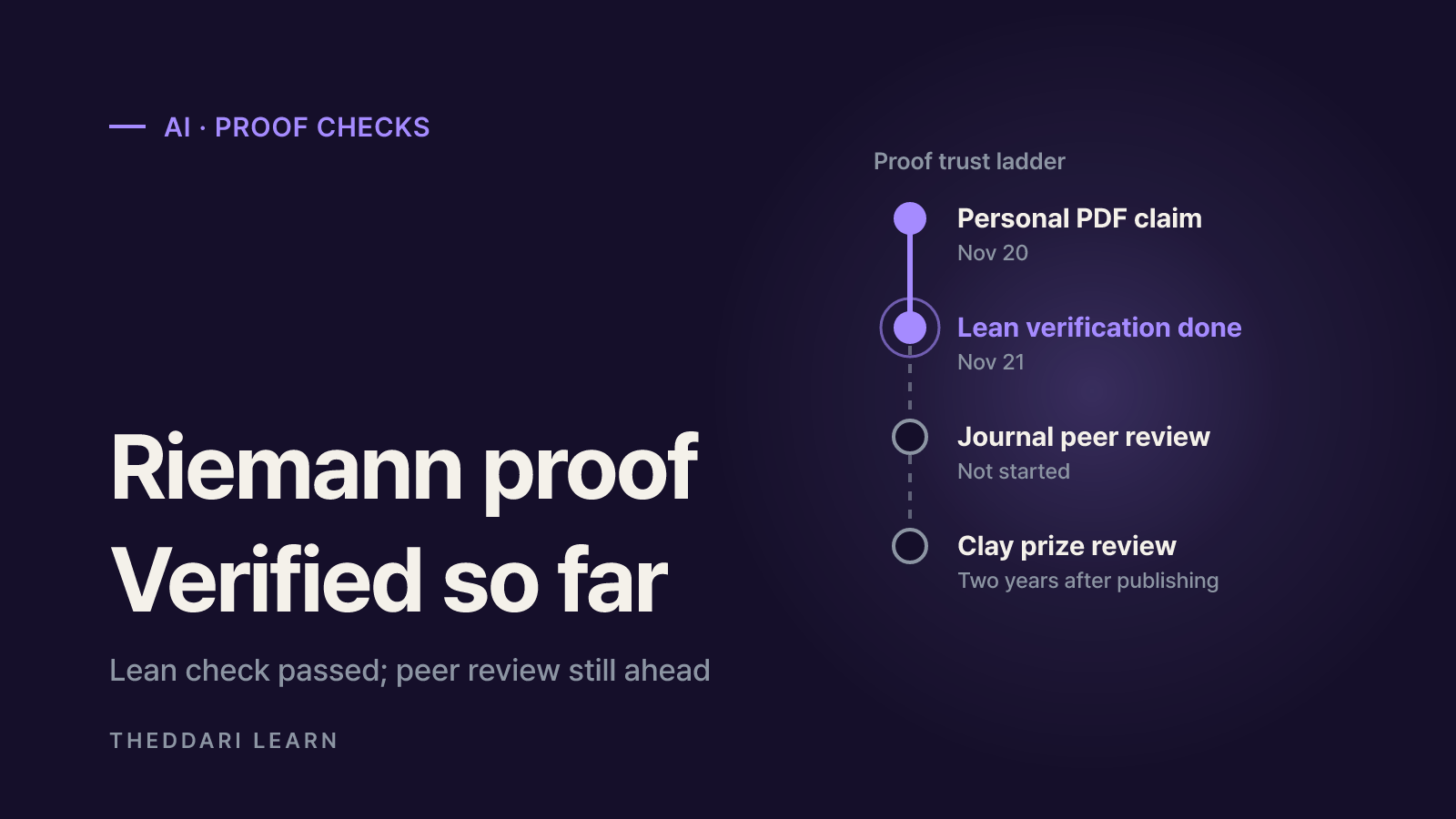
The claim went from a personal PDF to a community-certified formal proof in about a day. According to New Scientist, Alpöge did not publish a human-readable proof, saying an unpublished version ran past 250,000 pages and that posting unreadable "slop" would be inappropriate. Instead he released the proof written in Lean, a programming language that lets a computer check every logical step. Anthropic had listed on the stock market on November 19, and Alpöge wrote that the timing of the announcement was "horrible."
Nov 20
- What happened
- Alpöge posts a four-page note plus Lean code; also claims the Generalized Riemann Hypothesis (GRH)
- Status
- Self-published claim
Nov 20
- What happened
- Experts including Kevin Buzzard: first, see whether it compiles
- Status
- Checking begins
Nov 21
- What happened
- Lean and Mathlib joint statement certifies statement and proof
- Status
- Formal verification done
Next
- What happened
- Readable write-up, journal peer review, broad acceptance
- Status
- Not started
The joint statement says the library is about 17 million lines of Lean and depends directly only on Mathlib, the community's human-reviewed math library. Dozens of people reproduced the build, and the exported proof was accepted by Lean's official kernel plus several independent checkers. Scientific American quotes MIT mathematician Andrew Sutherland, who compiled it separately and confirmed it uses only the three standard axioms.
What is the Riemann Hypothesis and why it matters
Bernhard Riemann proposed the hypothesis in 1859. It says that all the non-trivial zeros of the Riemann zeta function lie on the line where the real part equals 1/2. Those zeros control how prime numbers are spread along the number line, so the hypothesis is often described as a hidden order behind primes that look random.
- A Millennium Prize Problem: it is one of seven problems the Clay Mathematics Institute attached a $1 million prize to.
- Conditional results become theorems: a large body of number theory assumes the hypothesis or its generalized form. If GRH holds, those results no longer need the assumption.
- A benchmark for AI research: the problem stood for 167 years, so a proof found with an AI model is a reference point in debates about what these systems can do.
Fame is not evidence, though. The Riemann Hypothesis attracts a steady stream of amateur proof claims every year, which is exactly why the verification route matters more than who is making the claim.
Self-published PDF vs formal proof vs peer review
Each stage of checking guarantees something different. Reading headlines with this ladder in mind helps you tell "claims" from "confirmed" from "accepted."
Personal PDF or blog post
- What it guarantees
- What is claimed and by whom
- What it does not
- Correctness, any outside review
Lean code released
- What it guarantees
- The claim is in checkable form
- What it does not
- That it compiles or states the right thing
Formal verification passed
- What it guarantees
- Correct statement; every logical step machine-checked
- What it does not
- Human understanding of the ideas
Journal peer review
- What it guarantees
- Experts read and accept the argument
- What it does not
- Zero errors (retractions still happen)
Community acceptance and prizes
- What it guarantees
- The result survived long scrutiny
- What it does not
- —
This case has reached the third row. Formal checking can be stricter than human refereeing on logic, but Buzzard notes that a correct Lean proof does not mean an accompanying PDF explanation is correct. The joint statement itself says the community now looks forward to work that explains the new ideas in the proof.
Verifying math proofs: four questions to ask about Lean claims
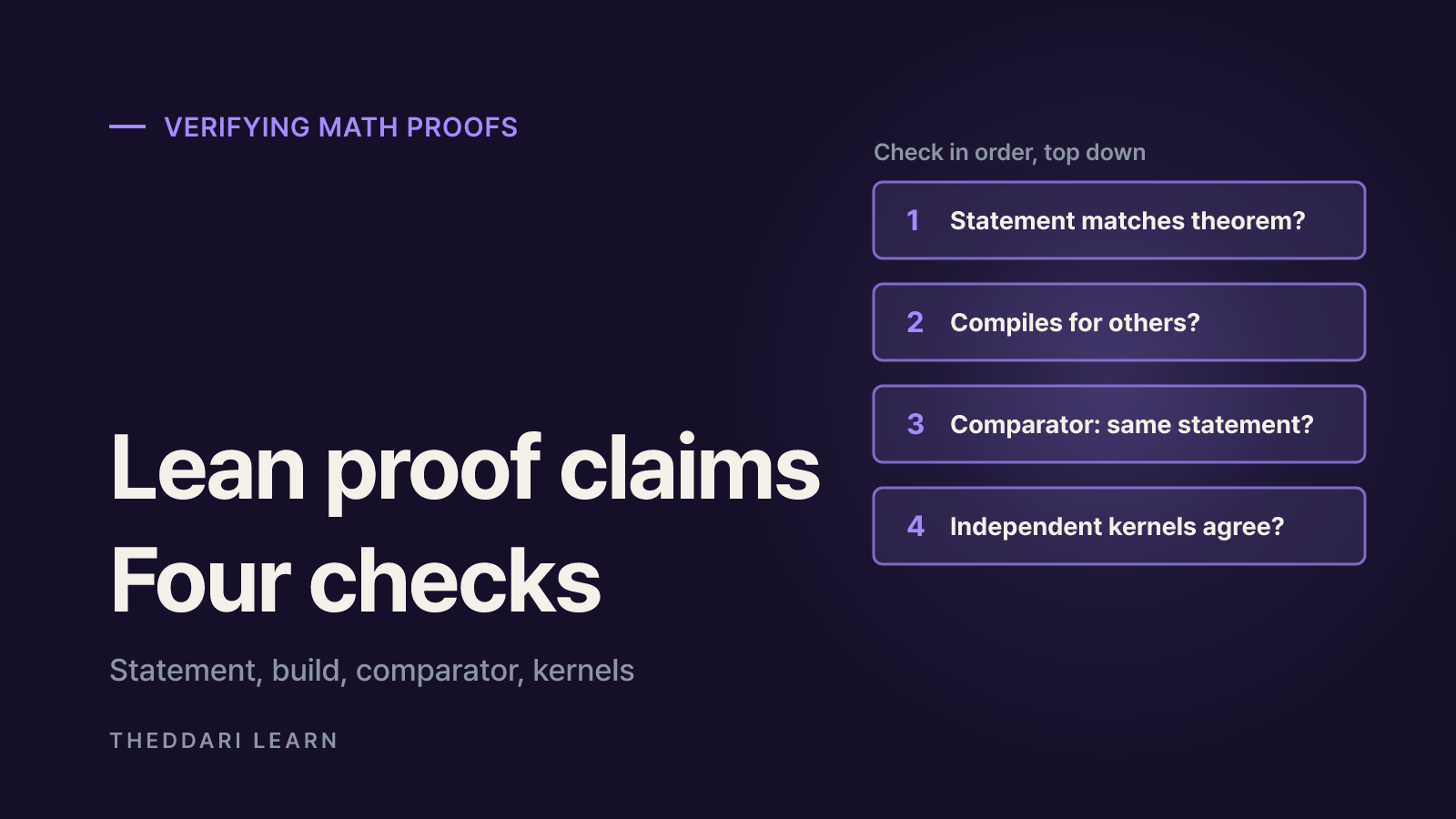
In a November 12, 2026 post, Kevin Buzzard of Imperial College London laid out how to read the phrase "checked in Lean," especially for AI-generated code. His four questions work as a checklist for any future claim.
- 1
1. Does the Lean statement match the real theorem?
Look at the statement, not the proof. Buzzard shows a two-line version of Fermat's Last Theorem that is trivially false because Lean's natural numbers include 0. Here the statement is Mathlib's existing
RiemannHypothesisdefinition, which experts had already vetted. - 2
2. Does the code compile for someone else?
An independent person must build the code without errors. Huge libraries may need a powerful machine, and AI-generated code from unknown sources should run in a sandbox.
- 3
3. Does the proof prove that exact statement?
Tools such as
comparatorcheck that the theorem proved through millions of untrusted lines is identical to the one in a trusted file, with no redefined symbols or extra axioms. Two independent tools confirmed the match in this case. - 4
4. Does it rely on a Lean kernel bug?
Several independent kernels, written in different languages, should accept the same proof. A hidden exploit would need to fool all of them at once.
When a story says a result was verified in Lean, look for which of these four checks were done independently. Buzzard points out that in OpenAI's October 2026 dump of 722 papers, about 38 of the 290 with Lean code did not even state the paper's main theorem.
Open questions and common misreadings
The Clay prize clock has not started
The Clay Mathematics Institute rules, revised on September 26, 2018, say it does not accept direct submissions. A solution must be published in a qualifying outlet, at least two years must pass, and it must have general acceptance in the global mathematics community. None of that has happened yet.
"AI solved it alone" is not what was claimed
Alpöge describes the work as done with Claude, not by Claude alone. How journals and prize committees will credit AI collaboration is an open question, and it is likely to come up as more results like this appear.
Keep the math separate from the stock story
The announcement came one day after Anthropic's market debut, which invites cynical readings. Whether the proof is correct is a separate question from any effect on the company's reputation or share price, and a math result does not by itself say anything about revenue or product quality.
To see how AI news like this spreads and is discussed across channels, you can follow the AI feed on THEDDARI's Telegram trends page.

The blog trends dashboard shows how the same topic is framed across blogs and news. The louder the headlines, the more it pays to open the original source and check which verification stage it describes.
Bottom line: this Riemann Hypothesis claim has moved well past the self-published stage and passed a formal check that most proof claims never reach. What to watch next is whether a readable explanation appears, whether it goes through journal review, and whether mathematicians come to understand and accept the new ideas. The next time a famous problem is declared solved, start with the four questions: right statement, independent build, comparator match, and multiple kernels.
常见问题
Has the Riemann Hypothesis actually been proven?
Can a proof checked in Lean still be wrong?
Will Alpöge get the $1 million Millennium Prize?
Why did Alpöge release Lean code instead of a paper?
来源与参考资料
- 1Lean verification of the Riemann Hypothesis — Lean community blog (2026-11-21)(在新标签页中打开)leanprover-community.github.io
- 2“…and the proof is checked in Lean” — Kevin Buzzard, Xena (2026-11-12)(在新标签页中打开)xenaproject.wordpress.com
- 3Rules for the Millennium Prize Problems — Clay Mathematics Institute(在新标签页中打开)www.claymath.org
- 4The AI Riemann hypothesis proof is true, independent mathematicians confirm — Scientific American(在新标签页中打开)www.scientificamerican.com
- 5Anthropic mathematician claims AI-assisted proof of the Riemann hypothesis — New Scientist(在新标签页中打开)www.newscientist.com
相关文章
 AI
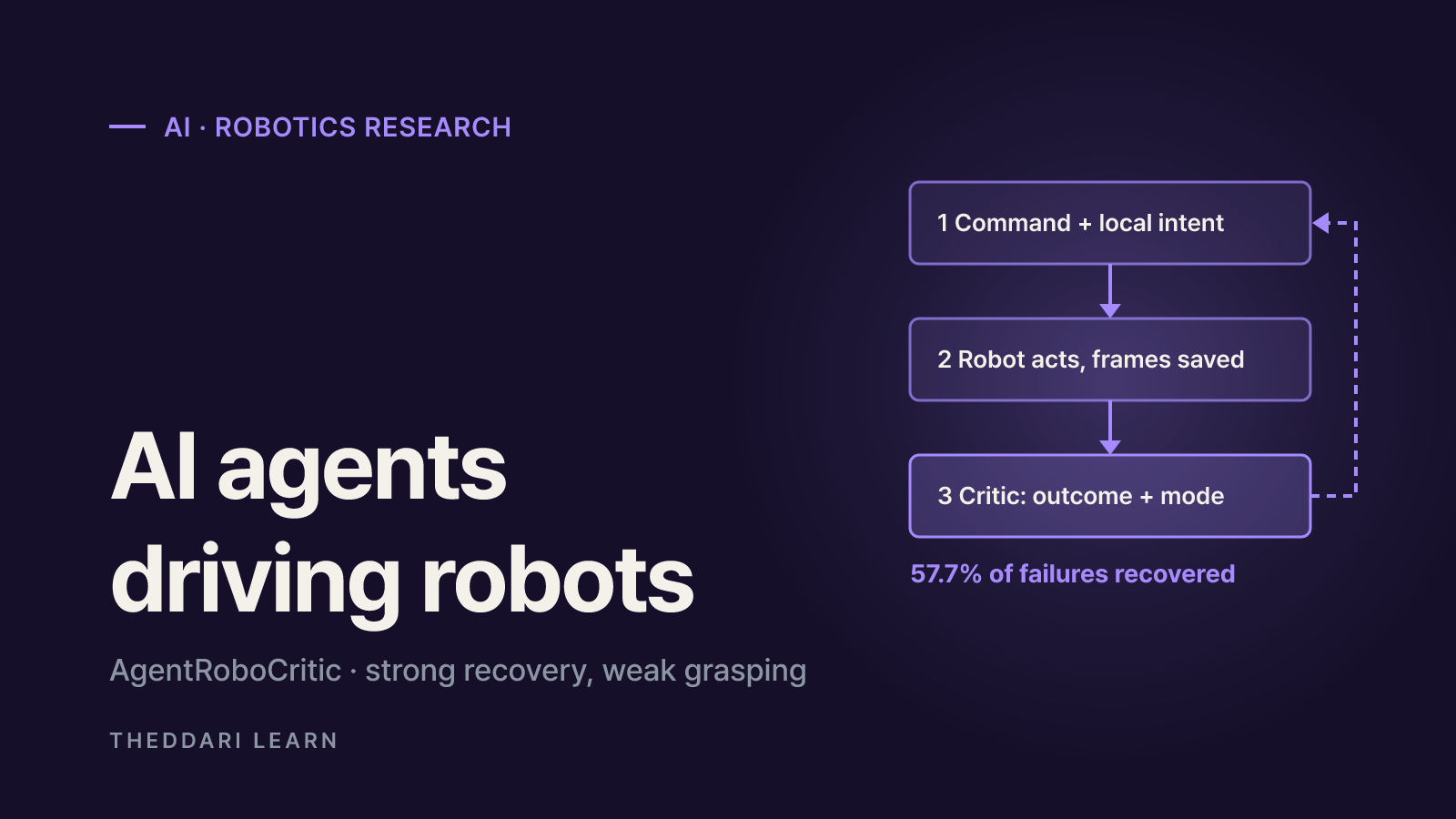
AgentRoboCritic: Can Frontier AI Agents Control Robots?
A November 2026 arXiv study from Carnegie Mellon, UIUC and Bosch scores every action a frontier AI agent sends to a robot. Here is what it found about recovery, grasping, alignment, zero-shot success and latency, and how far to trust it.
 AI
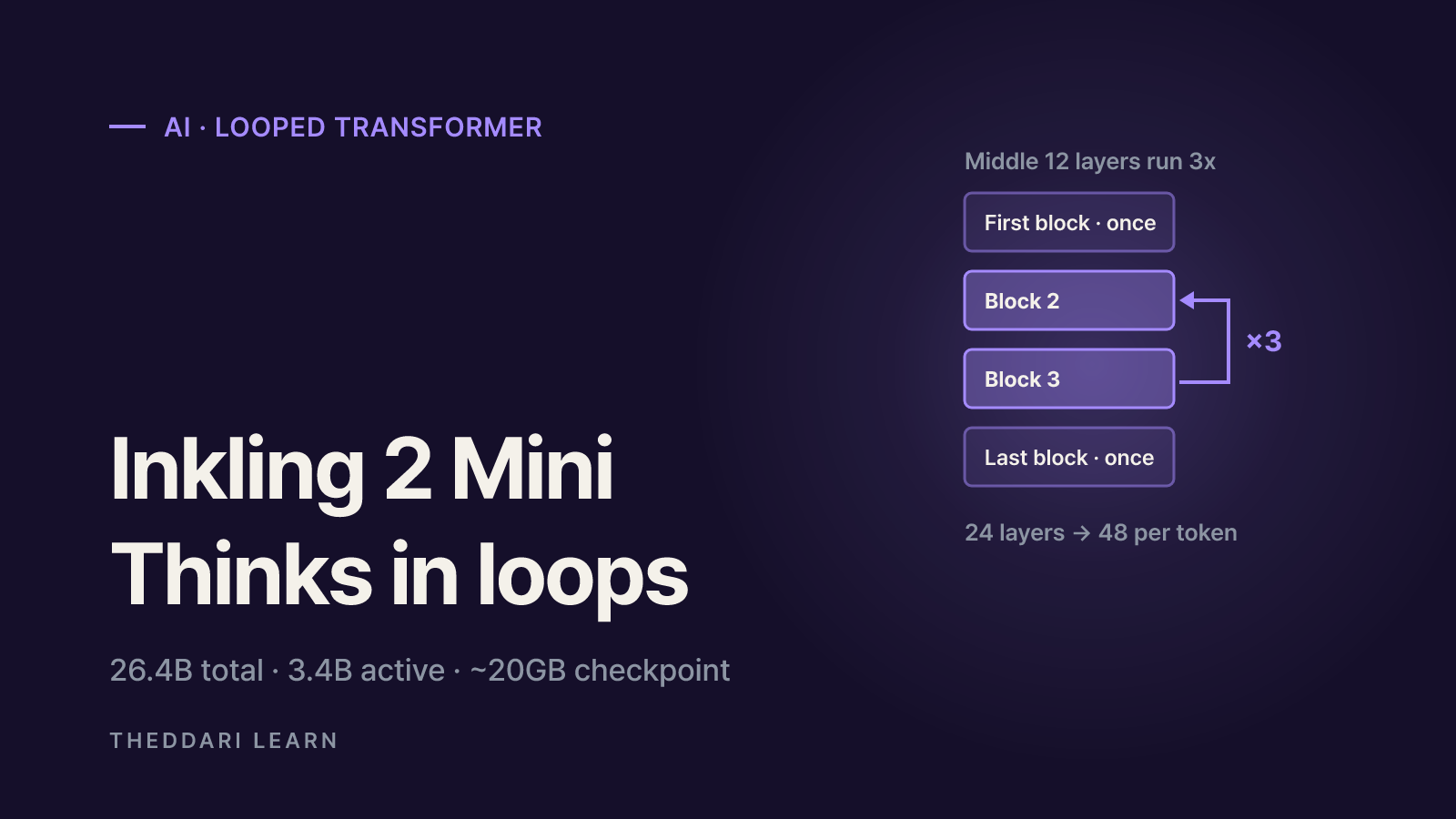
Inkling 2 Mini vs Inkling 2 Small: Specs, Local Use, Limits
Thinking Machines released Inkling 2 Mini on November 20, 2026: a 26.4B-parameter open-weights model with a ~20GB checkpoint that runs on 32GB Macs. Here is how it compares with Inkling 2 Small and what to check before you deploy it.
 AI
Frostbite CPU: What the AI-Designed Chip Claims Really Show
Architect Labs says AI agents took Frostbite from instruction set to final GDS layout. Here is what the AI actually did, what the 4.59x efficiency figure is measured against, and which claims still lack silicon or independent replication.