Quantus Coin (QTC): What to Check Before You Buy
Quantus coin (QTC) is a post-quantum proof-of-work Layer 1 that hit #1 on CoinGecko trending. Supply, unlocks, venues and scam checks as of October 2026.
目录8 个章节
- What is Quantus coin? A post-quantum proof-of-work chain
- Why Quantus is trending on CoinGecko: the numbers
- Supply and unlocks: the 27% genesis mint and the 2027 cliff
- Where QTC trades and how deep the market is
- Quantus coin checklist: five things to verify before buying
- Open questions and risks that remain
- 常见问题
- 来源与参考资料
核心要点
- Quantus is a proof-of-work Layer 1 that signs every transaction with NIST's lattice-based ML-DSA scheme; mainnet launched on September 9, 2026.
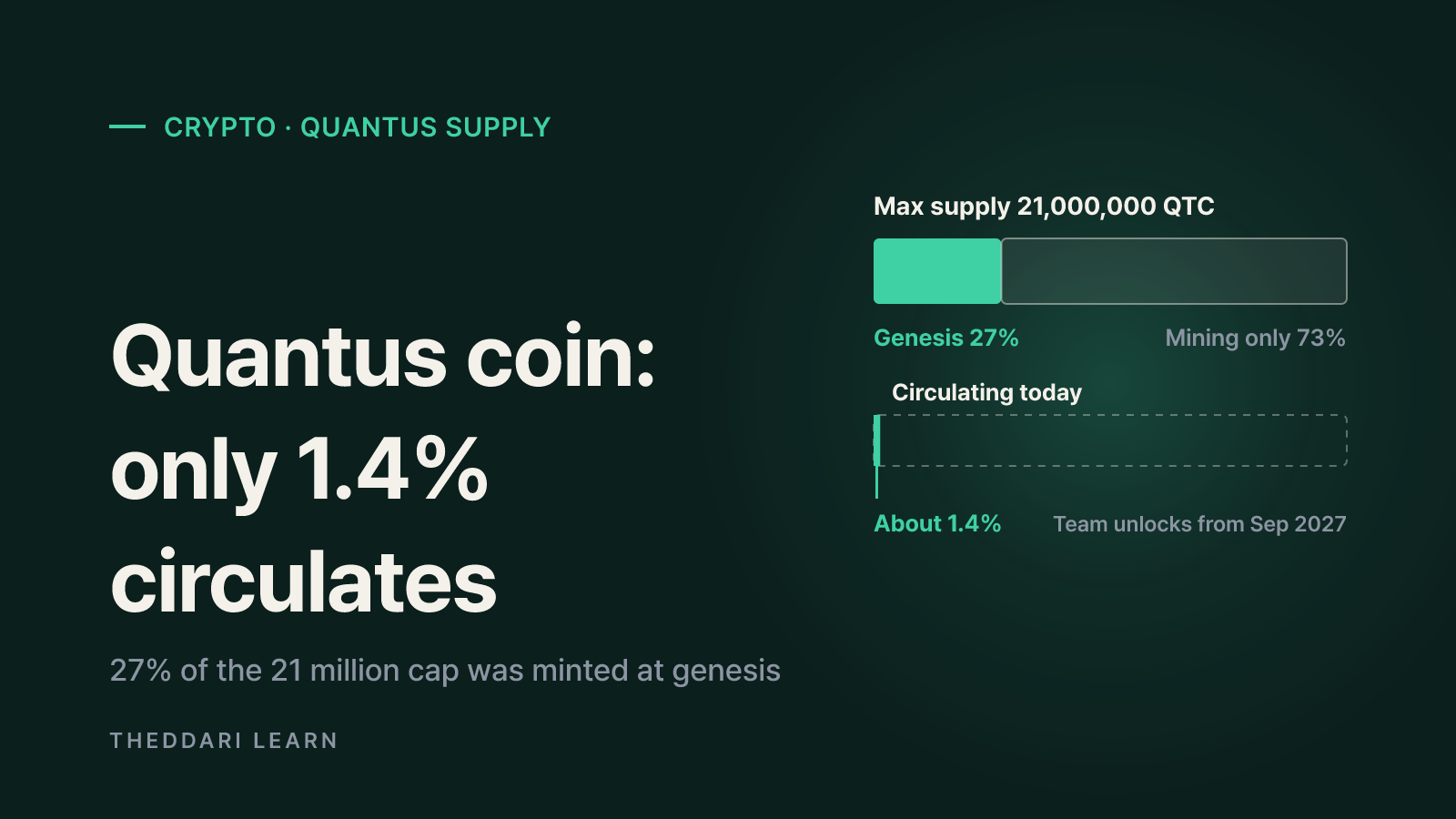
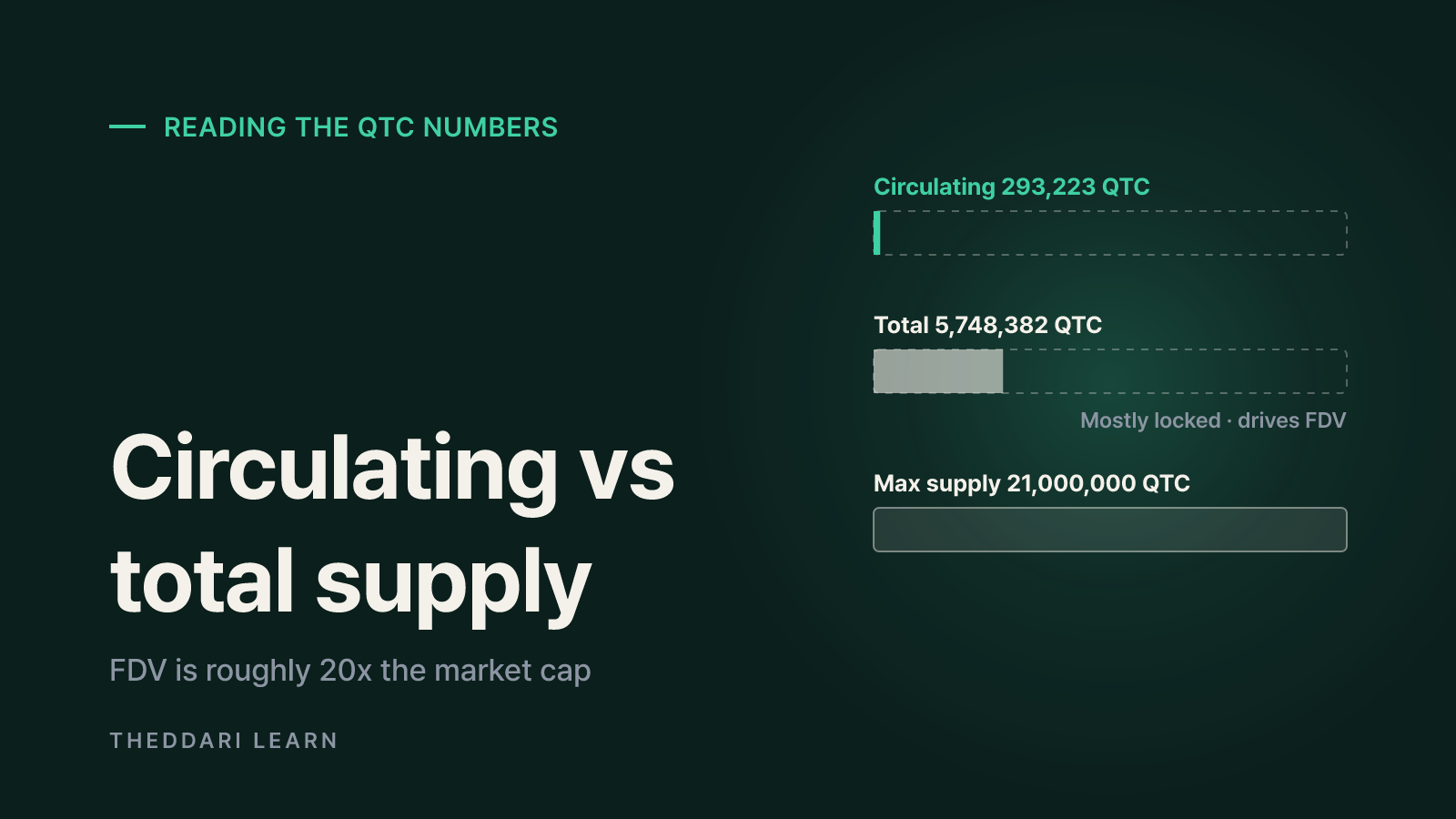
- As of October 20, 2026, CoinGecko showed 293,223 QTC circulating, about 1.4% of the 21,000,000 cap, so the fully diluted valuation is roughly 20 times the market cap.
- 27% of supply was minted at genesis; the 23% held by investors, founders and team is locked until September 2027 and then vests over 36 months.
- Trading is concentrated on NEAR-based venues (NEAR Intents, Rhea Finance) and a few smaller centralized exchanges such as BigONE and SafeTrade.
- QTC has no token contract, so any 'Quantus' or 'QTC' token on Ethereum, Solana or other chains is not the real coin.
Quantus coin (QTC) is the native asset of Quantus, a proof-of-work Layer 1 built from day one to use post-quantum signatures, on the theory that future quantum computers will break the elliptic-curve cryptography securing Bitcoin and Ethereum. It reached #1 on CoinGecko's trending list on October 20, 2026, but the chain is barely six weeks old (mainnet launched September 9, 2026) and only about 1.4% of its 21 million cap is circulating. This guide uses the Quantus whitepaper and CoinGecko data as of October 20, 2026 (UTC) to explain what it is, how supply works, where it trades, and what to verify before you buy.
What is Quantus coin? A post-quantum proof-of-work chain
Quantus describes itself as peer-to-peer electronic cash for the quantum era. According to whitepaper v0.4.1, it is deliberately not a smart contract platform. It aims to be closer to Bitcoin, Monero or Zcash than to Ethereum or Solana. That means there are no other tokens on the chain, no DeFi apps, and no staking yield. QTC is simply money that you mine, hold and send.
The four design choices that matter
- Post-quantum signatures. Every transaction is signed with ML-DSA, the lattice-based scheme standardized by NIST. The whitepaper says ML-DSA-65 is the wallet default, with ML-DSA-87 available for a higher security level. There are no legacy ECDSA addresses at all.
- Encrypted node traffic. Peer-to-peer connections use ML-KEM-768 for encryption, so the networking layer is post-quantum too.
- Proof-of-work with Poseidon2. Mining swaps Bitcoin's SHA-256 for the Poseidon2 hash, with a 12-second block target. The whitepaper is explicit that this is for zero-knowledge proof compatibility, not quantum security.
- Zero-knowledge 'wormhole' addresses. Post-quantum signatures are huge, so Quantus aggregates transfers into ZK proofs. The same mechanism powers encrypted transfers that break the on-chain link between sender and receiver.
Signature size is the core engineering problem. The whitepaper's own table puts an ML-DSA-87 signature at 4,627 bytes versus 65 bytes for ECDSA, roughly 70 times larger. The project claims about 43 to 58 transparent transfers per second and around 430 per second for aggregated encrypted transfers. Treat those as the team's theoretical figures, not independently measured throughput.
How the launch went
The team's mainnet update says genesis was September 9, 2026, that more than 7,000 GPUs started mining immediately, and that the average cost to mine one QTC in the first week was an estimated $20 to $35. At that point the only way to get QTC was to mine it, so today's market float comes from mined coins plus a small company liquidity allocation.
Why Quantus is trending on CoinGecko: the numbers
A CoinGecko trending rank reflects search and page-view interest, not a quality rating. The market data on October 20, 2026 at 06:41 UTC shows both why traders are looking and why caution is warranted.
Price
- CoinGecko, Oct 20, 2026
- $89.44 (-12.1% in 24h)
- What it means
- Double-digit daily swings
Market cap
- CoinGecko, Oct 20, 2026
- about $26.2 million (rank 704)
- What it means
- Based on circulating supply only
Fully diluted valuation
- CoinGecko, Oct 20, 2026
- about $514 million
- What it means
- Based on total minted supply, roughly 20x market cap
Circulating supply
- CoinGecko, Oct 20, 2026
- 293,223 QTC
- What it means
- About 1.4% of the cap
Total supply
- CoinGecko, Oct 20, 2026
- 5,748,382 QTC
- What it means
- Genesis mint plus mined coins
Max supply
- CoinGecko, Oct 20, 2026
- 21,000,000 QTC
- What it means
- Same cap as Bitcoin
All-time high
- CoinGecko, Oct 20, 2026
- $186.19 (Oct 8, 2026)
- What it means
- Price is about 52% below the peak
All-time low
- CoinGecko, Oct 20, 2026
- $10.20 (Sep 12, 2026)
- What it means
- Shortly after trading began
The gap between circulating and total supply is the number to focus on. Market cap counts only 293,223 QTC, yet 5,748,382 QTC already exist and most of them are locked. A market-cap-to-FDV ratio of about 5% means far more coins are scheduled to reach the market than are trading today.
The chart has been extreme. According to a Phemex Academy analysis, QTC rose about 462% between the September 27 and October 2 daily closes on CoinGecko, then closed October 4 about 38% below the October 2 close. When price is set on a thin float, modest orders move it a lot.

Supply and unlocks: the 27% genesis mint and the 2027 cliff
The whitepaper caps supply at 21,000,000 QTC. Of that, 27% (5,670,000 QTC) was minted once at genesis, and the other 73% (15,330,000 QTC) can only be mined. The block reward is (max supply - current supply) / 50,000,000, so it decays smoothly instead of halving every four years.
Investors, founders, team
- Share
- 23%
- Terms (whitepaper v0.4.1)
- Locked 1 year after mainnet, then linear over 36 months
Company operations
- Share
- 3%
- Terms (whitepaper v0.4.1)
- Locked 1 year, then linear over 36 months
Company liquidity
- Share
- 1%
- Terms (whitepaper v0.4.1)
- Liquid from genesis
Mining rewards
- Share
- 73%
- Terms (whitepaper v0.4.1)
- Paid to miners block by block
Two risks follow. First, concentration of the liquid 1%. Phemex, citing explorer data, reported that on October 5, 2026 the treasury account sent 199,950 of its 210,000 QTC to a single wallet, which then held roughly 73% of circulating supply. How those coins reach the market will matter a lot for price.
Second, the September 2027 cliff. Locked investor, team and company coins begin vesting on September 9, 2027 and continue for three years. Phemex estimates that at about 4,948 QTC per day, which would add the entire current float of 293,223 QTC roughly every two months. Unless demand grows to match, that is a long-running source of sell pressure.
A small market cap can hide a large fully diluted valuation. Before buying any new low-float coin, find out when locked tokens unlock, who holds them, and how many will hit the market.
Where QTC trades and how deep the market is
CoinGecko's market list on October 20, 2026 shows two main routes. One is the NEAR ecosystem, where a bridged version of QTC (QTC.OMFT.NEAR) trades against USDC, NEAR and other assets on NEAR Intents and the decentralized exchange Rhea Finance. The other is smaller centralized exchanges: BigONE (QTC/USDT) and SafeTrade (listed as QUANTUS/USDT). Large exchanges such as Coinbase, Kraken or Binance did not appear on that list.
- Bridged is not native. QTC on NEAR is a bridged representation. Moving it back to a Quantus wallet adds bridge fees, delays and the security of whoever operates the bridge.
- Wide spreads. The same day, CoinGecko showed bid-ask spreads of about 1.1% on BigONE and about 1.26% on SafeTrade, far wider than for large-cap coins. Market orders of any size can fill well away from the quoted price.
- Fragmented pricing. With liquidity split across venues, prices can drift apart temporarily, but deposit and bridge delays make those gaps hard to capture in practice.
If you want to see how cross-exchange price gaps form and why they do not close instantly, theddari's arbitrage view shows the pattern on more liquid coins.
Quantus coin checklist: five things to verify before buying
- 1
Confirm you are buying real QTC
Quantus has no smart contracts, so a 'Quantus' or 'QTC' token on Ethereum, Solana, BNB Chain or Base is not the real coin. Phemex counted at least 13 tokens using the name or ticker across five chains on DexScreener on October 5. Meme coins such as Quantus Cat (QCAT) on NEAR are also unrelated. Start from the official site link on the CoinGecko page and match the venues.
- 2
Compare float, FDV and the unlock schedule
Check circulating supply, total supply and FDV on CoinGecko against the lockups in the whitepaper. Watch the large treasury-funded wallet and, closer to September 9, 2027, the vesting flow, using the official explorer at explorer.quantus.com.
- 3
Check the venue and withdrawal path
Make sure the exchange actually appears in CoinGecko's market list, is permitted to serve customers where you live, and has QTC deposits and withdrawals open. If you buy the NEAR version, learn how the bridge works before you need it.
- 4
Look for published audits
Phemex reported on October 5 that audits of the ML-DSA code and of Poseidon2 and the mining algorithm were complete but their report links were still pending, while the audit of the zero-knowledge wormhole circuits was in progress. Check whether those reports are now public. The project's security policy states there is no fixed bug bounty.
- 5
Ignore airdrop and wallet impersonators
Per Phemex's summary of the project's update, the testnet miner airdrop can only be claimed in the official Quantus mobile app, with a December 1 deadline. Treat any other claim website, or any message asking for your seed phrase, as a scam.
Open questions and risks that remain
The quantum threat Quantus is built around is a real research topic, but nobody can date it. The whitepaper itself says a cryptographically relevant quantum computer could arrive within five years, not that it will. It also lists its own risks: lattice cryptography is newer and less battle-tested than elliptic curves, and a bug in the ZK circuits or verifier could cause unintended inflation. Even if the thesis is right, how much of it the price already reflects is a separate question.
- Short track record. A chain that started on September 9, 2026 has no long history of surviving attacks or upgrades.
- Miner selling. When price sits well above mining cost, miners have a steady reason to sell, and cost estimates change as difficulty rises.
- Holder concentration. If a few wallets hold much of the float, a single large transfer can move the market.
- Access and compliance. Without listings on major regulated exchanges, buyers rely on smaller or decentralized venues and must handle withdrawal limits and tax reporting on their own.
Bottom line: Quantus is a working chain with a public whitepaper and a named team, but as of October 2026 its price is set on a float of roughly 1.4% of the 21 million cap. If you are considering it, verify that you are buying genuine QTC, map the unlock schedule and concentrated wallets, confirm your exit route, and check whether audit reports have been published, sizing any position to an amount you can afford to lose entirely.
常见问题
Is Quantus (QTC) the same as Quant (QNT)?
Is Quantus legit or a scam?
Where can I buy Quantus coin?
Can I mine Quantus?
来源与参考资料
- 1Quantus Whitepaper v0.4.1 (September 9, 2026)(在新标签页中打开)www.quantus.com
- 2Quantus Weekly: Mainnet Is Live (September 16, 2026)(在新标签页中打开)www.quantus.com
- 3CoinGecko: Quantus (QTC) price, supply and markets(在新标签页中打开)www.coingecko.com
- 4Phemex Academy: What Is Quantus (QTC)? (October 6, 2026)(在新标签页中打开)phemex.com
- 5Quantus Security Policy(在新标签页中打开)www.quantus.com
相关文章
 加密货币
Ethereum Treasury Companies Selling ETH: Why mNAV Matters
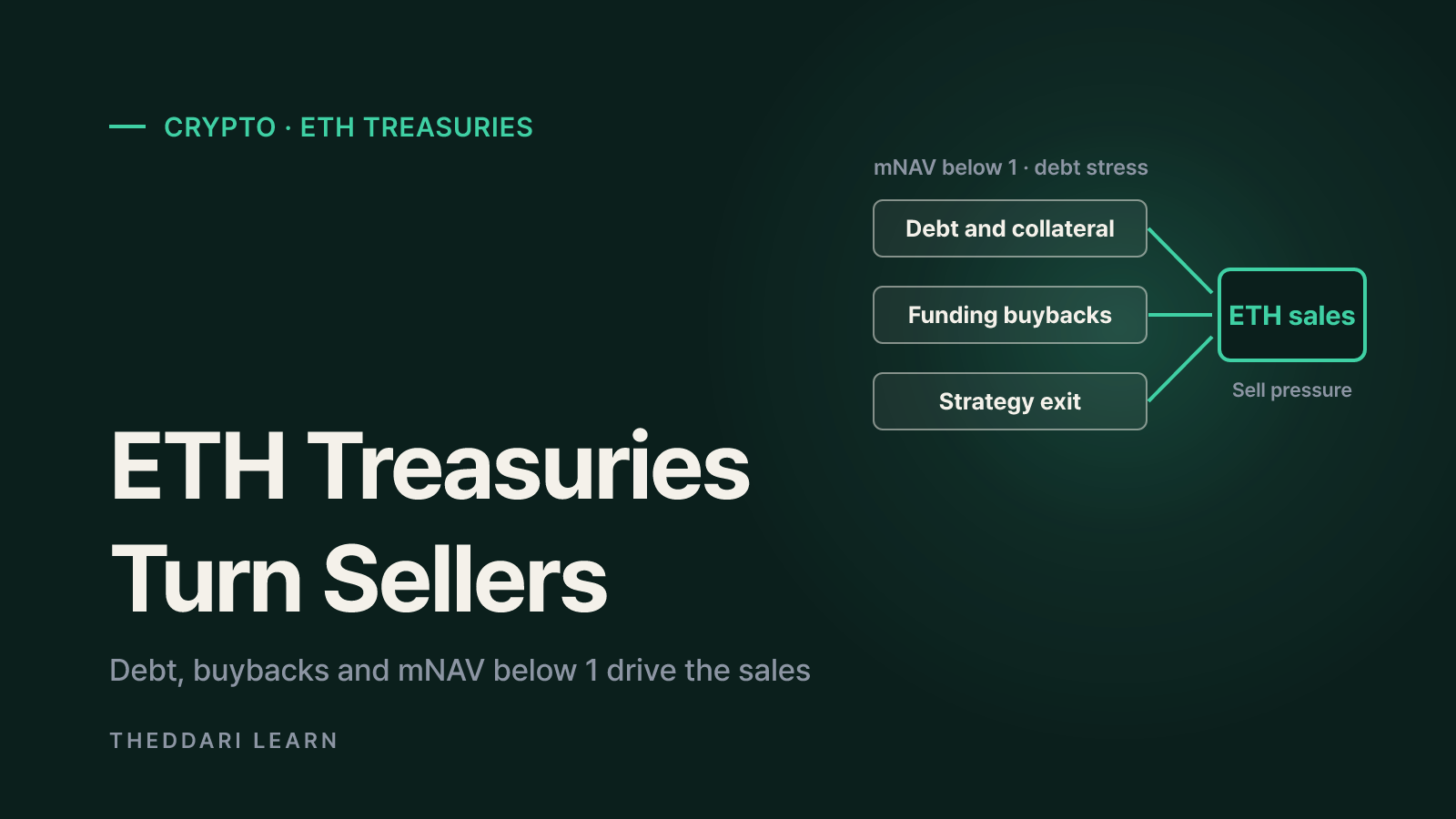
Some Ethereum treasury companies are now selling ETH below cost. Using BTCS's November 2026 filings, BitMine's data and DefiLlama figures, this guide explains why firms sell, how Aave liquidation lines work and how to check a sale claim.
 加密货币
ETH Whales Selling at a Loss? Reading On-Chain Whale Data
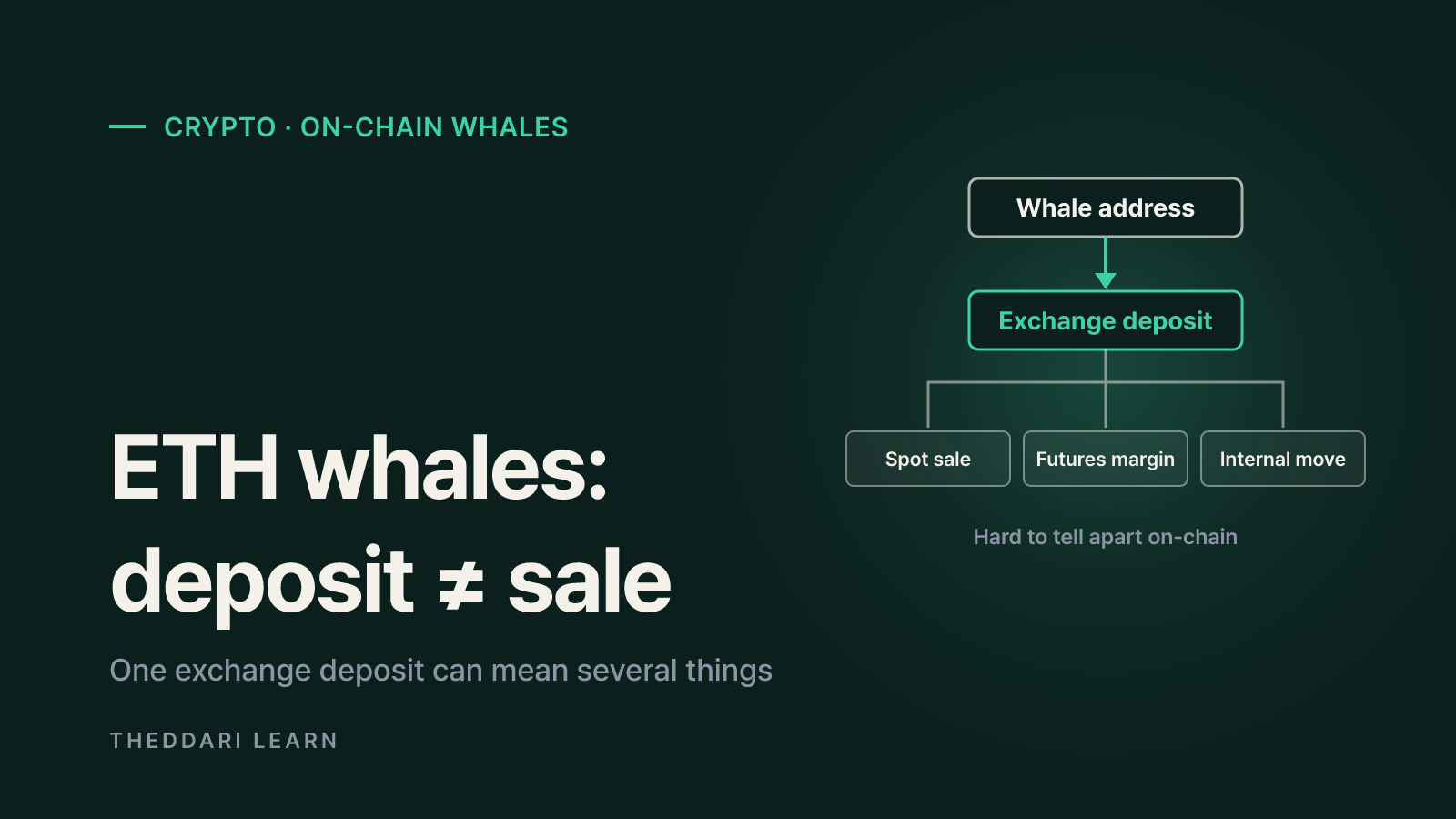
Headlines about Ethereum whales dumping at a loss are often read as a bottom signal or a warning. Here is how to check the wallet cohorts, exchange inflows and labels behind them, using November 2026 data.
 加密货币
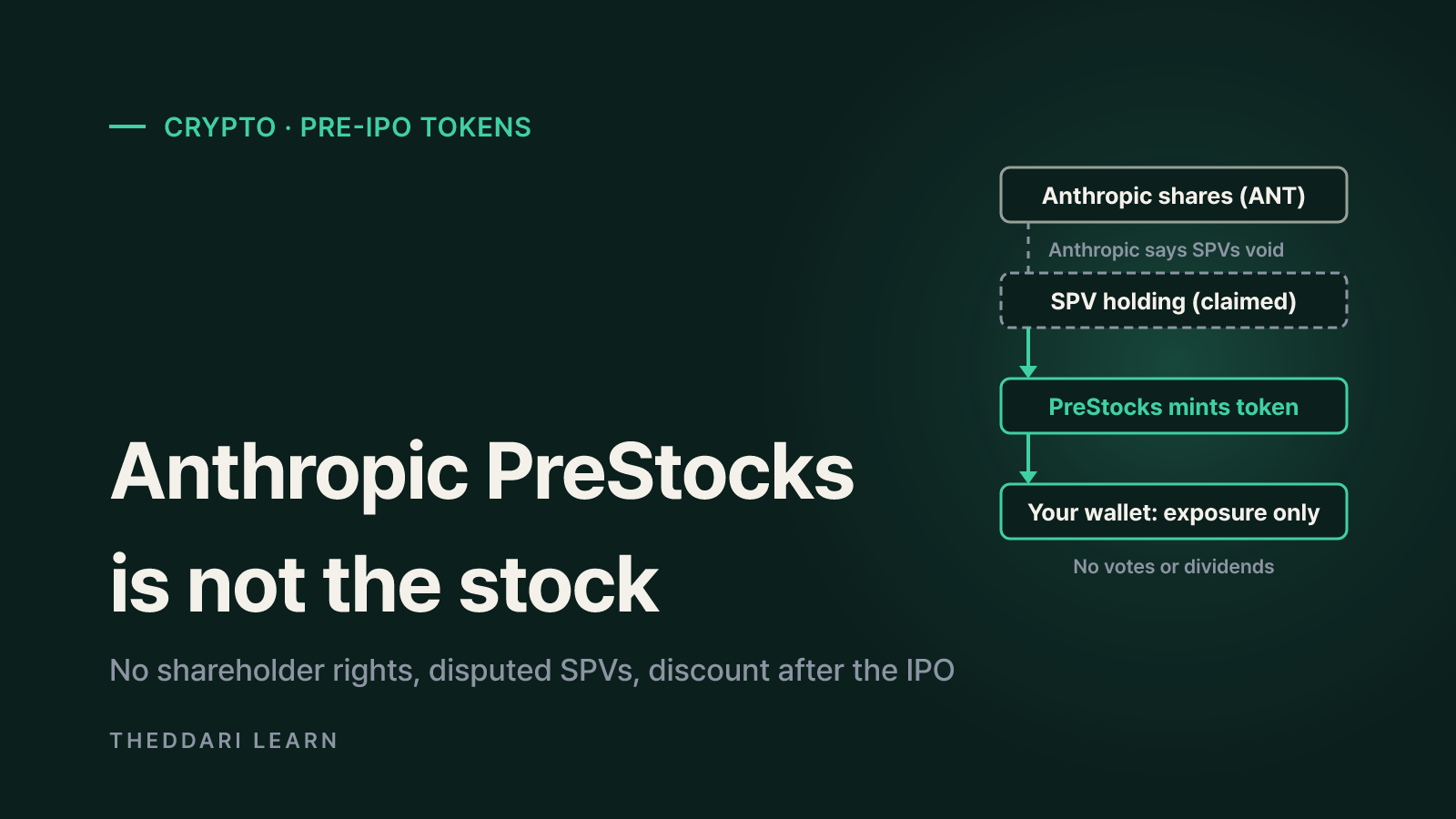
Anthropic PreStocks Token: How It Works, Risks After IPO
The ANTHROPIC token from PreStocks offers economic exposure only, with no shareholder rights. Here is how it is structured, why Anthropic disputes SPV transfers, and what the Nasdaq listing changes for holders.