ETH Whales Selling at a Loss? Reading On-Chain Whale Data
Are ETH whales selling at a loss? Learn how to read on-chain whale data, wallet-size cohorts and exchange inflows, and why whale moves are a weak price signal.
目次7セクション
要点
- ETH whale data tracks addresses, not people. Glassnode assigns a wallet-size cohort based on the address balance just before coins are spent.
- On November 20, 2026, Glassnode recorded 3,383,940 ETH spent at a loss, with the 10k-100k ETH cohort the largest at 1,518,005 ETH.
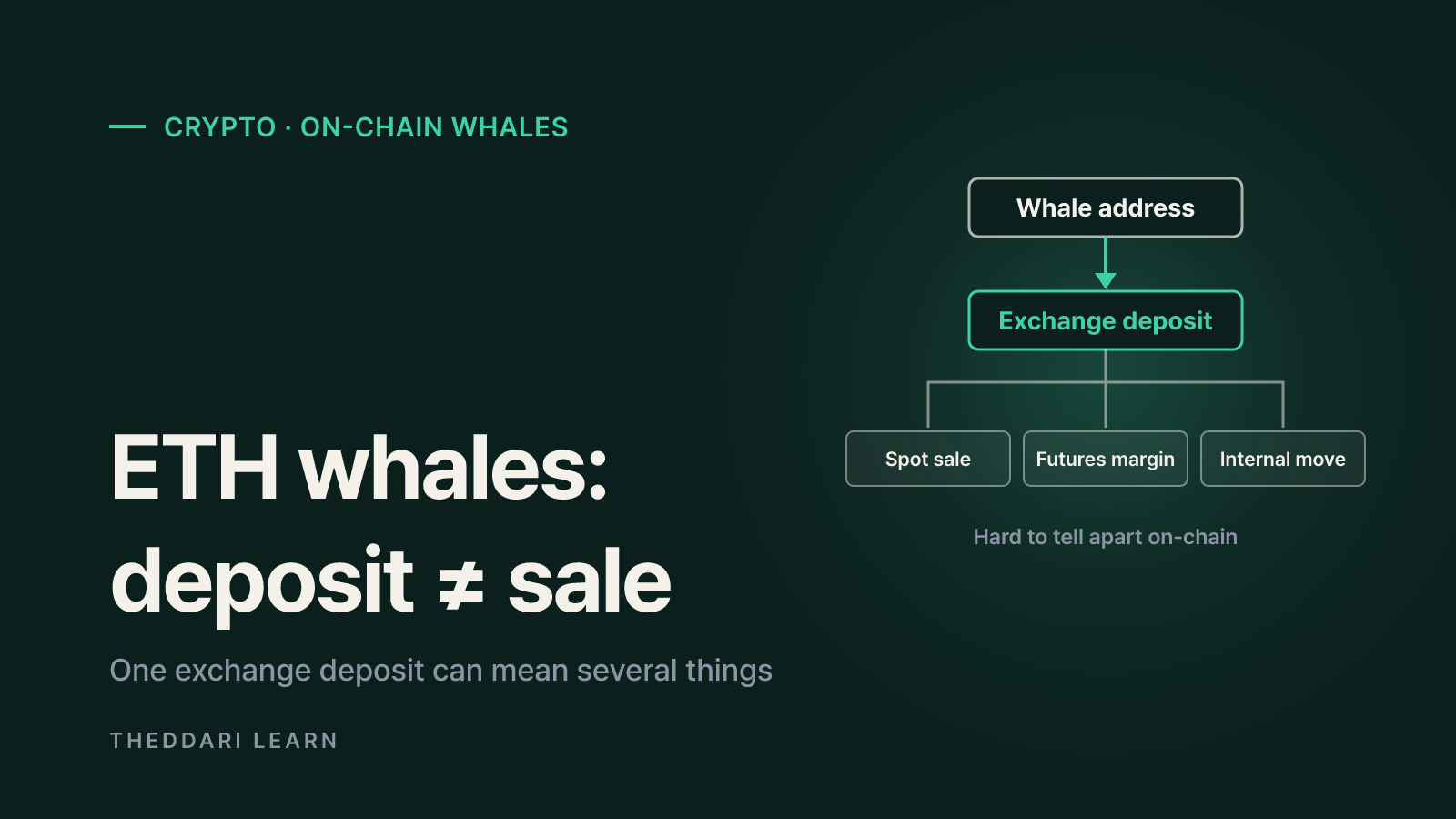
- An exchange deposit can mean a sale, but also margin, an OTC settlement or an internal reshuffle. Large single flows can later be revised.
- Loss-taking usually follows a price drop rather than predicting the next move. Judging whether a sell-off is ending needs several indicators over days, not one alert.
When ETH whales sell at a loss, social feeds split into two camps: the sell-off is nearly exhausted, or the big players know something and more downside is coming. The short answer is that whale data records coin movements that have already happened. It is useful context, but it does not tell you where the price goes next. This guide uses Glassnode metrics and reported whale trades available as of November 20, 2026 to show how to read on-chain whale data and where its limits are. It does not forecast any wallet's next move or the ETH price.
The backdrop matters. BattleTown News reported that ETH fell 10% over the week to about $1,750 on November 20, and TokenPost put ETH at $1,634.15 at 12:25 p.m. ET (17:25 UTC) the same day. Loss-making whale trades cluster in exactly this kind of drawdown, which is why it pays to separate what the data shows from the story attached to it.
What counts as ETH whales? Start with the definition
"Whale" has no standard meaning. Analytics providers group addresses into balance bands, while alert accounts tend to call any address moving a few thousand ETH a whale. Glassnode's wallet-size breakdown runs from under 0.001 ETH to above 100k ETH. According to its metric description, an address's band is set by its balance before the spend, and profit or loss is measured against that address's average acquisition price.
The key catch is that these metrics count addresses, not people. One investor spreading ETH across ten wallets shows up as ten smaller holders. Meanwhile, an exchange or custodian pooling thousands of customers' coins in one address looks like a single giant whale. ETF custody wallets, lending protocol contracts and bridges can also sit in the top bands purely because of their balances. Before reading "whales are dumping" as a verdict on smart money, find out what kind of address is actually moving.
Individual or fund wallet
- What it really is
- One owner's decision
- What to watch for
- Other wallets and derivatives hedges stay invisible
Exchange hot or cold wallet
- What it really is
- Pooled customer funds
- What to watch for
- Internal moves can look like large selling
Custody or ETF wallet
- What it really is
- Institutional client assets
- What to watch for
- Redemptions and settlements are not one trader's view
Lending or DeFi contract
- What it really is
- Collateral and liquidity
- What to watch for
- Liquidations and repayments differ from voluntary sales
Whale selling at a loss: reading the November 2026 numbers
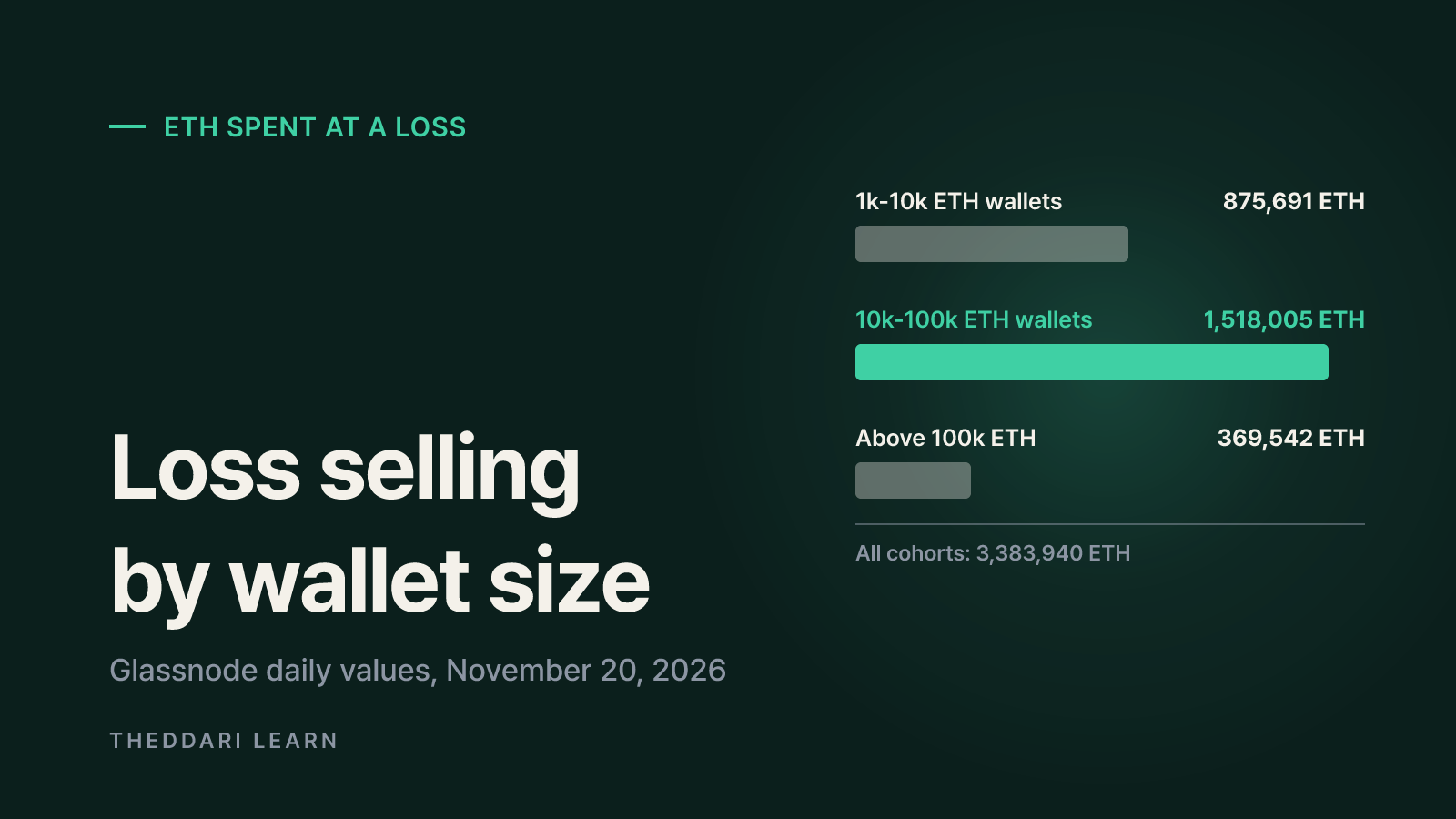
Selling at a loss, or realized loss, means coins are moved below their acquisition price. Glassnode's Spent Volume in Loss by Wallet Size shows how much ETH was spent at a loss in each cohort. Daily values for November 20, 2026 were:
1k-10k ETH
- ETH spent at a loss
- 875,691
- Share of total
- about 25.9%
10k-100k ETH
- ETH spent at a loss
- 1,518,005
- Share of total
- about 44.9%
Above 100k ETH
- ETH spent at a loss
- 369,542
- Share of total
- about 10.9%
All cohorts
- ETH spent at a loss
- 3,383,940
- Share of total
- 100%
On these numbers, addresses holding 1,000 ETH or more accounted for roughly 81.7% of loss-making volume that day (2,763,238 ETH out of 3,383,940 ETH). It is tempting to call that whale capitulation, but that is a leap. The largest bands can include exchange and custody addresses, and because the calculation is address-based, a pooled wallet moving customer coins registers as a big holder spending at a loss. Cost basis is also per address, so ETH just withdrawn to a fresh wallet inherits the price at withdrawal, not the owner's original purchase price.
Individual whale sales in the news
On November 12, crypto.news cited Lookonchain reporting that address 0x69A8 had bought 5,105 ETH ($13.74 million) near $2,691 about a month earlier, then sold 6,532 ETH ($13.62 million) at an average of $2,085, a loss of roughly $3.1 million. Notice that it sold more ETH than that purchase, so the loss figure rests on one tracked buy. TokenPost reported that a holder sold 32,541 ETH at $1,938 to repay an Aave loan, then 15,349 ETH at $1,701, for 47,890 ETH (about $89.1 million) across two trades. That selling was driven by debt, not by a market call.
The 0x4AB7 case shows how fast a narrative can flip. Lookonchain flagged the wallet in early November for withdrawing 9,777 ETH from Binance over five days, a classic accumulation read. On November 20 it sold 5,000 ETH near $1,730, with combined realized and unrealized losses above $8.5 million, according to BattleTown News. The same day, address 0x7F49 bought 2,879 ETH at $1,736.5. Large wallets often trade in opposite directions at the same moment.
Exchange inflows and outflows: one transfer, several meanings
Exchange inflows are the most quoted whale-selling metric, because coins on an exchange can be sold quickly. Glassnode Research notes that inflows can reflect more trading, profit-taking or de-risking, while outflows can mean self-custody but also OTC desk activity, custody services or using coins as collateral for lending.
Whale wallet to exchange
- Common read
- Preparing to sell
- Other explanations
- Futures margin, rebalancing between venues
Exchange to new wallet
- Common read
- Accumulation, long-term holding
- Other explanations
- OTC settlement, custody transfer, collateral
Whale wallet swaps on a DEX
- Common read
- Immediate selling
- Other explanations
- Raising stablecoins to repay debt or re-enter
Large move between exchange wallets
- Common read
- Big inflow or outflow
- Other explanations
- Internal wallet maintenance
A deposit is a precondition for selling on an exchange, not proof of a sale. On-chain data cannot see whether deposited ETH was sold on the spot market or posted as margin for a futures position. That is why inflow data works better next to derivatives data. Comparing funding rates across exchanges helps show whether leveraged longs or shorts are paying to hold positions; it describes positioning, not future direction.

Fund flows round out the picture of an Ethereum sell-off. Citing Farside Investors, crypto.news reported net outflows of about $144.8 million from US spot Ether ETFs on November 11. The same article cited Rain's data that roughly 36.3% of supply, about 45.3 million ETH, was staked. Selling and holding signals were running side by side.
Why whale alerts are a weak price signal
Labels are incomplete and get revised
Exchange metrics depend on knowing which addresses belong to which exchange. Glassnode's Exchange Data Transparency Notice says it combines exchange-verified addresses, vetted public tags and clustering algorithms, yet complete accuracy remains elusive. Because it optimizes against false positives, reported exchange balances are best seen as lower bounds, and history can be revised when new addresses are identified. In the notice's table, Coinbase and Kraken are not marked as providing verified or proof-of-reserves addresses, so data quality differs by venue.
Big single flows can be wrong at first
Glassnode advises caution with preliminary data such as a sudden large inflow or outflow. Exchanges regularly create new cold wallets and reshuffle funds, and a transfer to a never-seen address may not be recognized as internal right away. Its research gives the example of an apparent large exchange outflow that turns out to be an internal transfer. For backtesting, it recommends Point-in-Time metrics, which keep each value as first computed. Testing a whale rule on today's revised chart quietly feeds it information nobody had at the time.
Loss-taking is often a result, not a cause
A realized loss only exists after the price has already fallen below someone's entry. A spike in loss selling therefore often records the drop rather than causing it. How much any big sale moves the market depends on buyer demand, order-book depth and liquidity, and OTC trades may never touch exchange order books. Alert accounts also highlight dramatic losing trades, while quiet buyers get less attention, so headline frequency is not market share.
It also helps to see how widely a whale story has already spread. Tracking which crypto topics dominate Telegram channels gives a rough sense of how much of the news the market has likely absorbed.
A five-step check before reacting to whale selling
- 1
Open the address and transaction
Look up the address or hash from the alert in a block explorer. Whether the coins went to an exchange deposit address, a DEX contract or a lending protocol changes the meaning.
- 2
Confirm the whale definition and labels
Is the post using a balance band or the size of one transfer? If the address is labeled as an exchange, custodian or ETF wallet, do not read it as one investor's decision.
- 3
Check how the loss was calculated
Find the entry price the tracker assumed and whether other wallets or hedges were ignored. Reported losses are estimates.
- 4
Cross-check other indicators
Compare cohort loss volumes, exchange netflows, funding rates and ETF flows. If only one series looks extreme, suspect a revision or an internal transfer first.
- 5
Judge the trend, not the day
Daily points can change. To argue that selling is ending, look for loss-taking and exchange inflows to decline together over days or weeks.
Whale data is a valuable record of where large holders are under pressure, but an address is not a person, a deposit is not a sale, and early readings can be revised. Check the data source, the labeling method and the cost-basis assumptions, then read several indicators together. That approach will not predict the next candle, but it will stop a single alert from being mistaken for a market verdict.
よくある質問
How much ETH makes someone a whale?
Does whale capitulation mean the ETH bottom is in?
Can I trust whale alerts from accounts like Lookonchain?
Do rising exchange inflows always push ETH lower?
出典・参考資料
- 1Glassnode: ETH Spent Volume in Loss by Wallet Size(新しいタブで開きます)studio.glassnode.com
- 2Glassnode Docs: Exchange Data Transparency Notice(新しいタブで開きます)docs.glassnode.com
- 3Glassnode Research: On-Chain Exchange Metrics: The Good, The Bad, The Ugly(新しいタブで開きます)research.glassnode.com
- 4crypto.news: Ethereum price nears $2,000 as whale sells ETH at $3.1M loss (Nov 12, 2026)(新しいタブで開きます)crypto.news
- 5TokenPost: Whale Sells 47,890 Ether in Two Transactions to Repay Loans (Nov 20, 2026)(新しいタブで開きます)www.tokenpost.com
- 6BattleTown News: Wallet 0x4AB7 offloads 5,000 ETH near $1,730 (Nov 20, 2026)(新しいタブで開きます)battletown.com
関連記事
 暗号資産
Ethereum Treasury Companies Selling ETH: Why mNAV Matters
Some Ethereum treasury companies are now selling ETH below cost. Using BTCS's November 2026 filings, BitMine's data and DefiLlama figures, this guide explains why firms sell, how Aave liquidation lines work and how to check a sale claim.
 暗号資産
Anthropic PreStocks Token: How It Works, Risks After IPO
The ANTHROPIC token from PreStocks offers economic exposure only, with no shareholder rights. Here is how it is structured, why Anthropic disputes SPV transfers, and what the Nasdaq listing changes for holders.
 暗号資産
GTA 6 Memecoins on CoinGecko Trending: What to Check First
On November 19, 2026, GTA 6 launch day, three GTA-themed tokens hit CoinGecko's trending list. Here is what the data showed, why market cap misleads, and a step-by-step checklist before buying a hype token.